

AI in Warehouse Management: Transform Your Operations
Share on
The logistics landscape is undergoing a fundamental transformation as artificial intelligence reshapes how warehouses operate, make decisions, and respond to market demands. Modern warehouse facilities face mounting pressure to process higher volumes, meet tighter delivery windows, and maintain accuracy whilst controlling operational costs. AI in warehouse management has emerged as the critical technology enabling distribution centres, fulfilment operations, and 3PL providers to meet these challenges head-on. By combining machine learning algorithms, computer vision, robotics, and predictive analytics, intelligent warehouse systems are delivering measurable improvements in throughput, accuracy, and resource utilisation across every operational function.
The Foundation of Intelligent Warehouse Operations
AI in warehouse management represents more than simple automation. It encompasses a sophisticated ecosystem of interconnected technologies that learn from operational data, adapt to changing conditions, and optimise processes in real time.
Machine learning algorithms analyse historical patterns to predict demand fluctuations, identify bottlenecks, and recommend process improvements. These systems continuously refine their accuracy as they process more data, creating increasingly precise forecasts and operational insights.
Computer vision technology enables systems to identify products, verify quality, read labels, and monitor stock levels without human intervention. When combined with robotic systems, this technology powers autonomous inventory verification and picking operations.
The integration of these technologies creates a responsive warehouse environment where systems communicate, coordinate, and self-optimise throughout the operational day.
Real-Time Decision Making and Adaptation
Traditional warehouse management systems operate on predefined rules and static workflows. AI-driven platforms continuously assess current conditions and adjust operations accordingly.
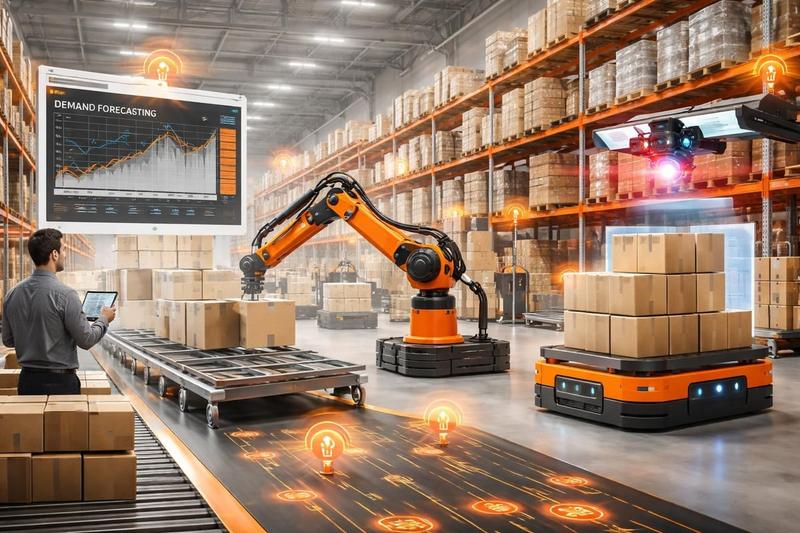
When order volumes spike unexpectedly, AI warehouse management systems automatically reallocate resources, adjust picking sequences, and reconfigure labour assignments to maintain throughput. This dynamic response capability prevents bottlenecks before they impact customer delivery times.
Similarly, these systems detect emerging patterns that indicate potential disruptions. Equipment performance degradation, seasonal demand shifts, and supplier delivery variations all trigger proactive adjustments that maintain operational continuity.
Autonomous Mobile Robots and Material Handling
Robotic systems powered by artificial intelligence have fundamentally changed material movement within warehouse facilities. These autonomous mobile robots (AMRs) navigate warehouse environments independently, transport goods between locations, and collaborate with human workers safely and efficiently.
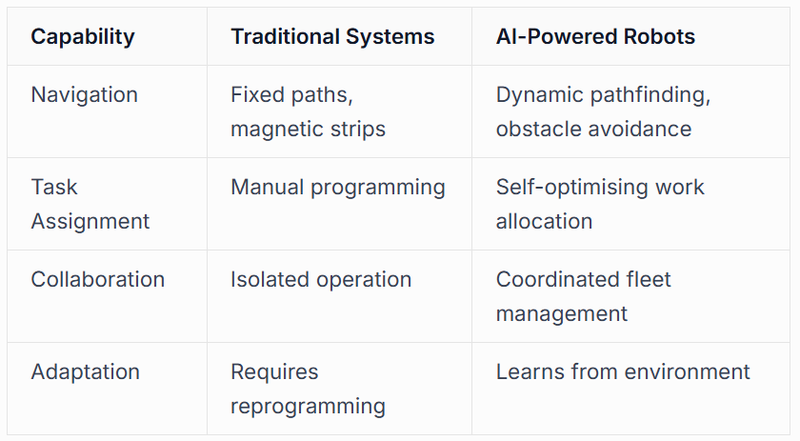
Modern autonomous robots utilise simultaneous localisation and mapping (SLAM) technology combined with machine learning to build spatial understanding of warehouse layouts. This enables them to identify optimal routes, avoid congestion, and respond to changing floor conditions without human intervention.
Fleet management systems coordinate multiple robots, distributing tasks based on robot location, battery status, current workload, and priority levels. This orchestration maximises productivity whilst preventing conflicts and ensuring efficient battery management across the entire robot population.
The deployment of autonomous mobile robots has proven particularly valuable in high-volume e-commerce fulfilment, where rapid order processing and space optimisation directly impact profitability.
Integration with Picking Operations
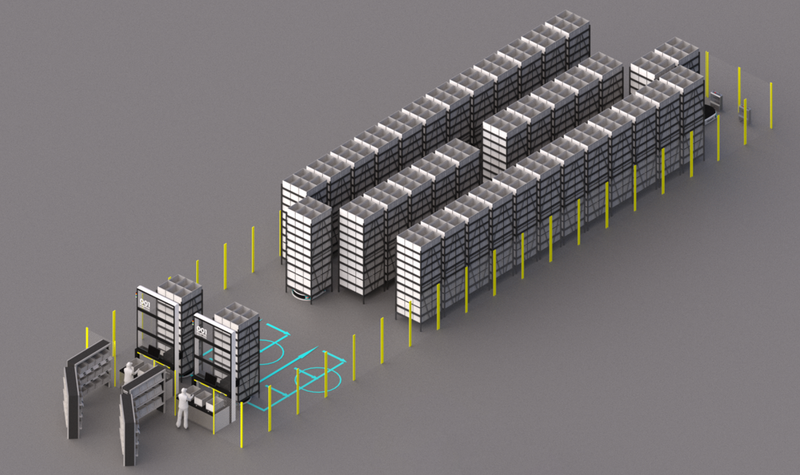
AI in warehouse management extends beyond transportation to revolutionise picking accuracy and speed. Goods-to-person systems bring products directly to stationary pickers, eliminating unproductive travel time and enabling higher pick rates.
Vision-guided picking systems use computer vision to verify product selection, highlight correct items, and detect errors before they enter the packing process. This technology has demonstrated error rate reductions exceeding 99% in high-volume operations.
For businesses looking to implement these capabilities without massive capital investment, scalable solutions like the Automate-X GTP Starter Grid provide an accessible entry point into goods-to-person automation, enabling smaller operations to benefit from AI-enhanced picking workflows.
Voice-directed warehousing, enhanced by natural language processing capabilities, has become increasingly sophisticated. Modern voice-directed systems understand context, adapt to accents, and provide intelligent guidance that improves over time through machine learning.
Predictive Analytics and Demand Forecasting
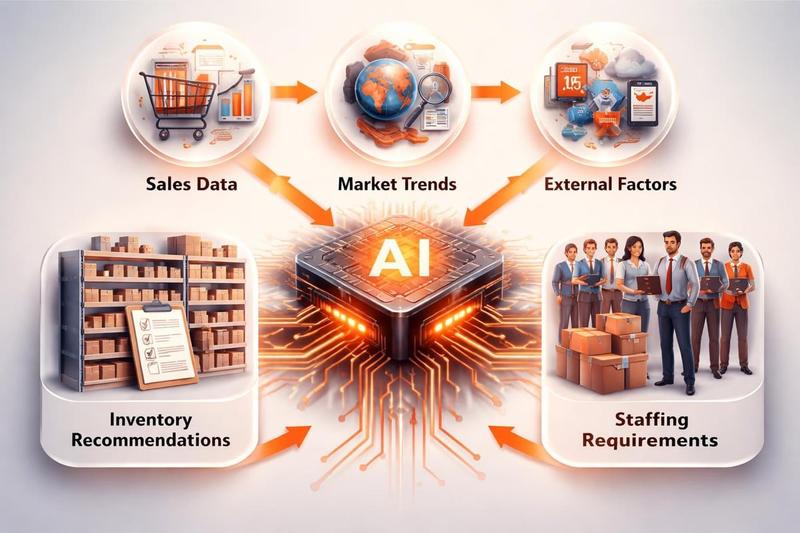
Accurate forecasting represents one of the highest-value applications of AI in warehouse management. Traditional forecasting methods rely on historical averages and seasonal patterns, creating significant variance between predictions and actual demand.
Machine learning models incorporate hundreds of variables including:
- Historical sales patterns across multiple timeframes
- Promotional campaign schedules and past performance
- Market trends and competitive activity
- Weather patterns and regional events
- Social media sentiment and search trend data
- Economic indicators and consumer confidence metrics
These models identify complex relationships between variables that human analysts cannot detect, producing forecasts with substantially higher accuracy than conventional methods. Advanced forecasting frameworks continuously adjust predictions as new data arrives, enabling warehouses to optimise inventory levels and resource allocation dynamically.
Inventory Optimisation and Space Utilisation
AI systems analyse product velocity, storage requirements, and access patterns to determine optimal placement strategies. Fast-moving items migrate closer to packing stations, whilst slower products move to higher-density storage areas.
Dynamic slotting algorithms continuously reassess placement decisions based on:
- Recent picking frequency and patterns
- Seasonal trends and upcoming promotions
- Product dimensions and storage compatibility
- Cross-dock opportunities and direct putaway possibilities
- Order correlation patterns for batch picking efficiency
This intelligent space management typically increases storage density by 25-40% whilst simultaneously improving picking efficiency through reduced travel distances.
Labour Management and Workforce Optimisation
AI in warehouse management transforms workforce planning from reactive scheduling to predictive resource allocation. These systems forecast labour requirements with remarkable precision, accounting for order volumes, product mix complexity, and individual worker productivity patterns.
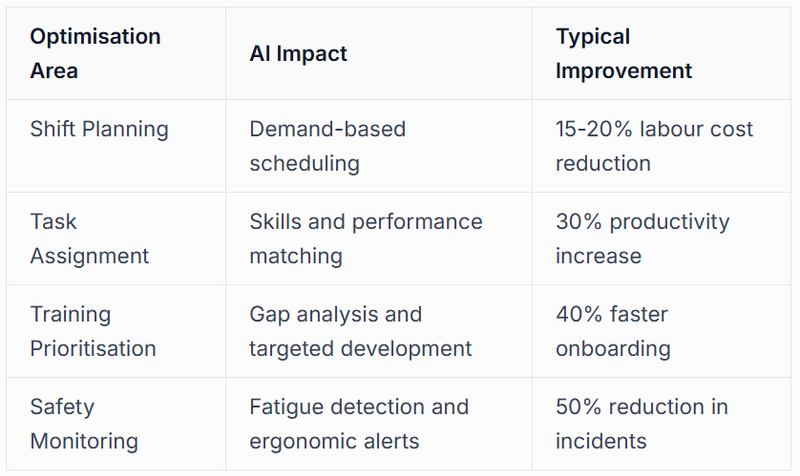
Workforce management platforms monitor individual performance metrics whilst identifying training opportunities and potential burnout indicators. Rather than replacing workers, these systems enable managers to deploy human talent where it delivers maximum value.
The technology recognises that experienced workers excel at complex problem-solving, quality assessment, and exception handling whilst automated systems handle repetitive, physically demanding tasks. This complementary relationship enhances both job satisfaction and operational efficiency.
Predictive Maintenance and Equipment Reliability
Equipment downtime creates cascading disruptions throughout warehouse operations. AI-powered predictive maintenance systems monitor equipment health continuously, identifying degradation patterns that indicate impending failures.
Sensor networks collect vibration data, temperature readings, power consumption patterns, and operational metrics from conveyor systems, sortation equipment, automated storage systems, and material handling devices. Machine learning algorithms analyse this data stream to detect subtle changes that precede mechanical failures.
This approach enables maintenance teams to:
- Schedule repairs during planned downtime periods
- Order replacement parts before failures occur
- Extend equipment lifespan through optimised maintenance intervals
- Reduce emergency repair costs by 60-70%
- Maintain consistent operational capacity
Predictive analytics applications have proven particularly valuable in high-throughput automated facilities where equipment failures immediately impact throughput and customer service levels.
Quality Control and Automated Inspection
Computer vision systems perform quality inspections at speeds impossible for human inspectors whilst maintaining consistent accuracy. These systems detect packaging damage, verify label accuracy, confirm product specifications, and identify contamination or defects.
In pharmaceutical and food distribution environments, vision systems ensure compliance with regulatory requirements by verifying batch numbers, expiry dates, and temperature-sensitive handling indicators. This automated verification creates comprehensive audit trails whilst eliminating human error from critical quality processes.
Integration Challenges and Implementation Strategies
Successful AI implementation requires careful planning and systematic execution. Organisations achieving the highest returns approach warehouse automation as an integrated system rather than isolated technology deployments.
Data infrastructure forms the foundation of effective AI applications. Systems require clean, structured data from warehouse management platforms, enterprise resource planning systems, transportation management software, and operational equipment.
The integration process typically follows this progression:
- Assessment and baseline establishment to identify improvement opportunities and quantify current performance
- Infrastructure preparation including network capacity, sensor deployment, and data integration
- Pilot implementation in controlled operational areas to validate assumptions and refine configurations
- Systematic rollout expanding proven capabilities across broader operational scope
- Continuous optimisation leveraging AI learning capabilities to drive ongoing improvement
Change management proves critical to successful adoption. Workforce engagement, comprehensive training, and transparent communication about how AI enhances rather than replaces human capabilities directly correlate with implementation success.
Emerging Trends and Future Developments
The evolution of AI in warehouse management continues accelerating as technologies mature and converge. Several emerging trends promise to reshape warehouse operations further over the coming years.
Digital twin technology creates virtual replicas of physical warehouse environments, enabling simulation and optimisation before implementing changes in live operations. These platforms test layout modifications, equipment configurations, and process changes without disrupting actual operations.
Edge computing moves AI processing closer to operational equipment, reducing latency and enabling real-time decision-making that cloud-based systems cannot match. This architecture proves essential for autonomous vehicle coordination and time-sensitive process control.
The expansion of warehouse robotics demonstrates how major operators validate AI technologies before widespread industry adoption. Innovations emerging from large-scale implementations cascade to mid-market operations as technology costs decline and integration complexity reduces.
Advanced reinforcement learning algorithms enable warehouse systems to discover optimal strategies through trial and experimentation rather than relying solely on programmed rules. These systems explore operational variations, measure outcomes, and converge on approaches that maximise defined objectives.
Cross-Functional Benefits and Operational Alignment
AI in warehouse management delivers value extending beyond traditional warehouse metrics. The technology creates operational visibility and coordination opportunities across the entire supply chain.
Transportation coordination improves as warehouse systems communicate capacity, readiness, and constraints to carrier scheduling platforms. This integration reduces dock congestion, minimises detention charges, and improves carrier relationships.
Customer experience enhancement occurs through accurate delivery predictions, proactive exception management, and reduced order cycle times. Real-time inventory visibility enables promise engines to commit available stock confidently whilst preventing overselling situations.
Sustainability improvements emerge from optimised energy consumption, reduced packaging waste, and efficient space utilisation. AI systems identify opportunities to consolidate shipments, minimise deadhead miles, and reduce the environmental impact of warehouse operations.
Measuring Return on Investment
Quantifying AI implementation value requires comprehensive metrics spanning operational, financial, and strategic dimensions. Leading organisations track performance across multiple categories:
- Throughput efficiency: Orders processed per labour hour, items picked per shift, dock-to-stock cycle times
- Accuracy metrics: Order accuracy rates, inventory record precision, quality defect detection
- Resource utilisation: Space density, equipment uptime, labour productivity, energy consumption per unit
- Customer service: Order cycle time, on-time shipment percentage, damage rates, returns processing speed
- Financial performance: Operating cost per unit shipped, inventory carrying costs, overtime expenditure
Baseline measurements established before implementation provide the foundation for demonstrating value realisation and guiding continuous improvement priorities.
Sector-Specific Applications and Customisation
Different warehouse operations face unique challenges requiring tailored AI applications. E-commerce fulfilment centres prioritise order accuracy and rapid processing, whilst pharmaceutical distribution demands stringent compliance verification and cold-chain integrity.
Third-party logistics providers leverage AI to manage multi-client complexity, optimising shared resources whilst maintaining client-specific service level commitments. Systems allocate labour, equipment, and space dynamically based on real-time client demands and contractual priorities.
Food and beverage distribution utilises AI for first-expired-first-out inventory rotation, temperature monitoring, and batch traceability. Vision systems verify product integrity whilst forecasting algorithms account for perishability constraints in inventory planning.
Manufacturing logistics integrates warehouse AI with production scheduling systems, coordinating raw material availability with manufacturing requirements whilst optimising finished goods staging and shipment sequencing.
The strategic implementation of AI warehouse management across diverse sectors demonstrates the technology's adaptability to specific operational requirements and industry regulations.
Understanding methodologies like wave picking and how AI optimises these established processes showcases the technology's ability to enhance proven practices rather than requiring complete operational redesign.
Technology Selection and Vendor Evaluation
Choosing appropriate AI solutions requires evaluating capabilities against specific operational requirements and strategic objectives. Successful implementations align technology selection with current maturity levels whilst enabling future capability expansion.
Key evaluation criteria include:
- Integration compatibility with existing warehouse management systems and enterprise platforms
- Scalability potential to accommodate volume growth and operational expansion
- Vendor stability and long-term technology roadmap alignment
- Implementation support including training, change management, and ongoing optimisation
- Total cost of ownership incorporating licensing, infrastructure, maintenance, and upgrade expenses
Proof-of-concept deployments in controlled environments validate vendor claims whilst revealing integration challenges before full-scale commitment. These pilots should include realistic operational conditions and measure outcomes against predetermined success criteria.
AI in warehouse management has evolved from experimental technology to operational necessity for distribution operations seeking competitive advantage through superior efficiency, accuracy, and responsiveness. The technologies discussed throughout this article deliver measurable improvements across every operational dimension whilst creating foundations for continuous advancement as AI capabilities mature. Automate-X combines intelligent robotics, advanced warehouse software, and comprehensive system integration to help logistics providers, e-commerce operations, and distribution centres implement AI-powered automation that scales with business growth. Whether you're operating a pharmaceutical distribution centre requiring compliance precision or managing high-volume e-commerce fulfilment, our team designs solutions matching your specific operational requirements and strategic objectives.