

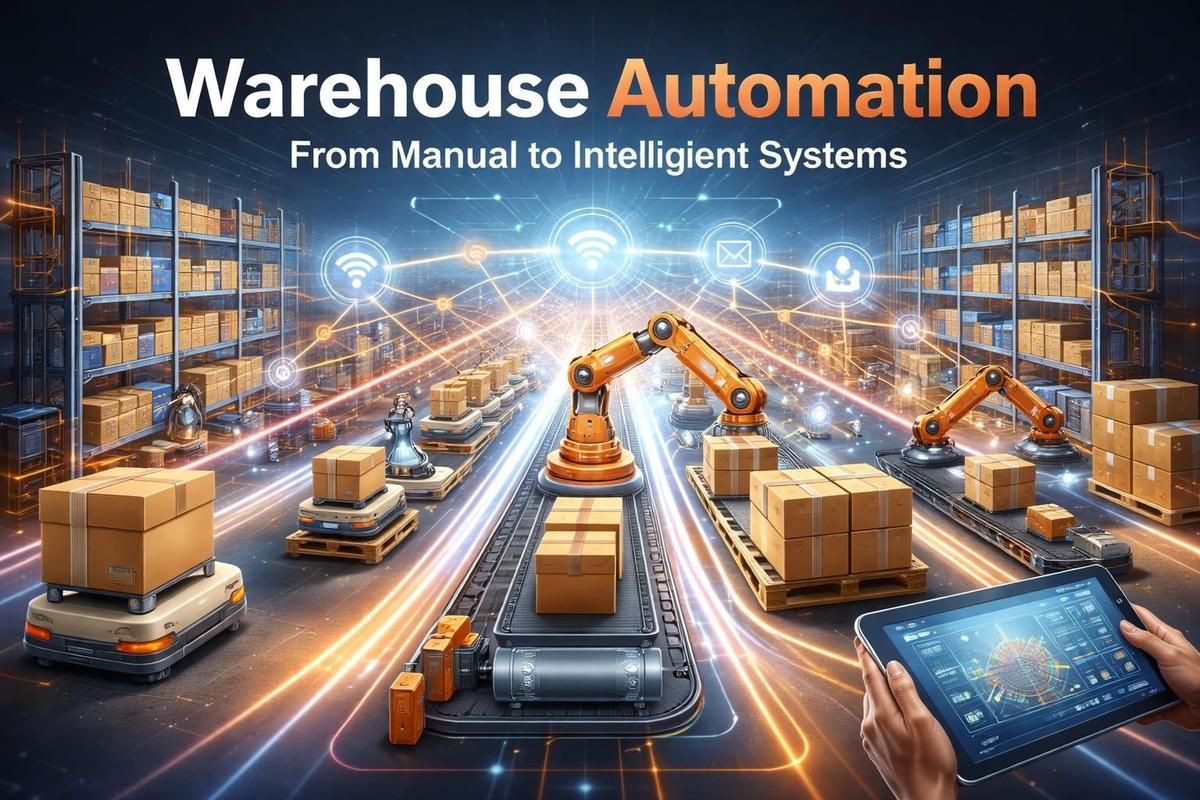
Benefits of Warehouse Automation in 2026
Share on
The landscape of warehouse operations has transformed dramatically over the past decade, driven by rising customer expectations, labour shortages, and the relentless pressure to reduce costs while maintaining accuracy. Warehouse automation has emerged as a critical solution for businesses across logistics, third-party logistics (3PL), e-commerce, manufacturing, and pharmaceutical sectors. The benefits of warehouse automation extend far beyond simple mechanization, encompassing improved productivity, enhanced safety, scalability, and data-driven decision-making that positions operations for sustainable growth in an increasingly competitive marketplace.
Enhanced Operational Efficiency and Throughput
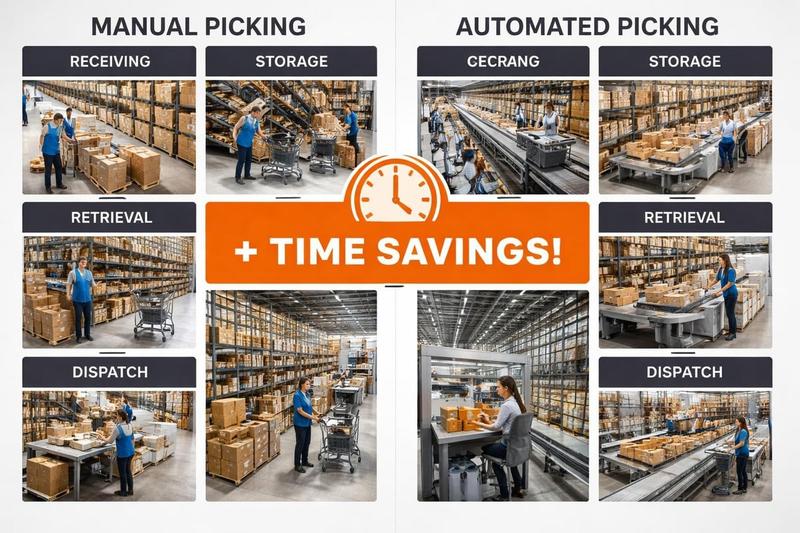
Automated warehouse systems fundamentally transform how facilities handle goods from receiving through dispatch. Traditional manual processes create bottlenecks that limit throughput, particularly during peak periods when demand surges. Automated warehouse picking systems enable facilities to process significantly higher volumes without proportional increases in labour costs.
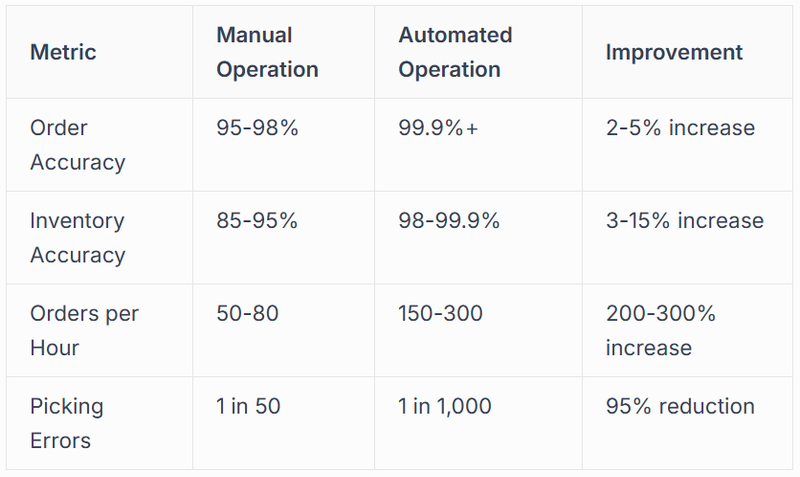
Robotics and automation technologies work continuously without fatigue, maintaining consistent performance across shifts. This reliability translates into predictable capacity planning and the ability to meet tight delivery windows. Facilities implementing goods-to-person systems report productivity improvements of 200-300% compared to traditional pick-and-pack operations.
Reduced Processing Time and Faster Order Fulfillment
Modern consumers and business customers expect rapid order fulfillment. Research shows that automated warehouses significantly reduce processing time from order receipt to dispatch. Automated storage and retrieval systems (AS/RS) eliminate walking time, which can account for up to 60% of a warehouse worker's shift in manual operations.
The benefits of warehouse automation become particularly evident during seasonal peaks. Automated systems scale capacity without the delays associated with hiring and training temporary staff. This responsiveness supports revenue growth and protects customer relationships during critical trading periods.
Improved Accuracy and Reduced Error Rates
Human error represents one of the most significant challenges in warehouse operations, impacting customer satisfaction, returns processing costs, and brand reputation. Picking errors, inventory discrepancies, and shipping mistakes create costly inefficiencies that compound throughout the supply chain.
Automated systems leverage barcode scanning, vision systems, and weight verification to ensure order accuracy rates typically exceeding 99.9%. This precision eliminates the costly cycle of returns, reshipping, and customer service interventions. For pharmaceutical and food & beverage operations, where compliance and product integrity are paramount, this accuracy is non-negotiable.
Data Capture and Inventory Visibility
One of the substantial benefits of warehouse automation involves real-time data capture at every operational touchpoint. Modern warehouse management systems integrated with automation equipment provide unprecedented visibility into inventory levels, location accuracy, and product movement.
This data foundation supports better demand forecasting, optimized replenishment strategies, and informed decision-making. Operations managers gain insights into performance metrics that were previously invisible or required manual data collection. The integration of industrial automation and robotics creates a continuous feedback loop that drives operational improvements.
Optimized Space Utilization
Real estate costs represent a significant operational expense for warehouse facilities. The benefits of warehouse automation include substantially improved space utilization through vertical storage solutions and high-density configurations that maximize cubic capacity.
Automated storage and retrieval systems can utilize ceiling heights of 12-15 metres or more, compared to 6-8 metres in manual operations. This vertical efficiency reduces the warehouse footprint required for equivalent storage capacity, lowering property costs, utilities, and maintenance expenses.
Automated systems also optimize aisle widths, as robotic equipment requires less clearance than forklifts or manual pickers. This compact design increases storage density by 40-85% compared to traditional racking configurations, allowing businesses to defer expensive facility expansions or operate from more strategically located properties closer to customer populations.
Enhanced Workplace Safety
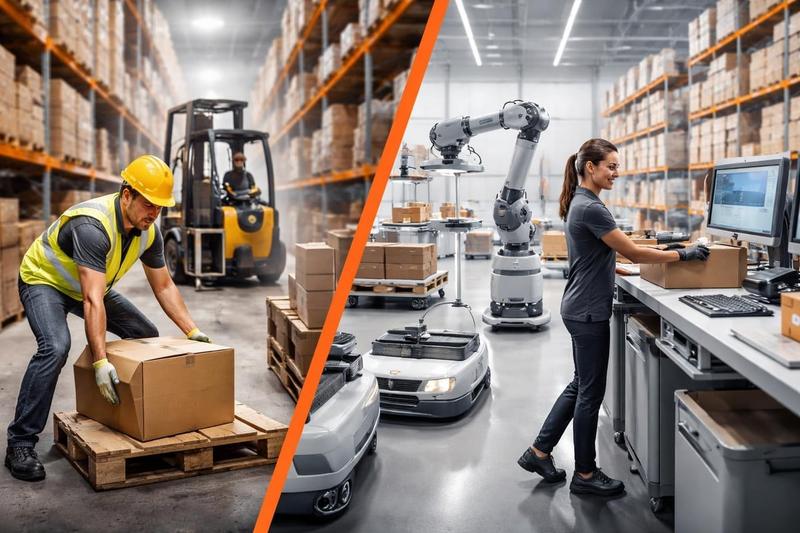
Warehouse environments present inherent safety risks, from forklift operations and manual material handling to repetitive strain injuries and slip hazards. The benefits of warehouse automation extend to creating fundamentally safer working environments by removing workers from hazardous situations.
Multiple studies highlight that automation reduces workplace injuries by eliminating manual lifting of heavy items, minimizing interaction with mobile equipment, and reducing congestion in high-traffic areas. Collaborative robots and autonomous mobile robots incorporate sophisticated safety systems including sensors, emergency stops, and collision avoidance that protect both workers and equipment.
Ergonomic Improvements for Remaining Tasks
Automation doesn't eliminate human workers but rather redefines their roles toward higher-value activities. Goods-to-person systems bring items to ergonomic workstations positioned at comfortable heights, eliminating bending, stretching, and excessive walking. This ergonomic design reduces fatigue, improves job satisfaction, and decreases workers' compensation claims.
For operations like e-commerce fulfillment services, where handling diverse SKUs at high volumes is essential, automation creates working conditions that support sustainable, long-term employment rather than high-turnover manual labour models.
Scalability and Flexibility for Growth
Business growth creates operational challenges in traditional warehouses. Scaling manual operations requires recruiting, training, and retaining additional staff in increasingly competitive labour markets. The benefits of warehouse automation include modular scalability that aligns capacity with demand.
Modern automated systems deploy in phases, starting with high-impact areas and expanding as business needs evolve. This staged approach manages capital investment while delivering immediate returns. A facility might begin with automated picking for fast-moving SKUs before adding automated storage or robotic truck unloading capabilities.
Adapting to Product and Order Profile Changes
Market dynamics shift constantly, with product life cycles shortening and customer expectations evolving. Automated warehouse systems offer configuration flexibility that manual operations cannot match. Storage zones reconfigure to accommodate different product sizes, and software updates adjust picking strategies without physical infrastructure changes.
This adaptability proves crucial for 3PL providers serving multiple clients with varying requirements. Leading warehouse automation providers design systems that accommodate diverse operational profiles within a single facility, maximizing asset utilization and return on investment.
For businesses exploring their automation journey, entry-level solutions provide accessible pathways to experience these benefits firsthand. The Automate-X GTP Starter Grid offers small and medium operations in Australia and New Zealand a low-cost approach to automating picking processes without the complexity of full-scale implementations.

Cost Optimization and Return on Investment
Financial justification drives most automation decisions. While capital investment requirements are substantial, the benefits of warehouse automation deliver measurable returns through multiple cost reduction mechanisms and revenue enablement opportunities.
Labour cost savings typically represent the most visible benefit. Research demonstrates that automated facilities reduce labour requirements by 30-70% for equivalent throughput volumes. These savings compound over time as wage inflation continues while automation costs decline through technology maturity and competitive market dynamics.
Beyond Labour: Holistic Cost Reduction
Direct labour represents only one component of total cost optimization. Automated facilities experience:
- Reduced error costs: Eliminated mispicks, returns processing, and customer credits
- Lower damage rates: Controlled handling reduces product damage by 40-60%
- Decreased utility expenses: Automated facilities often operate with reduced lighting and climate control in storage zones
- Optimized inventory levels: Improved accuracy and visibility enable leaner stock holdings
- Extended equipment lifespan: Coordinated automated movements reduce wear compared to manual forklift operations
The combination of these factors typically delivers full ROI within 2-5 years, with continuing benefits throughout the system's operational lifespan of 15-20 years or more.
Workforce Transformation and Talent Retention
The narrative that automation eliminates jobs oversimplifies a more nuanced reality. The benefits of warehouse automation include transforming warehouse work from physically demanding, repetitive tasks into technical positions requiring problem-solving skills and technology interaction.
This transformation addresses fundamental labour market challenges. Younger workers increasingly reject traditional manual warehouse roles, creating recruitment difficulties that threaten operational continuity. Automated facilities offer positions in systems operation, maintenance, and continuous improvement that appeal to technology-oriented candidates and support long-term career development.
Training and Skill Development
Leading operations invest in comprehensive training programs that upskill existing staff to operate and maintain automated systems. This approach honours workforce loyalty while building internal expertise that drives system optimization. Workers transition from order pickers to system operators, from forklift drivers to automation technicians, retaining institutional knowledge while elevating their professional capabilities.
Industry leaders like Amazon have demonstrated that automation and employment can grow simultaneously when implemented thoughtfully, with technology enabling expansion rather than simply replacing workers.
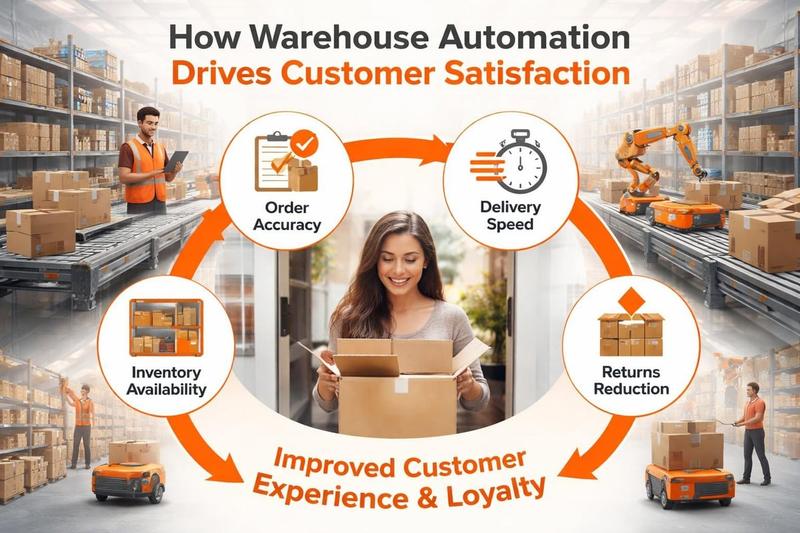
Improved Customer Satisfaction and Service Levels
Supply chain performance directly impacts customer experience. The benefits of warehouse automation translate into tangible improvements in service delivery that strengthen competitive positioning and customer loyalty.
Faster order processing enables same-day or next-day delivery commitments that meet rising expectations set by e-commerce leaders. Order accuracy eliminates frustrating delivery errors that damage brand perception. Real-time inventory visibility supports reliable available-to-promise functionality that prevents overselling and backorder situations.
For B2B operations, these service improvements translate into strengthened relationships with retail partners and end customers. Pharmaceutical distributors benefit from enhanced traceability and cold chain compliance. FMCG operations maintain product freshness through optimized rotation and reduced handling time.
Environmental Sustainability Benefits
Sustainability considerations increasingly influence operational decisions as businesses respond to regulatory requirements, investor expectations, and corporate responsibility commitments. The benefits of warehouse automation include meaningful environmental performance improvements across multiple dimensions.
Energy-efficient automated systems consume less power than equivalent manual operations using extensive lighting and climate control throughout facilities. Optimized storage density reduces building footprints, lowering embodied carbon from construction and ongoing operational emissions.
Operational Efficiency Equals Environmental Efficiency
Reduced error rates directly decrease waste from damaged goods, obsolete inventory, and transportation emissions from returns. Optimized picking paths minimize unnecessary equipment movement, while automated systems enable lights-out operation in storage areas, substantially reducing energy consumption.
Route optimization algorithms integrated with automated dispatch systems consolidate shipments more effectively, reducing transportation emissions per order. These environmental benefits align financial and sustainability objectives, creating business cases that satisfy both operational and corporate social responsibility goals.
Technology Integration and Future-Readiness
Modern warehouse automation extends beyond mechanical equipment to encompass sophisticated software platforms, artificial intelligence, and Internet of Things connectivity. The benefits of warehouse automation include creating digital infrastructure that positions operations for continuous advancement as technology evolves.
Custom automation solutions integrate with enterprise resource planning (ERP), warehouse management systems (WMS), and transportation management systems (TMS) to create seamless information flow across the supply chain. This integration eliminates manual data entry, reduces communication delays, and enables coordinated optimization across organizational boundaries.
Machine learning algorithms continuously improve system performance by analyzing operational patterns and adjusting parameters automatically. Predictive maintenance capabilities monitor equipment health, preventing unexpected failures through scheduled interventions. These advanced capabilities transform warehouses from passive storage facilities into intelligent, adaptive systems that optimize themselves.
Competitive Positioning Through Technology Leadership
Organizations implementing advanced automation signal technology leadership that attracts customers, talent, and investment. This positioning proves particularly valuable for 3PL providers competing for sophisticated clients requiring advanced capabilities and integration sophistication.
The benefits of warehouse automation compound over time as systems mature, data accumulates, and operational teams develop expertise. Early adopters establish competitive advantages that become increasingly difficult for competitors to replicate, particularly as labour scarcity and cost pressures intensify across the industry.
Implementation Considerations and Success Factors
Realizing the full benefits of warehouse automation requires careful planning, realistic expectations, and commitment to change management. Successful implementations share common characteristics that maximize return while minimizing disruption risks.
Critical Success Factors
Organizations achieving optimal results from automation investments typically:
- Conduct thorough operational assessments: Understanding current workflows, volumes, and pain points before selecting solutions
- Engage stakeholders early: Building buy-in across operations, IT, finance, and workforce representatives
- Select scalable platforms: Choosing systems that grow with the business rather than requiring replacement
- Invest in integration: Ensuring seamless data flow between automation and existing business systems
- Prioritize training: Developing comprehensive programs that prepare staff for new roles and responsibilities
- Establish performance metrics: Defining clear KPIs that demonstrate value and guide continuous improvement
The complexity of warehouse automation demands expertise in technology selection, system integration, and operational optimization. Partnering with experienced providers who understand industry-specific requirements reduces implementation risks while accelerating time-to-value.
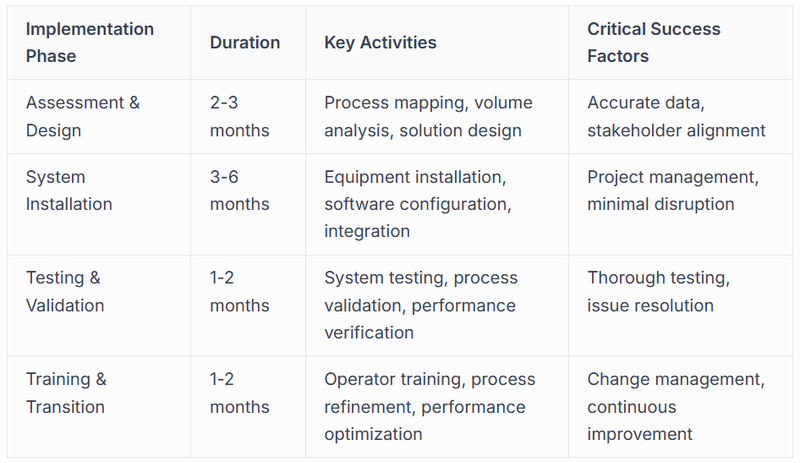
The benefits of warehouse automation manifest progressively as systems stabilize and organizations develop operational expertise. Operations implementing advanced solutions typically experience initial productivity at 60-70% of design capacity, ramping to full performance over 6-12 months as processes optimize and workforce proficiency develops.
Warehouse automation delivers transformative benefits that extend across operational efficiency, cost optimization, service quality, and strategic positioning. From enhanced accuracy and throughput to improved safety and sustainability, automation addresses the fundamental challenges facing modern warehouse operations while positioning businesses for scalable growth. Automate-X combines advanced robotics, intelligent software, and deep industry expertise to design and implement warehouse automation solutions tailored to your specific operational requirements. Whether you're operating in logistics, e-commerce, manufacturing, or specialized sectors like pharmaceuticals or cold storage, our team can help you realize the full potential of automation technology to transform your warehouse performance and competitive positioning.