

Industrial Automation Solutions Provider Selection Guide
Share on
The modern warehouse landscape demands more than isolated equipment purchases. Selecting an industrial automation solutions provider represents one of the most strategic decisions facing logistics and supply chain leaders today. The difference between implementing disconnected automation tools and deploying an integrated ecosystem often determines whether operations achieve incremental improvements or transformational results. As businesses across sectors face pressure to increase throughput, reduce errors, and scale efficiently, the provider relationship becomes the foundation for sustainable operational excellence.
Understanding the Industrial Automation Solutions Provider Landscape
The automation industry encompasses diverse specialists, each bringing different capabilities to warehouse operations. System integrators focus on connecting existing infrastructure, whilst robotics vendors excel in mobile automation. Software specialists develop warehouse management systems, and consultants guide strategic planning.
An industrial automation solutions provider differs fundamentally from equipment vendors. Rather than selling standalone products, comprehensive providers architect end-to-end solutions that address operational challenges holistically. They evaluate current workflows, identify bottlenecks, design integrated systems, and maintain ongoing optimisation.
Key Provider Categories
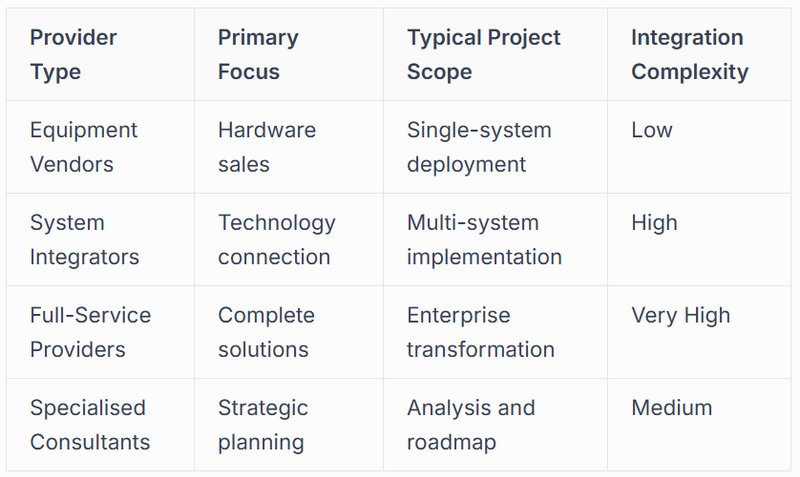
The most effective partnerships form when organisations align provider capabilities with their automation maturity level. Finding the right industrial automation solutions requires understanding both current operational gaps and future scalability requirements.
Core Capabilities That Define Leading Providers
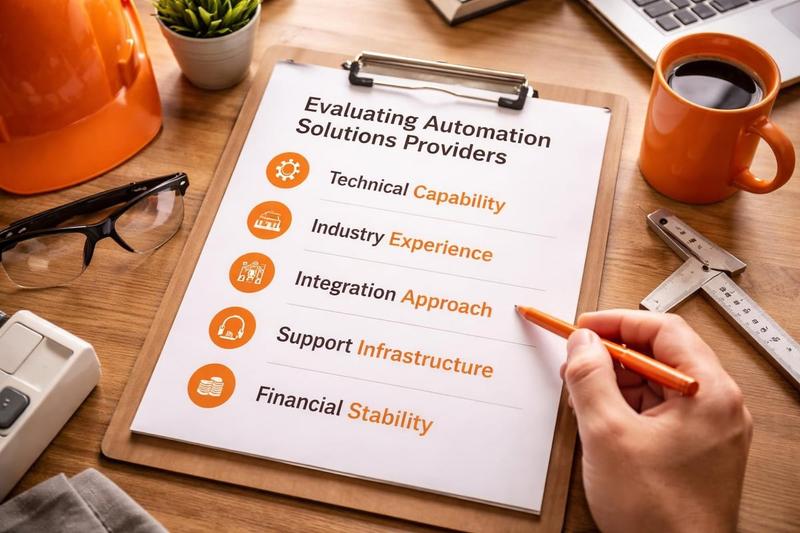
Technical competence forms the baseline, but exceptional industrial automation solutions provider partnerships extend well beyond engineering expertise. The provider ecosystem has evolved rapidly, with emerging technologies creating new specialisation areas whilst foundational capabilities remain critical.
Technology Integration Expertise
Modern warehouse automation relies on seamless connectivity between disparate systems. Warehouse management software must communicate with robotics platforms, inventory systems need real-time synchronisation with picking technologies, and data flows require continuous monitoring across all touchpoints.
Leading providers demonstrate proficiency across:
- Robotics platforms including AMRs, AGVs, and goods-to-person systems
- Control systems that orchestrate multi-vendor equipment
- Software integration connecting WMS, ERP, and TMS platforms
- Data infrastructure supporting analytics and continuous optimisation
- Network architecture ensuring reliable connectivity and cybersecurity
The Industrial Automation Authority provides structured reference materials that help organisations understand the technical landscape and evaluate provider capabilities across automation categories.
Industry-Specific Knowledge
Warehouse automation requirements vary dramatically across sectors. E-commerce fulfilment centres prioritise speed and order accuracy, pharmaceutical operations demand strict compliance and traceability, whilst cold-storage facilities require equipment rated for extreme temperatures.
An effective industrial automation solutions provider brings documented experience within your specific sector. Case studies, reference installations, and sector-specific compliance knowledge demonstrate capability beyond generic automation expertise. For e-commerce operations particularly, understanding peak season demands and returns processing creates significant value. The Talk Shop community offers insights into how e-commerce merchants navigate operational scaling challenges, which often intersect with automation decisions.
Evaluating Provider Credentials and Track Record
Due diligence separates promising pitches from proven performance. The automation industry includes established players with decades of experience alongside innovative startups bringing fresh approaches. Both can deliver exceptional results when properly matched to project requirements.
Financial Stability and Longevity
Automation investments represent multi-year commitments requiring ongoing support, software updates, and potential system expansion. Provider financial health directly impacts your operational continuity.
Critical evaluation factors include:
- Years in operation and ownership stability
- Client retention rates and reference availability
- Financial backing and investment profile
- Geographic presence and local support infrastructure
- Partnerships with major technology vendors
The vendor-neutral Automation-List directory helps organisations identify verified automation providers worldwide, facilitating initial research and provider comparison.
Technical Certifications and Standards Compliance
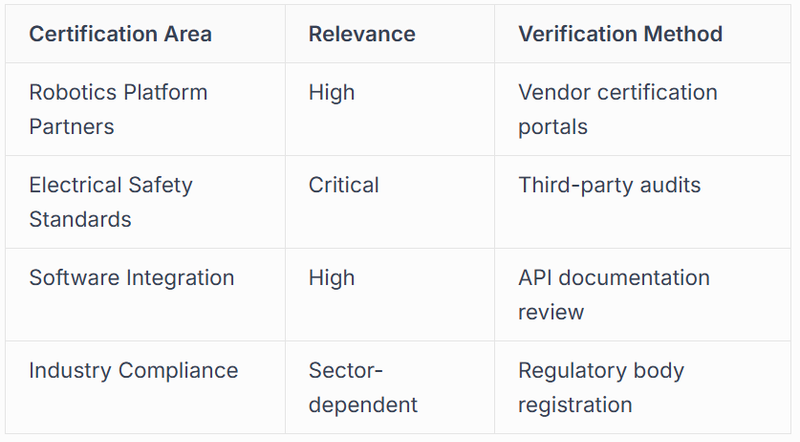
Professional certifications validate technical competency and commitment to industry standards. Look for providers maintaining certifications from major automation platforms, safety standards organisations, and industry associations.
Implementation Methodology and Project Management
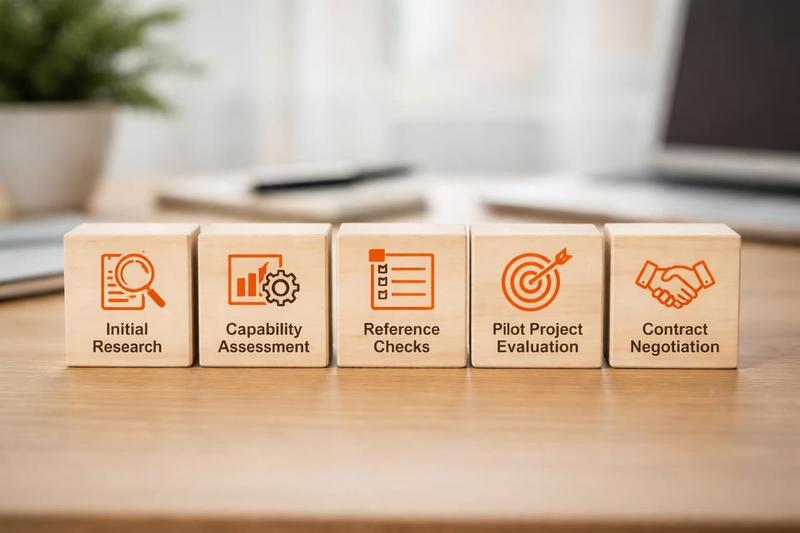
The implementation approach determines project success as significantly as technical capability. An industrial automation solutions provider should articulate a clear methodology covering discovery, design, deployment, and optimisation phases.
Discovery and Assessment Process
Thorough discovery prevents costly redesigns and ensures solutions address actual operational constraints. Effective providers invest substantial time understanding existing workflows, physical infrastructure limitations, workforce capabilities, and growth projections.
The discovery phase typically examines:
- Current throughput metrics and bottleneck analysis
- Facility layout and structural considerations
- Existing technology infrastructure and integration points
- Workforce skills and change management requirements
- Financial parameters and ROI expectations
Supply chain resilience has become increasingly critical, particularly for organisations managing complex dependencies. The Sov Sentinel platform helps enterprises map supplier risks and simulate geopolitical impacts, which can inform automation strategies focused on operational independence and redundancy.
Phased Deployment Strategies
Large-scale automation rarely succeeds through single "big bang" implementations. Progressive deployment allows operational learning, workforce adaptation, and incremental investment validation.
Phased approaches typically follow this progression:
- Pilot zone implementation testing core technologies in controlled environment
- Performance validation measuring actual vs projected improvements
- Workforce training building internal capability across shifts
- Incremental expansion scaling proven solutions systematically
- Continuous optimisation refining parameters based on operational data
For businesses beginning their automation journey, solutions like the Automate-X GTP Starter Grid provide accessible entry points that demonstrate value before committing to enterprise-scale deployments. This goods-to-person system allows small and medium warehouses to implement automated picking processes with manageable investment and complexity.
Integration Capabilities Across Technology Ecosystems
No warehouse automation exists in isolation. Modern operations depend on data flowing seamlessly between automation hardware, warehouse management systems, enterprise resource planning platforms, and transportation management solutions.
Software Integration Architecture
An industrial automation solutions provider must demonstrate expertise connecting proprietary automation systems with your existing technology stack. API capabilities, data standards compliance, and middleware experience determine integration success.
Critical integration points include:
- WMS connectivity for task assignment and inventory updates
- ERP synchronisation maintaining financial and planning accuracy
- TMS coordination optimising outbound shipment processes
- Analytics platforms providing operational intelligence
- Mobile workforce systems coordinating human-robot collaboration
Industrial automation solution providers increasingly focus on open architecture approaches that prevent vendor lock-in whilst ensuring reliable performance across multi-vendor environments.
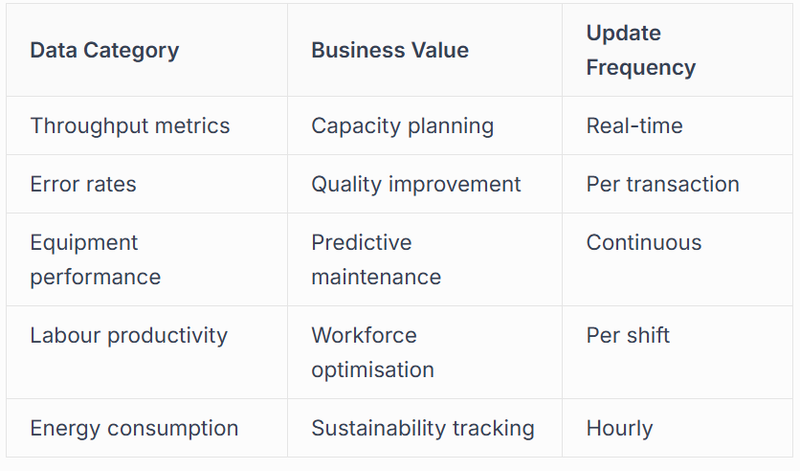
Data Management and Analytics
Automation generates vast operational data streams. Leading providers transform raw data into actionable intelligence through purpose-built analytics frameworks.
Support Infrastructure and Ongoing Optimisation
Post-implementation support determines long-term automation value. Initial deployment represents the beginning of a continuous improvement journey requiring technical support, performance optimisation, and system evolution.
Service Level Agreements and Response Times
Clear SLA definitions prevent ambiguity when issues arise. An industrial automation solutions provider should offer tiered support matching your operational criticality.
Essential SLA components include:
- Response time commitments by severity level
- Remote diagnostic and resolution capabilities
- On-site technician availability and travel time
- Spare parts inventory and logistics
- Escalation procedures and management engagement
Twenty-four-hour operations demand corresponding support availability. Verify provider coverage matches your operational hours, particularly for multi-shift or continuous operations.
Continuous Improvement Programs
Static automation systems deteriorate in value as operational requirements evolve. Forward-thinking providers establish formal optimisation programs that review performance metrics, identify enhancement opportunities, and implement refinements systematically.
Regular optimisation activities encompass parameter tuning based on seasonal patterns, workflow adjustments reflecting product mix changes, capacity expansion planning, and technology refresh roadmaps. The comprehensive services offered by industrial automation specialists increasingly include proactive monitoring and algorithmic optimisation alongside reactive troubleshooting.

Total Cost of Ownership Considerations
Initial capital investment represents one component of automation economics. Comprehensive financial analysis examines total cost of ownership across the solution lifecycle, typically spanning seven to ten years.
Direct and Indirect Cost Components
Capital expenditure includes:
- Hardware and robotics equipment
- Software licensing and customisation
- Installation and commissioning
- Facility modifications and infrastructure
- Project management and integration services
Ongoing operational costs encompass:
- Software subscription and support fees
- Preventative maintenance and parts replacement
- Energy consumption increases
- Insurance and risk management
- Technology refresh and upgrade cycles
ROI Validation and Performance Guarantees
Reputable providers stand behind performance projections through structured validation frameworks. Some offer performance guarantees tying final payment to achieving defined metrics, whilst others provide extended pilots allowing measurement before full commitment.
Establish clear baseline metrics before implementation, define specific improvement targets, implement measurement systems capturing actual performance, and schedule formal review periods assessing ROI realisation. Many organisations discover automation delivers unexpected benefits beyond initial projections, including reduced safety incidents, improved employee retention, and enhanced customer satisfaction through consistent service levels.
Scalability and Future-Proofing Strategies
Warehouse automation investments must accommodate growth and operational evolution. An effective industrial automation solutions provider architects solutions supporting expansion whilst protecting initial investment value.
Modular Design Principles
Modular approaches allow incremental capacity addition without wholesale system replacement. Grid-based goods-to-person systems exemplify scalability, permitting additional storage modules, picking stations, and robot units as throughput requirements increase.
Technology selection should consider standardisation across modules, vendor ecosystem openness, backward compatibility commitments, and upgrade path clarity. Solutions locked to proprietary technologies or discontinued platforms create significant future risk regardless of current performance excellence.
Emerging Technology Integration Roadmaps
The automation landscape evolves continuously. Artificial intelligence enhances decision-making, computer vision improves quality control, collaborative robots enable flexible human-automation partnerships, and autonomous mobile robots provide dynamic material movement.
Leading industrial automation solutions provider partnerships include technology roadmap discussions, exploring how emerging capabilities might address future operational requirements. These conversations should remain grounded in business value rather than technology novelty, focusing on measured adoption aligned with proven ROI rather than speculative investment in unproven approaches.
Risk Management and Business Continuity
Automation concentration creates operational dependency. Comprehensive providers address business continuity through redundancy planning, graceful degradation strategies, and contingency protocols.
Redundancy and Failover Design
Critical operations require automation architectures preventing single points of failure. Redundant systems increase initial investment but protect against catastrophic operational disruption.
Redundancy strategies include:
- Duplicate equipment for critical functions
- Manual fallback procedures for automation failures
- Distributed control preventing centralised vulnerabilities
- Regular disaster recovery testing and documentation
- Spare parts inventory supporting rapid repairs
Change Management and Workforce Transition
Automation transforms workforce roles, creating anxiety alongside opportunity. Successful industrial automation solutions provider partnerships include structured change management addressing communication, training, and career development.
Effective change management begins before installation, engaging affected teams in planning and design. Transparent communication about role evolution, comprehensive training programs, and clear career pathways help organisations retain institutional knowledge whilst adopting new technologies. The most successful implementations position automation as amplifying human capability rather than replacing workers, creating roles focused on oversight, exception handling, and continuous improvement rather than repetitive physical tasks.
Selecting the right industrial automation solutions provider fundamentally shapes operational trajectory, determining whether automation investments deliver transformational value or incremental improvements. Success requires evaluating technical capability, industry expertise, implementation methodology, and partnership approach across the complete solution lifecycle. Automate-X combines robotics, warehouse software, and system integration expertise to help logistics and supply chain businesses streamline operations, improve productivity, and enable scalable growth across distribution and fulfilment environments. Whether you're beginning your automation journey or expanding existing capabilities, our team brings proven experience across logistics, 3PL, e-commerce, manufacturing, and specialised sectors including pharmaceuticals and cold-storage operations.