

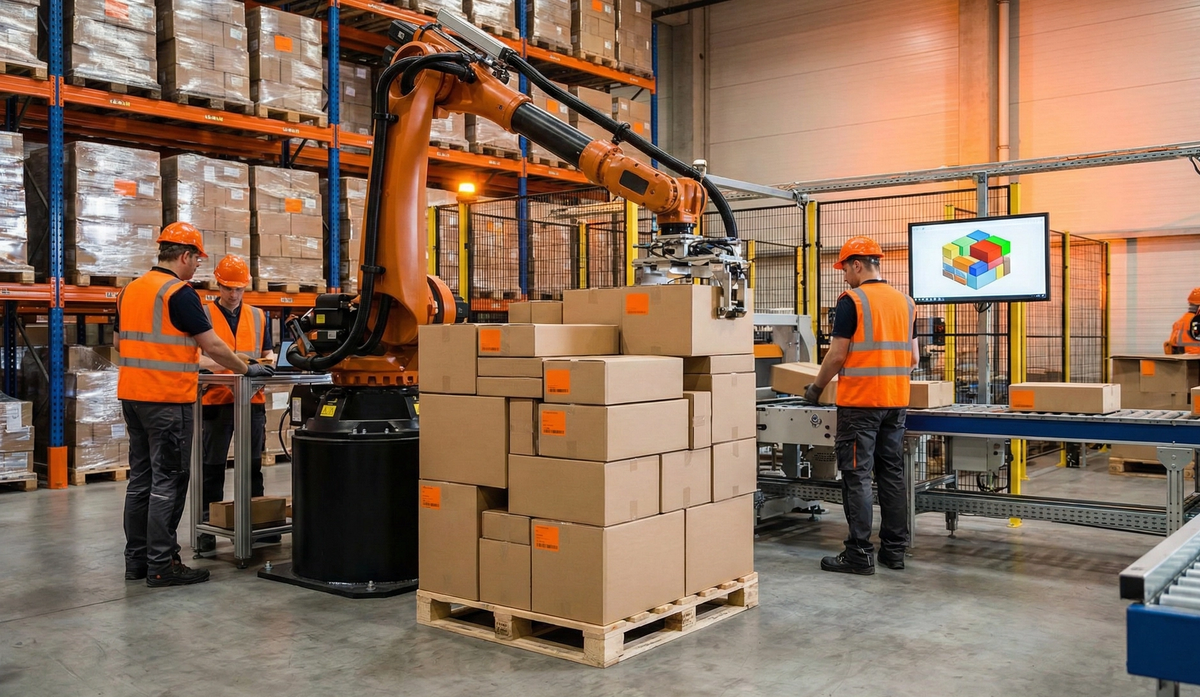
Solving the "3D Tetris" of Logistics: A Guide to Mixed Case Palletizing
Share on
In the fast-paced world of B2B distribution and retail replenishment, few tasks are as complex—or as critical—as mixed case palletizing. It’s the industrial equivalent of playing 3D Tetris: arranging products of varying sizes, weights, and fragilities onto a single stable pallet.
For warehouse operators in New Zealand and Australia, the challenge is two-fold: dealing with an explosion of SKU varieties while managing rising labour costs. At Automate-X, we believe the solution lies in smarter, not just harder, work. By integrating advanced robotic palletizing systems powered by vision technology, we are transforming how local distribution centres handle diversity.
The Mixed Case Challenge in ANZ
Traditional supply chains were built for uniformity. But today’s market demands agility. Retailers want mixed pallets ready for shelf-stocking, and e-commerce has fragmented order profiles.
Currently, manual labour remains the dominant method for building these complex loads in many Australian and Kiwi warehouses. However, this approach is becoming unsustainable due to:
- Labour Shortages: Finding staff willing to perform heavy, repetitive lifting is increasingly difficult in our region.
- Safety Risks: Manual palletizing is a leading cause of musculoskeletal injuries, driving up premiums and lost time.
- Inconsistent Quality: A tired human builds a less stable pallet than a fresh one, leading to product damage during transit.
How Automate-X Optimizes the Process
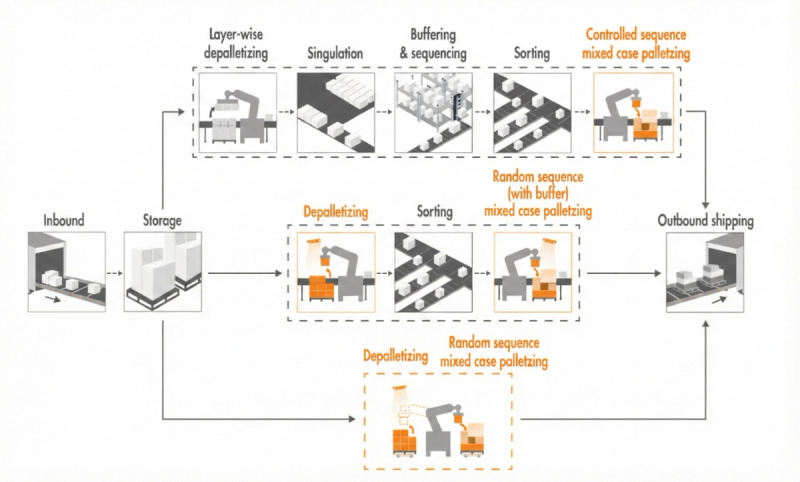
We don't just install robots; we design the workflow. Partnering with leaders like XYZ Robotics, we implement solutions that handle random sequence palletizing. Unlike older, rigid systems that required massive "sequencing towers" and expensive infrastructure, our modern cells use AI to adapt in real-time.
1. Visual Perception & AI Planning
The core of our system is its "brain." Using advanced computer vision, the robot identifies cases as they arrive on the conveyor—regardless of the order. The system then calculates the optimal stacking pattern instantly to ensure:
- Maximum Density: Reducing shipping air, which cuts freight costs—a crucial factor for logistics in Australia and New Zealand.
- Load Stability: Ensuring heavy items are placed low and fragile items high.
2. Space-Saving Footprint
Real estate in hubs like Sydney, Melbourne, and Auckland is at a premium. Traditional layer palletizers take up massive floor space. Our robotic integration solutions are compact, often fitting into the same footprint as a manual station but delivering double the throughput.
Why Automate-X? The Integrator Advantage
Buying a robot is easy; making it work with your WMS (Warehouse Management System) is where the expertise lies. As your local system integrator, Automate-X ensures:
- Seamless Connectivity: We bridge the gap between your data and the robot’s actions.
- Local Compliance: We ensure every cell meets strict AS/NZS 4024 safety of machinery standards, protecting your workforce and your liability.
- Rapid ROI: By eliminating the need for costly sequencers and reducing labour dependence, our clients often see a return on investment in as little as 12–24 months.
Ready to Stack Smarter?
The days of manual "Tetris" are numbered. If you are ready to improve ergonomics, increase picking accuracy, and future-proof your warehouse against labour volatility, it’s time to talk to a specialist.
Contact the Automate-X engineering team today for a site audit and see how mixed case automation can fit your floor plan.