

The State of Warehouse Automation in New Zealand: What We're Seeing
Share on
Warehouse automation enquiries in New Zealand grew by about 50% from 2024 to 2025, and the question people ask has changed from "can a robot move this?" to "how do we automate the pick face?" Here is what we are seeing across our enquiries and projects.
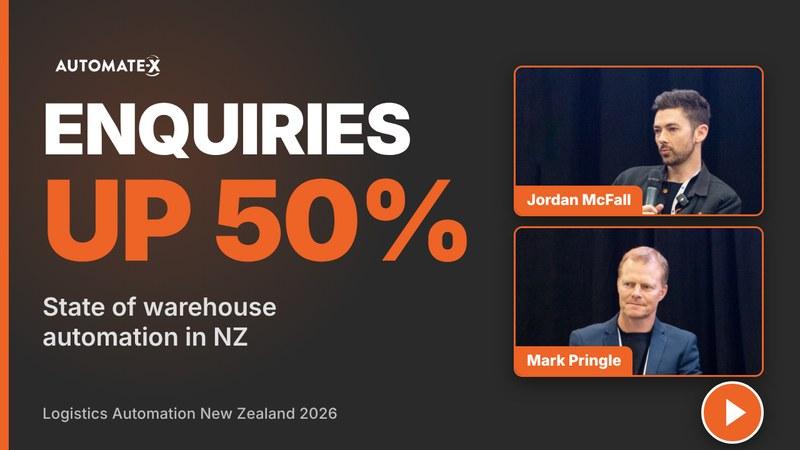
Watch the full 30-minute session on YouTube
What the numbers say
We went back through every warehouse automation enquiry and project we have worked on in New Zealand since 2024. Three things stood out.
Volume is up. Warehouse automation enquiries grew by about 50% from 2024 to 2025, and 2026 had already matched all of last year with a couple of months still to go.
The warehouse is where the energy is. Warehouse automation was a bit under half of the automation enquiries we saw in 2024. This year it is about eight in ten.
The question has changed. A few years ago the most common ask was whether a robot could move something from A to B, and automated guided vehicles led the conversation. Today, about half of new projects are goods-to-person picking, where robots bring the totes to the picker. People have moved on from automating the forklift to automating the pick face, which is the most labour-hungry part of the building.
That matches what we see on site. Two years ago a visit started at the dock, looking at pallets coming off containers and trucks. Now it starts at the pick face, with questions about lines per day, lines per hour and how many pickers it takes. That is also where the best returns are showing up. Mobile robots still have a strong business case, but they are no longer the lowest hanging fruit.
If we had to sum up the market in one sentence: the interest is here, and people are ready. We are in what we call the education phase, with businesses learning what is out there.
Why New Zealand automates differently
We all see videos of huge distribution centres overseas and assume that is what automation means. It does not translate directly here, for four very Kiwi reasons. These are our own observations from working on projects here, not sourced statistics.
- Our order profile. We are a smaller country, so we get less of each product but still carry a wide range of items. That means a mix of bulk and small items that fit in totes. Most of the time the answer is not to automate everything. It is to automate the 70 to 80 percent that makes sense and keep the rest manual. There is nothing wrong with manual processes, and the last 20 percent often costs the most to automate.
- A long country. Many businesses run distribution centres in more than one place, for example Auckland and Christchurch. The question is usually how to automate the main hub and keep the second site simple, not how to build one mega site.
- Lumpy peaks. Black Friday, Christmas, harvest and export seasons all push volumes well above normal for a few weeks. You design for the peak, not the average, which favours systems that can flex up and down.
- Distance from the factory. Most equipment is made overseas and stock has to last long enough to supply customers. That affects how you build the warehouse, and it makes local support matter far more. A great system is hard work if spare parts and engineers are a long flight away.
Who is moving first, and the projects on pause
Third-party logistics (3PL) leads. 3PLs are the biggest group again this year. They tend to know where the technology is at and often have support from counterparts overseas. They also feel all four of the New Zealand differences at once, and their contracts are often shorter than the life of the equipment, so flexibility is the business case.
E-commerce is close behind. Small orders, lots of lines and big promotional peaks make goods-to-person and sortation a natural fit.
Food, grocery and cold chain are rising. Cold is the hardest environment to staff, and every cubic metre you refrigerate costs money. Automation adds density, which brings down the cost per square metre and makes the return look better.
Healthcare and pharma are smaller but focused. Accuracy and traceability matter most, so these businesses are often early to automate.
Manufacturing has slowed, but the plants that are automating want a point of difference and a way to hold their margin in a tough market.
Projects on pause
Many businesses we have spoken to put a project on hold in the last year or two. When we looked at the projects that stalled or did not proceed, fewer than one in ten were lost on price or to a competitor. Well over half came down to timing: not this financial year, paused, or withdrawn while something else took priority. In most cases the business case still stands.
The last six months have shown signs of change. Fewer businesses are afraid of the spend, and some companies that paused a year ago are going back into their data and starting to buy again. A backlog is building, and projects already take about a year from first conversation to decision. If you are in that group, we would encourage you to keep investigating, so you are ready when you decide to move. Waiting for the economy to improve can be a long road, and there are companies out there already seeing the rewards.
Hype check: what is real today
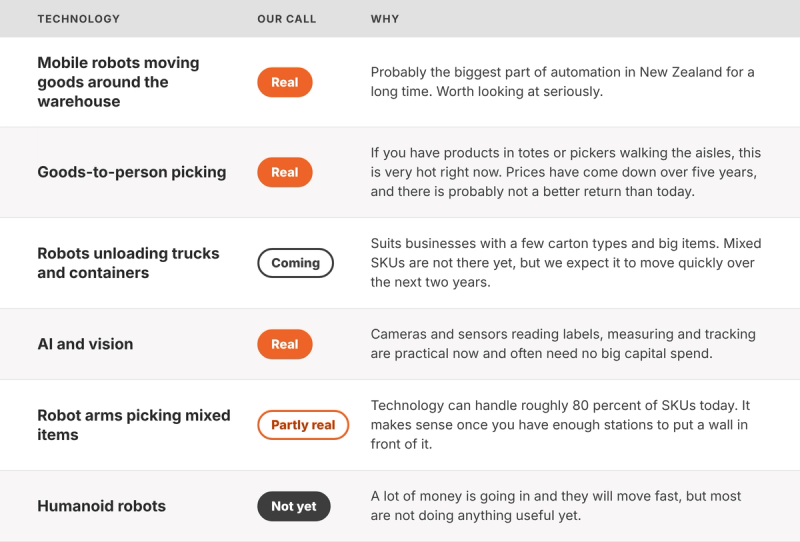
We also ran through the technologies people ask about most, and called each one as real today, coming soon, or not yet.
Where it is heading by 2029
Goods-to-person becomes the standard. Many people do not want to work in warehouses that are hot in summer and cold in winter. Taking away the walking, up to 20 kilometres a day, and putting pickers at a comfortable station changes the job. One picker we spoke to in Melbourne said she now goes home with energy for her kids. Worries that automation will hurt workers are not what we see on the ground.
Cold chain is the surprise. Freezing space is expensive, so density pays. We have seen a big rise in cold storage enquiries and projects over the past year or two.
What to do next
The interest is here. The next step is turning it into a plan that fits your business. Three questions come up again and again, and they are worth asking any automation partner:
- Where is your data? You cannot measure what you do not track. Understanding your volumes, peaks and SKUs is the best place to start, and it usually needs no big spend.
- Who supports it, and where? Ask how many service engineers they have in Auckland, Christchurch or wherever your warehouses are, and what response times they will commit to. Some providers say they have a team and do not.
- What is the building going to be? Brownfield and greenfield are different conversations. If you are planning a new site, work out the automation first, because it can mean a smaller or shorter building than you thought you needed.
If you want to talk through your own site, get in touch.
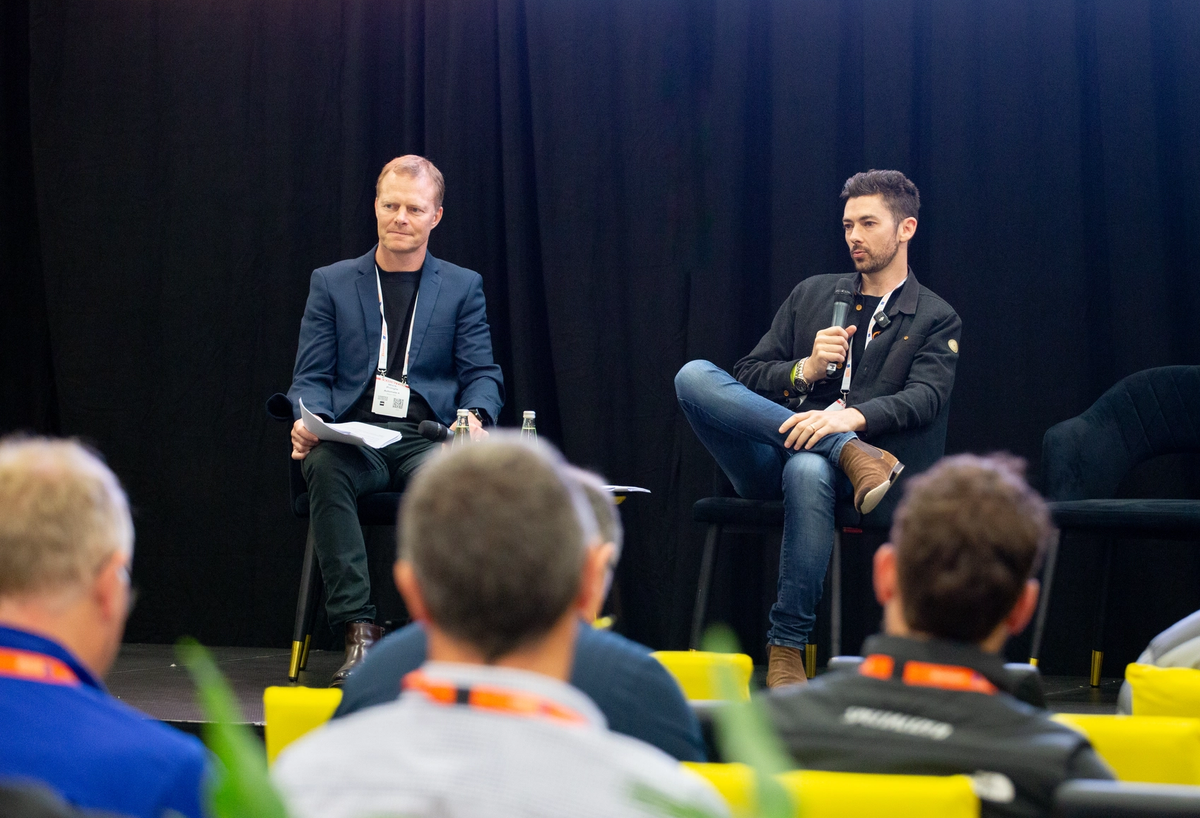
This article draws on Automate-X's own enquiries and projects in New Zealand since 2024, and on the talk by Jordan McFall and Mark Pringle in the Knowledge Theatre at Logistics Automation New Zealand 2026. It reflects what we are seeing across our own work and is not a market survey, so treat the figures as directional.