

What Is Warehouse Automation: A Complete 2026 Guide
Share on
Modern logistics operations face unprecedented pressure to deliver faster, cheaper, and more accurately than ever before. Traditional manual processes simply cannot keep pace with rising consumer expectations and the explosive growth of e-commerce. This challenge has driven businesses across New Zealand, Australia, and globally to fundamentally rethink how they manage their distribution and fulfillment operations. Understanding what is warehouse automation has become essential for any organization seeking to remain competitive in today's fast-paced supply chain environment.
Understanding What Is Warehouse Automation
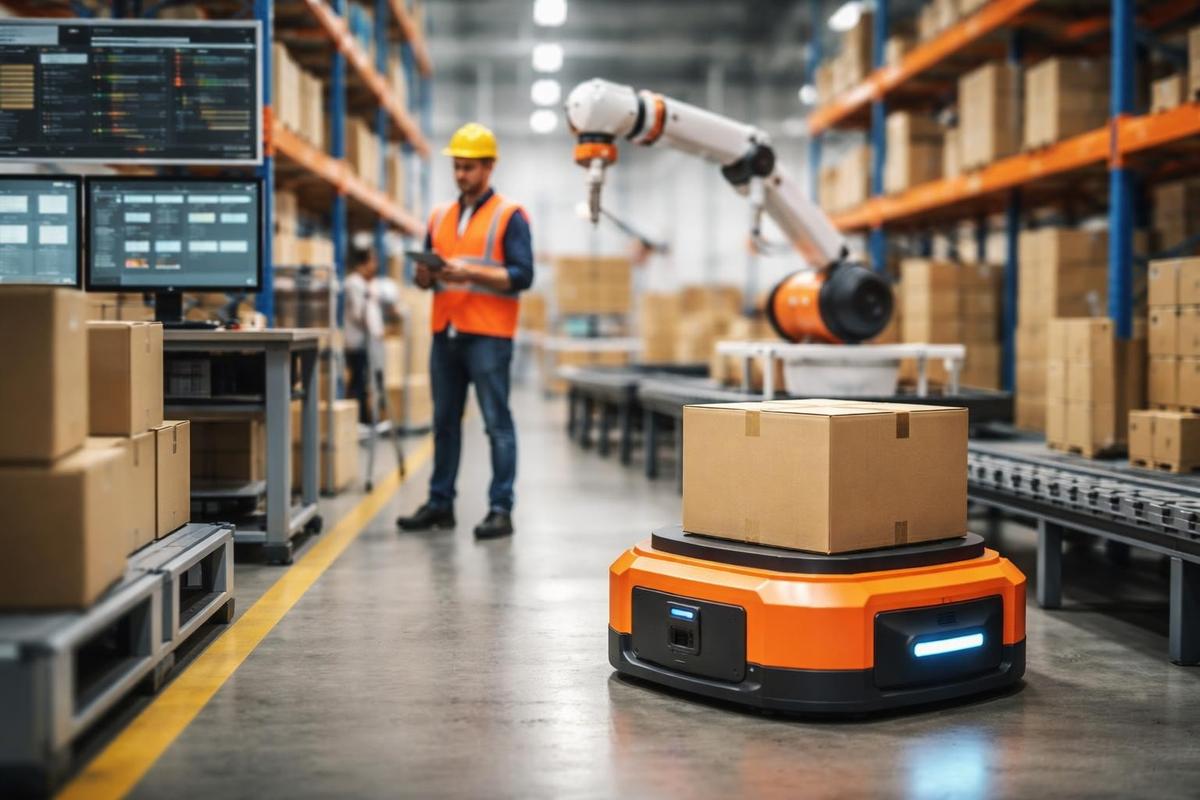
What is warehouse automation? At its core, warehouse automation refers to the use of technology, software, and mechanical systems to minimize or eliminate manual processes within warehouse and distribution centre operations. This encompasses everything from robotic picking systems and automated storage and retrieval solutions to warehouse management software and conveyor networks.
The concept extends beyond simply replacing human workers with machines. Modern warehouse automation represents an intelligent integration of multiple technologies working together to optimize the entire fulfillment process. It's about creating smarter, more responsive operations that can scale efficiently with business growth.
Digital and Physical Automation Components
Warehouse automation typically divides into two interconnected categories: digital automation and physical automation. Digital and physical automation systems work together to create comprehensive solutions that address both data management and material handling challenges.
Digital automation includes:
- Warehouse Management Systems (WMS)
- Inventory tracking software
- Order management platforms
- Analytics and reporting tools
- Integration with enterprise resource planning (ERP) systems
Physical automation encompasses:
- Autonomous mobile robots (AMRs)
- Automated guided vehicles (AGVs)
- Conveyor systems
- Robotic picking arms
- Automated storage and retrieval systems (AS/RS)
- Palletizing equipment
Core Technologies Driving Warehouse Automation
The question of what is warehouse automation becomes clearer when examining the specific technologies that power these systems. Each technology serves distinct functions within the broader automation ecosystem.
Autonomous Mobile Robots and AGVs
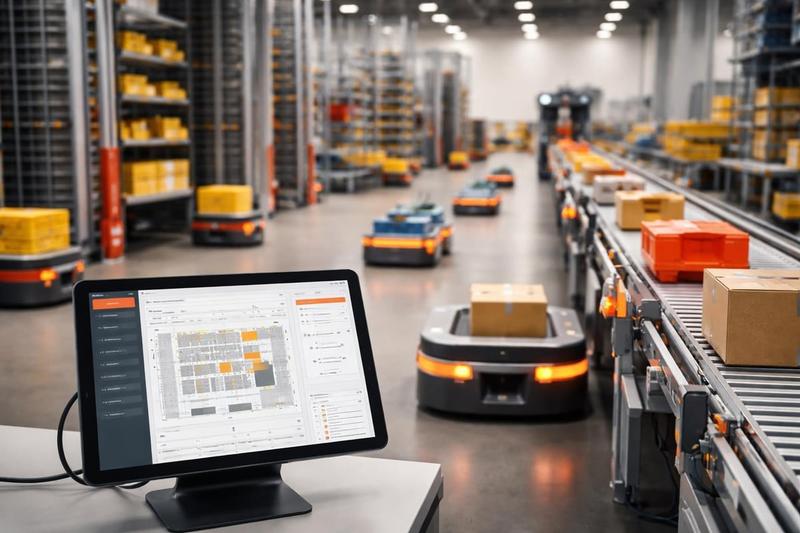
AGV warehouse automation has evolved significantly in recent years. While traditional AGVs followed fixed paths using magnetic strips or wires, modern AMRs use sophisticated navigation systems to move dynamically through warehouse environments.
These mobile robots handle various tasks:
- Goods-to-person picking - bringing products to stationary workers
- Pallet transportation - moving full pallets between zones
- Sortation assistance - directing items to appropriate locations
- Inventory counting - scanning shelves during routine patrols
The flexibility of AMR technology makes it particularly valuable for operations experiencing frequent layout changes or seasonal volume fluctuations. Companies can redeploy robots to different tasks as needs change, maximizing return on investment.
Automated Storage and Retrieval Systems
Automated storage and retrieval systems represent one of the most transformative warehouse automation technologies. These systems use computer-controlled mechanisms to automatically place and retrieve items from designated storage locations.
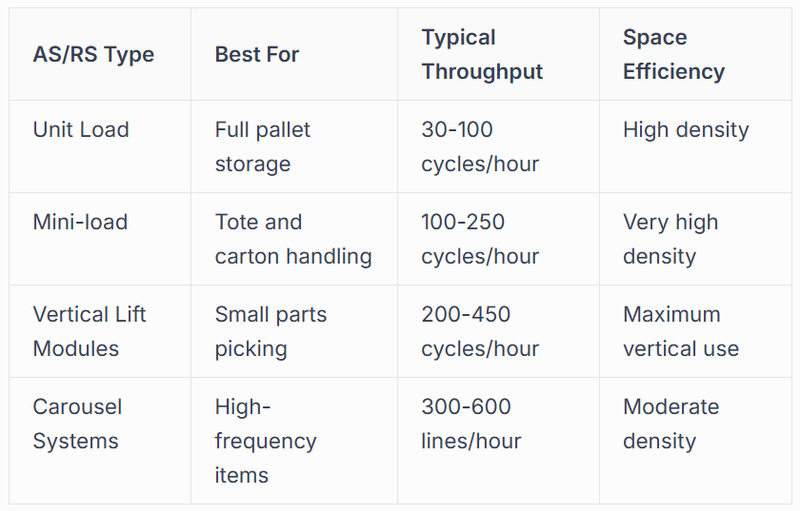
These systems dramatically reduce the walking time associated with traditional picking methods while maximizing cubic space utilization within the facility.
Conveyor and Sortation Systems
Conveyor system networks form the circulatory system of automated warehouses, moving products efficiently between different operational zones. Modern conveyor technology includes sophisticated sortation capabilities that automatically direct items to specific destinations based on order requirements.
Advanced sortation systems can process thousands of items per hour with remarkable accuracy. This capability proves essential for high-volume operations, particularly in e-commerce fulfillment where order profiles consist of multiple individual items requiring consolidation.
Benefits Transforming Warehouse Operations
Understanding what is warehouse automation also means recognizing the tangible benefits these systems deliver. The advantages of warehouse automation extend across multiple operational dimensions.
Productivity and Throughput Improvements
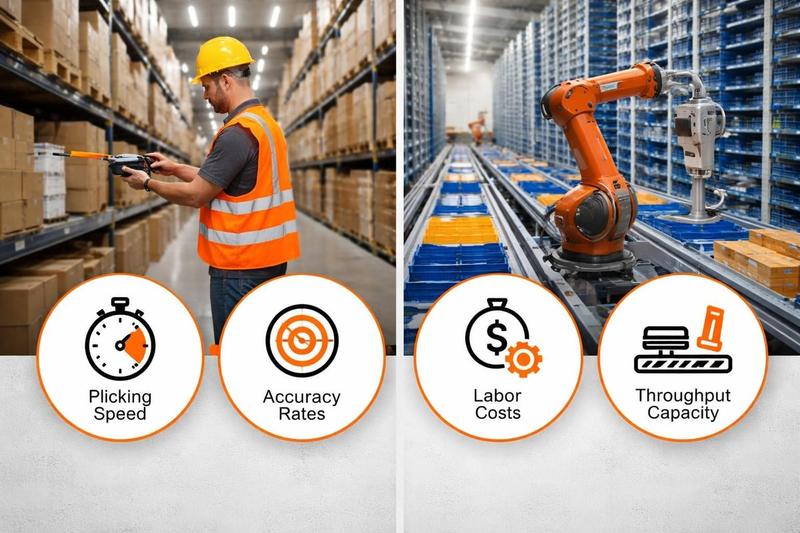
Automated systems operate continuously without fatigue, breaks, or shift changes. This consistency enables significant throughput improvements compared to manual operations.
Measurable productivity gains include:
- 2-3x increase in picking rates with goods-to-person systems
- 40-60% reduction in order processing time
- 99.9%+ inventory accuracy with automated tracking
- 24/7 operational capability with minimal supervision
These improvements translate directly to increased capacity without proportional increases in facility size or labor costs.
Accuracy and Quality Enhancement
Human error represents one of the largest challenges in manual warehouse operations. Picking mistakes, shipping errors, and inventory discrepancies create costly problems that damage customer relationships and erode profitability.
Automated systems equipped with barcode scanning, computer vision, and weight verification substantially reduce these errors. Many operations report error rates dropping from 1-3% in manual processes to less than 0.1% after automation implementation.
Labor Optimization and Safety
Rather than eliminating jobs, effective warehouse automation reshapes the workforce toward higher-value activities. Workers transition from repetitive physical tasks to system oversight, quality control, exception handling, and continuous improvement initiatives.
Safety improvements are equally significant. Automated material handling reduces the physical strain associated with manual lifting, bending, and reaching. This leads to fewer workplace injuries, lower workers' compensation costs, and improved employee satisfaction.
For fast-growing e-commerce brands working with fulfillment partners like Ecom Automation Prep, the combination of automated warehousing and specialized prep services creates a powerful solution for scaling operations efficiently.
Implementation Considerations and Challenges
While the benefits are substantial, successful warehouse automation requires careful planning and realistic expectations. Common challenges in warehouse automation implementation deserve thorough consideration.
Capital Investment and ROI Analysis
Automation systems require significant upfront investment. Businesses must conduct thorough analysis to ensure projects deliver acceptable returns within reasonable timeframes.
Key financial considerations:
- Total project costs including equipment, installation, and integration
- Ongoing maintenance and support expenses
- Expected labor savings and productivity improvements
- Payback period and long-term ROI projections
- Financing options and cash flow implications
Most warehouse automation projects target ROI periods of 2-4 years, though this varies significantly based on operation size, technology selection, and implementation scope.
System Integration Complexity
Modern warehouses typically run multiple software systems that must communicate seamlessly. Industrial system integration challenges can derail automation projects if not properly addressed during planning phases.
Integration requirements include:
- WMS connectivity with automation controllers
- ERP system data synchronization
- Order management platform interfaces
- Shipping carrier system connections
- Real-time inventory visibility across platforms
Successful implementations treat integration as a core project component rather than an afterthought, allocating appropriate time and resources to ensure all systems work harmoniously.
Facility Infrastructure Requirements
Not all buildings suit automation equally well. Floor quality, ceiling height, column spacing, and structural loading capacity all impact technology selection and implementation costs.
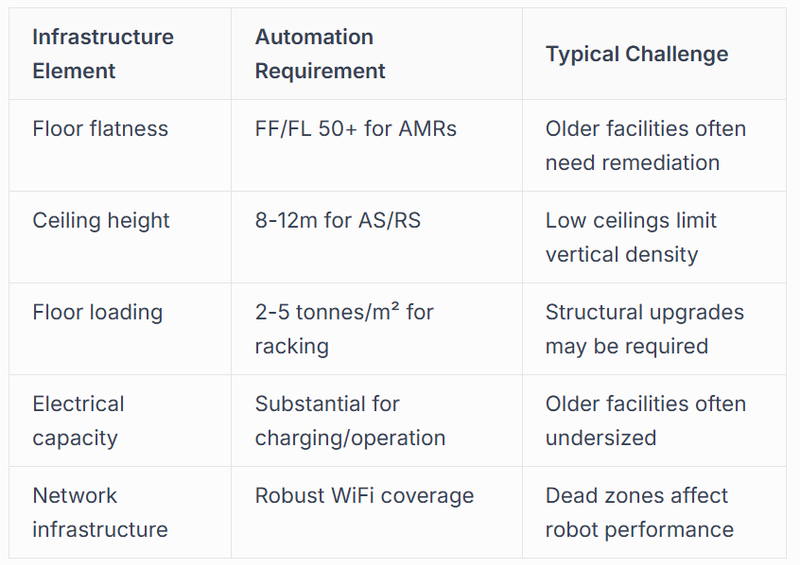
Organizations should conduct thorough facility assessments before finalizing automation strategies to identify potential infrastructure limitations.
Types of Warehouse Automation Solutions
What is warehouse automation in practical terms? The answer depends largely on which specific technologies and approaches best match operational requirements. Different automation levels suit different business contexts.
Goods-to-Person Systems
Goods-to-person automation revolutionizes traditional picking by bringing inventory to stationary workers rather than sending workers to search for products throughout the warehouse.
These systems eliminate unproductive travel time, enabling workers to focus entirely on picking tasks. Productivity improvements of 200-300% are common compared to traditional pick-to-cart methods.
The Automate-X GTP Starter Grid offers an accessible entry point for small and medium businesses looking to experience goods-to-person benefits without massive capital investment. This scalable solution helps operations begin their automation journey with proven technology that can grow alongside business needs.

Automated Picking Technologies
Automated warehouse picking encompasses various technology approaches, each suited to different product profiles and operational requirements:
- Pick-to-light systems - LED indicators guide workers to correct locations
- Voice-directed picking - Audio instructions enable hands-free operation
- Robotic piece picking - Arms with grippers handle individual items
- Autonomous mobile robots - Units retrieve and deliver totes or shelves
- Automated case picking - Systems handle full-case selections
The optimal approach depends on factors including SKU count, order profiles, product dimensions, and throughput requirements.
Sortation and Distribution Automation
Modern sortation systems handle increasingly complex requirements, supporting omnichannel fulfillment strategies that combine retail replenishment, e-commerce orders, and wholesale distribution.
Advanced sortation capabilities include:
- Multi-directional sorting with hundreds of destinations
- Dynamic destination assignment based on real-time priorities
- Automated quality verification during transit
- Integration with shipping manifesting systems
- Batch and wave picking optimization
These systems prove particularly valuable for operations processing diverse order types with varying urgency levels and shipping methods.
Industry-Specific Applications
The application of warehouse automation varies significantly across different sectors. Understanding what is warehouse automation means recognizing how solutions adapt to unique industry requirements.
E-commerce and 3PL Operations
E-commerce fulfillment demands rapid processing of individual item orders with same-day or next-day delivery expectations. Automation in this sector typically emphasizes:
- High-speed sortation for individual items
- Goods-to-person systems for efficient picking
- Automated packing and labeling stations
- Integration with multiple carrier systems
- Real-time inventory visibility across channels
Third-party logistics providers serving multiple clients benefit particularly from flexible automation that can handle diverse product types and order profiles within shared infrastructure.
Manufacturing and FMCG Distribution
Manufacturing operations require automation that coordinates raw material storage, work-in-process management, and finished goods distribution. FMCG warehouse automation focuses on high-volume movement of standardized products.
Common automation elements include:
- Automated pallet handling and storage
- Conveyor networks connecting production to distribution
- Automated truck loading and unloading
- Batch tracking and lot management systems
- Temperature-controlled automated storage
Pharmaceutical and Cold Storage
Pharmaceutical automation must address stringent regulatory requirements, temperature control, and absolute traceability. Automated systems in this sector often incorporate:
- Environmental monitoring and control
- Serialization tracking at unit level
- Automated quarantine management
- First-expired-first-out (FEFO) inventory rotation
- Contamination prevention through reduced handling
Cold storage operations face additional challenges where automation reduces door openings, minimizes temperature fluctuations, and eliminates prolonged human exposure to extreme environments.
Emerging Trends Shaping 2026 and Beyond
The warehouse automation landscape continues evolving rapidly. Current warehouse automation trends indicate several key directions shaping the industry.
Artificial Intelligence and Machine Learning
AI enhances warehouse automation through:
- Predictive analytics for inventory positioning
- Dynamic route optimization for mobile robots
- Automated demand forecasting
- Anomaly detection in operational data
- Computer vision for quality inspection
These intelligent systems continuously learn from operational data, improving performance over time without manual reprogramming.
Collaborative Robotics
Collaborative robots (cobots) work alongside human workers, combining automation efficiency with human flexibility and decision-making. These systems prove particularly valuable for:
- Variable task requirements that change frequently
- Products requiring gentle handling or judgment
- Operations with seasonal volume fluctuations
- Facilities with space constraints limiting full automation
- Businesses seeking gradual automation adoption
Cloud-Based Warehouse Management
Cloud WMS platforms offer advantages over traditional on-premise systems including lower upfront costs, automatic updates, multi-site visibility, and easier scaling. These systems integrate more readily with modern automation equipment and support the distributed operations common in contemporary supply chains.
Planning Your Automation Journey
For organizations asking what is warehouse automation and how to begin implementation, a structured approach maximizes success probability while minimizing risk.
Assessment and Strategy Development
Begin with comprehensive operational assessment covering:
- Current throughput and accuracy metrics
- Labor costs and availability challenges
- Facility constraints and opportunities
- Order profile analysis and SKU characteristics
- Growth projections and scalability requirements
This analysis informs technology selection and implementation priorities, ensuring automation investments address actual operational constraints rather than perceived solutions.
Phased Implementation Approach
Rather than attempting complete automation overnight, successful projects typically follow phased approaches that:
- Start with highest-ROI applications
- Prove technology in controlled environments
- Build internal expertise gradually
- Maintain operational continuity throughout transitions
- Allow course corrections based on early learnings
This methodology reduces risk while delivering incremental benefits that fund subsequent phases.
Partner Selection and Support
Choosing the right automation partner significantly impacts project success. Evaluate potential partners on:
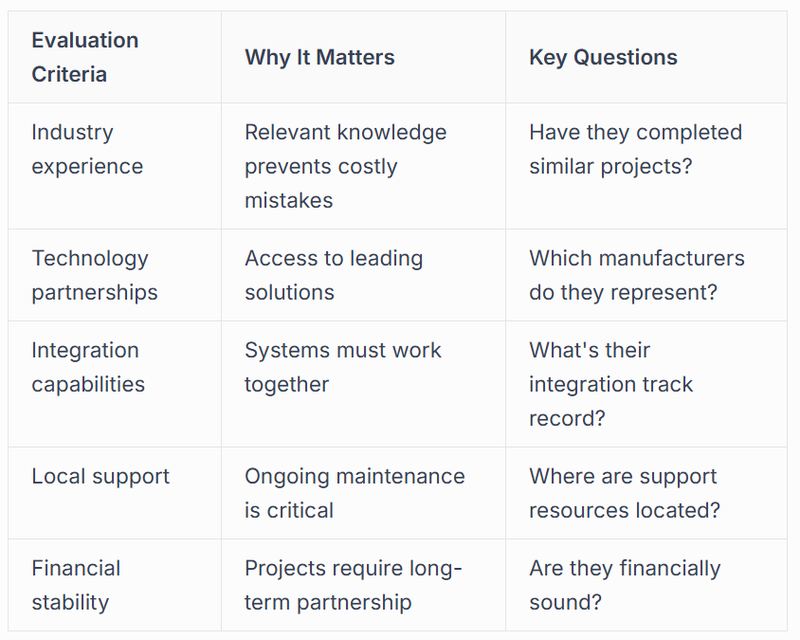
The challenges and benefits of warehouse automation make experienced guidance invaluable throughout the implementation journey.
Measuring Automation Success
Understanding what is warehouse automation includes establishing appropriate metrics to evaluate performance and return on investment. Effective measurement frameworks track both operational and financial outcomes.
Operational Performance Metrics
Key performance indicators include:
- Orders processed per labor hour
- Picking accuracy percentage
- Inventory accuracy rates
- Order cycle time from receipt to shipment
- System uptime and availability
- Space utilization efficiency
- Returns and error rates
Regular monitoring of these metrics identifies optimization opportunities and validates automation benefits.
Financial Performance Tracking
Beyond operational metrics, financial tracking should measure:
- Labor cost per unit - tracking productivity improvements
- Operating cost per order - comprehensive efficiency view
- Inventory carrying costs - reflecting density improvements
- Error and rework costs - capturing quality benefits
- Revenue per square metre - measuring space optimization
These financial metrics demonstrate automation value in terms business leaders understand and support.
Continuous Improvement Processes
Automation implementation doesn't end at go-live. Leading operations establish continuous improvement frameworks that:
- Regularly review performance data
- Identify bottlenecks and constraints
- Test process refinements
- Optimize system parameters
- Train staff on evolving best practices
This ongoing optimization ensures automation investments deliver maximum value throughout their operational lifespan.
What is warehouse automation? It's the strategic integration of robotics, software, and intelligent systems that transforms traditional distribution operations into responsive, efficient fulfillment engines capable of meeting modern supply chain demands. As e-commerce growth accelerates and labor challenges intensify, automation has shifted from competitive advantage to operational necessity. Automate-X combines proven robotics, advanced warehouse software, and comprehensive system integration to help logistics, 3PL, and manufacturing operations throughout New Zealand and Australia achieve their automation goals-whether you're taking initial steps or scaling to the next level of sophistication.