


ASRS Warehouse Guide: Expert Insights for 2026
Share on
Warehouse operations are changing rapidly as automation becomes essential for staying competitive in 2026. Businesses now face increasing pressure to boost throughput, optimise space, and reduce labour costs, all while improving accuracy and efficiency.
The asrs warehouse is at the centre of this transformation, revolutionising inventory management, order fulfilment, and supply chain performance. With demand for smarter, faster solutions on the rise, decision-makers are looking for expert guidance to implement or upgrade automation.
This guide offers the latest insights, trends, and actionable steps for asrs warehouse systems. Explore the fundamentals, benefits, technology options, implementation strategies, future trends, and real-world examples to help you make informed choices for the year ahead.
Understanding ASRS: Fundamentals and Evolution
The asrs warehouse landscape is rapidly changing, driven by the need for speed, accuracy, and efficiency in storage and retrieval. Automated Storage and Retrieval Systems (ASRS) are now at the heart of this transformation, offering businesses the tools to modernise their operations and overcome traditional bottlenecks. From robotics to advanced software, the evolution of asrs warehouse technology is reshaping how goods are managed, stored, and moved.
What is ASRS? Definitions and Core Concepts
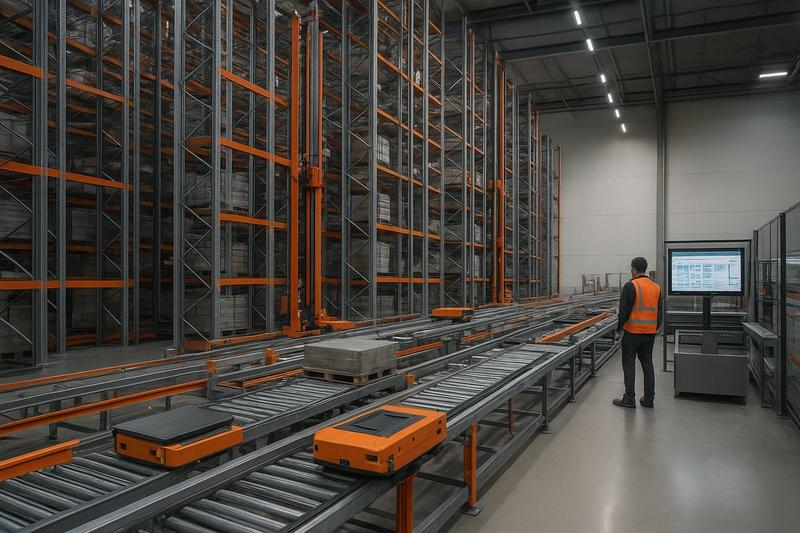
An asrs warehouse system is a fully automated solution designed to handle storage, retrieval, and inventory management tasks with minimal human intervention. These systems use a combination of technology—such as cranes, robotic shuttles, conveyors, and sophisticated warehouse management software—to move goods efficiently within a facility.
Unlike traditional manual or semi-automated setups, an asrs warehouse relies on precise machine control and real-time data to optimise every movement. Core components include unit-load systems for heavy pallets, mini-load systems for totes and cartons, vertical lift modules, and shuttle systems. For example, a unit-load ASRS might use tall cranes to store pallets in high-bay racking, while a shuttle system employs rail-guided robots to move smaller items quickly across multiple levels.
The flexibility and scalability of these systems set them apart, making them suitable for a range of industries and storage needs.
Historical Development and Market Growth
The journey of asrs warehouse technology began in the 1960s, with early mechanical systems that automated basic storage and retrieval. Over time, advances in robotics, software, and sensor technology have driven a shift from manual processes to highly automated, high-bay and robotic solutions.
This evolution has had a profound impact on warehouse design, enabling higher storage density and faster throughput. Market data reflects this trend: the ASRS market was valued at $7.35 billion in 2019 and is forecast to reach $12.9 billion by 2027. According to a recent ASRS market projection, the global ASRS market is expected to hit $14.80 billion by 2030, highlighting the growing adoption rate.
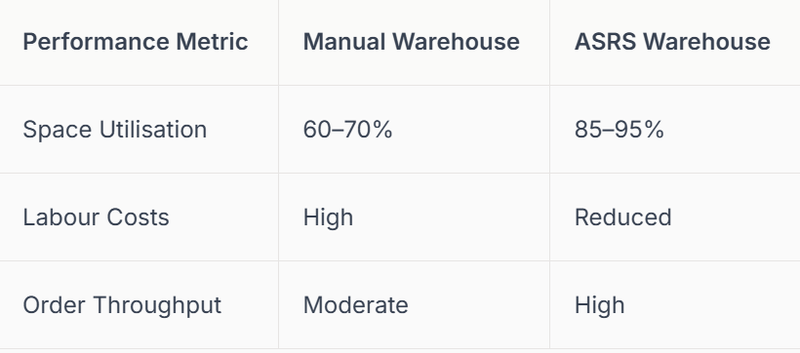
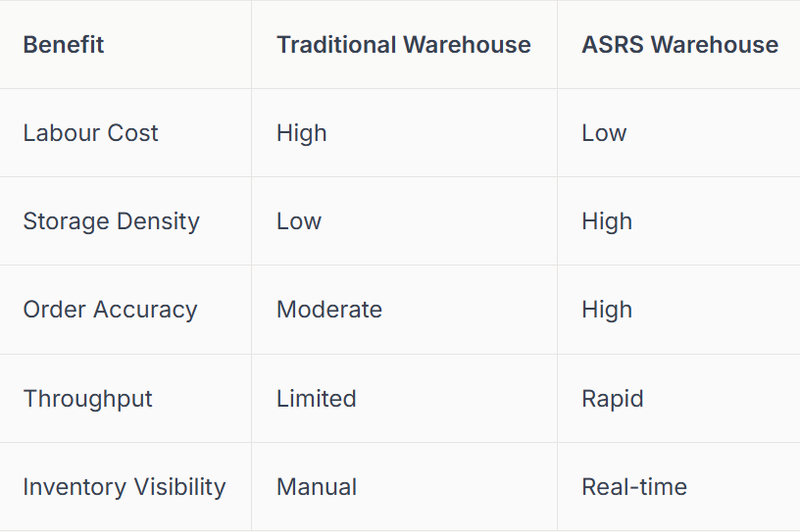
A comparison of manual versus automated warehouses shows significant improvements in space utilisation, labour savings, and order accuracy with ASRS technology.
Key Drivers for ASRS Adoption in 2026
Several factors are accelerating the adoption of asrs warehouse systems in 2026. The explosive growth of e-commerce has led to a surge in SKUs and inventory complexity, making automation essential. Labour shortages and rising wages are pushing businesses to reduce reliance on manual work.
The demand for round-the-clock operations and real-time inventory visibility is also increasing. Regulatory requirements—especially in food, beverage, and pharmaceuticals—necessitate precise tracking and safe handling. Additionally, companies are seeking to improve workplace safety and ergonomics by automating hazardous or repetitive tasks.
These drivers combine to make asrs warehouse solutions not just a competitive advantage but a necessity for modern logistics.
ASRS in Modern Supply Chains
Today, the asrs warehouse is a vital link in agile, data-driven supply chains. Integration with Warehouse Management Systems (WMS) allows for optimised resource allocation, real-time inventory tracking, and seamless order fulfilment.
ASRS technology supports just-in-time manufacturing and lean logistics principles, reducing waste and improving responsiveness. In sectors such as automotive, FMCG, e-commerce, and cold storage, automated solutions enable rapid order turnaround and consistent quality.
The asrs warehouse is no longer a futuristic concept but a proven enabler of operational excellence and long-term business growth.
Types of ASRS Technologies and Configurations
Modern asrs warehouse operations rely on a diverse range of automated storage and retrieval technologies. Each solution is tailored to address specific inventory profiles, throughput needs, and space constraints. Understanding these options empowers logistics leaders to select systems that drive efficiency and future-proof their operations.
Unit-Load ASRS
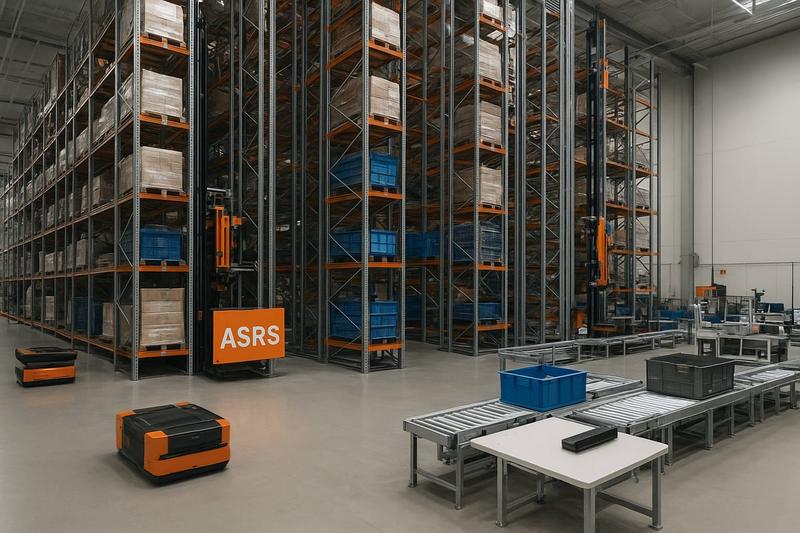
Unit-load asrs warehouse systems are engineered for handling large, heavy pallets, typically ranging from 1,000 to 5,500 lbs. These systems feature tall racking structures, sometimes exceeding 30 metres, maximising vertical storage and optimising warehouse footprints.
Automated cranes, both fixed-aisle and moveable-aisle, retrieve and store pallets with precision. This makes unit-load solutions ideal for environments such as automotive manufacturing and bulk distribution, where high-density storage and fast pallet movement are crucial.
Key benefits include:
- Increased pallet capacity per square metre.
- Reduced manual handling and improved safety.
- Seamless integration with warehouse management systems.
Mini-Load ASRS
Mini-load asrs warehouse solutions focus on lighter loads, such as totes, trays, and cartons, usually up to 34 kilograms. They are perfect for operations with a high number of SKUs and limited floor space, such as e-commerce fulfilment or electronics distribution.
Robotic shuttles and compact cranes move goods quickly and accurately between storage locations and pick stations. These systems excel in environments where picking speed, order accuracy, and space efficiency are top priorities.
Advantages include:
- High SKU density in a small footprint.
- Rapid order picking with minimal errors.
- Adaptability for changing inventory profiles.
Shuttle systems represent a flexible, high-throughput approach for asrs warehouse environments. Multi-level robotic shuttles travel along rails, transporting cartons, trays, or pallets across multiple storage levels.
This configuration enables scalable storage and retrieval, supporting fast-moving consumer goods and retail operations. For businesses seeking advanced shuttle technology, ASRS 4-Way Shuttle Systems offer enhanced flexibility and throughput, adapting to shifting demand and SKU profiles.
Key features:
- Modular, expandable design.
- Simultaneous picking and replenishment.
- High operational speed and accuracy.
Carousel Systems (Horizontal and Vertical)
Carousel systems in an asrs warehouse come in two main forms: horizontal and vertical. Horizontal carousels use rotating bins to present small items directly to pickers, reducing travel time and boosting picking efficiency.
Vertical carousels and vertical lift modules automate the retrieval of trays from tall, enclosed towers, offering ergonomic access and maximising vertical space. These systems are widely used in industries like pharmaceuticals, spare parts, and electronics for secure, efficient storage.
Benefits include:
- Improved picking ergonomics and safety.
- Space savings through vertical storage.
- Enhanced inventory tracking and control.
Cube-Based and Goods-to-Person Systems
Cube-based systems are a breakthrough in asrs warehouse automation. They use a grid-based layout with robot pickers operating on top, delivering bins directly to pick stations.
Goods-to-person systems further streamline order fulfilment by bringing items straight to operators, minimising walking and reducing picking times. These solutions are favoured by e-commerce and third-party logistics providers, where speed and accuracy are essential.
Advantages:
- Dramatically reduced operator travel.
- Scalable, modular design.
- Enhanced order accuracy.
System Configurations for ASRS
The right asrs warehouse configuration depends on operational goals, such as order staging, material storage, or supply replenishment. Systems can be set up for first-in, first-out (FIFO) or last-in, first-out (LIFO) inventory management.
A notable case study from an e-commerce retailer shows capacity doubling after deploying a robotic goods-to-person system. This highlights the importance of aligning configuration with throughput, order accuracy, and inventory turnover needs.
Key considerations:
- Matching configuration to SKU profile.
- Integration with picking and packing workflows.
- Flexibility for future growth.
Integration and Scalability
A hallmark of a future-ready asrs warehouse is its modularity and scalability. Modern systems are designed for phased implementation, allowing businesses to expand capacity as needs evolve.
Integration with existing warehouse infrastructure and management software is seamless, ensuring smooth data flow and coordinated operations. This approach minimises disruption and maximises return on investment.
In summary, selecting the right mix of ASRS technologies and configurations ensures that your asrs warehouse delivers optimal performance, adaptability, and longevity.
Key Benefits and ROI of ASRS Implementation
Warehouses in 2026 face mounting pressure to deliver more with less. The asrs warehouse is at the forefront of this transformation, offering a suite of benefits that help operations leaders meet modern logistics challenges. Here, we explore how implementing ASRS delivers measurable improvements in efficiency, space, accuracy, and long-term value.
Labour Efficiency and Cost Reduction
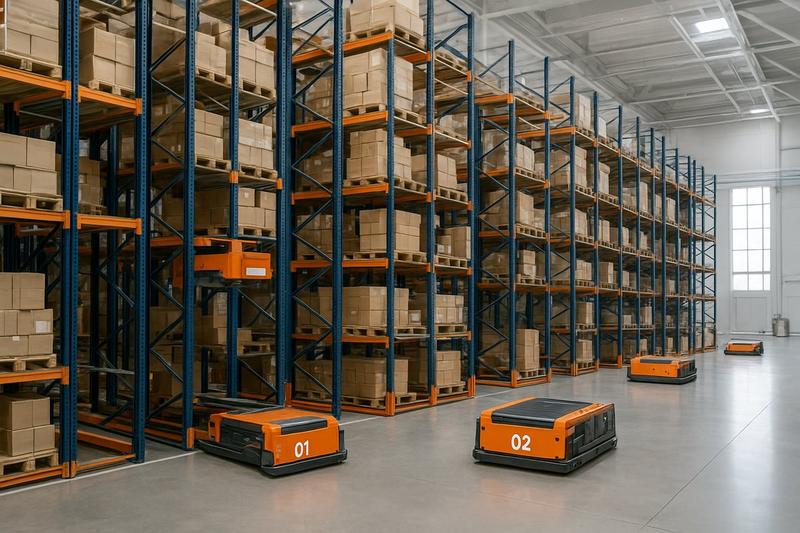
Automating routine storage and retrieval tasks with an asrs warehouse leads to significant labour savings. Manual picking, replenishment, and inventory checks are replaced by automated systems, reducing the need for a large workforce. This is especially valuable in regions facing labour shortages or rising wage costs.
- Routine, repetitive work is automated
- 24/7 operation possible with minimal staff
- Lower risk of errors and workplace injuries
A well-designed asrs warehouse can decrease overall labour costs by up to 50 percent, while also improving staff safety. In environments like cold storage or hazardous materials, automation further limits human exposure to risk, ensuring compliance with safety regulations.
Space optimisation is another critical advantage. ASRS enables vertical storage, maximising cubic capacity and allowing more inventory in a smaller footprint. This not only reduces real estate costs but also supports future growth without major facility expansion.
Throughput, Accuracy, and Order Fulfilment Speed
Speed and accuracy are essential in modern supply chains. An asrs warehouse supports rapid picking, replenishment, and order processing, dramatically boosting throughput. Automated software manages inventory locations and movements, minimising errors and reducing order cycle times.
- Picking and packing times can be halved
- Inventory accuracy rises with automation
- Real-time order tracking and fulfilment
For example, Goods-to-Person Automation Solutions offer fast, accurate order picking by bringing items directly to operators, cutting travel time and improving productivity. This is crucial for e-commerce, FMCG, and third-party logistics providers handling high SKU volumes.
A modern asrs warehouse also enhances inventory visibility. Integrated WMS systems provide real-time stock data, automated expiry tracking, and audit trails, supporting both operational efficiency and regulatory compliance.
Enhanced Safety, Sustainability, and ROI
Safety and ergonomics are greatly improved in an asrs warehouse. Automation reduces manual lifting and repetitive strain, while advanced sensors and controls lower the risk of accidents. This creates a safer, more attractive workplace for staff.
Sustainability is also a growing focus. ASRS systems use energy-efficient motors, lightweight materials, and smart software to manage energy consumption. This can lead to lower utility bills and a smaller carbon footprint.
The return on investment for an asrs warehouse is compelling. Market data shows strong adoption across industries thanks to clear, measurable gains in efficiency, accuracy, and capacity. Businesses that invest in automation today gain a strategic edge, ready to adapt to future demands and market shifts.
Step-by-Step Guide to Planning and Implementing ASRS in 2026
Embarking on an asrs warehouse project requires careful planning, strategic decision-making, and a structured approach. In this section, we break down each critical step, ensuring your warehouse automation journey in 2026 is efficient, future-proof, and delivers measurable value.

Step 1: Assessing Warehouse Needs and Readiness
Begin by conducting a detailed audit of your current asrs warehouse operations. Identify pain points, such as space constraints, labour shortages, or frequent order errors.
Evaluate your SKU profiles, order volumes, and projected growth. This foundational analysis ensures you understand where automation will deliver the most impact and sets the stage for a tailored solution.
Step 2: Defining Project Goals and Success Metrics
Set clear, measurable objectives for your asrs warehouse project. For example, your goals might include increasing storage density, reducing labour costs, or improving order accuracy.
Establish key performance indicators (KPIs), such as throughput rates, picking error percentages, or average pick times. These metrics will help you track progress and demonstrate ROI as your project unfolds.
Step 3: Selecting the Right ASRS Technology and Configuration
Choosing the appropriate technology is crucial for asrs warehouse success. Match solution types, such as unit-load cranes, mini-load systems, shuttles, or carousels, to your operational needs.
Consider scalability, integration capabilities, and future expansion. For an in-depth comparison of available solutions, explore Order Picking System Options for 2026, which outlines essential criteria for modern warehouses.
Step 4: Partnering with Experienced ASRS Solution Providers
Selecting the right technology partner is just as important as the system itself. Look for providers with proven experience in your sector and a strong track record of asrs warehouse implementations.
Assess their ability to customise solutions, provide ongoing support, and offer robust after-sales service. End-to-end providers who handle robotics, software, and integration can simplify your rollout and optimise long-term performance.
Step 5: System Design, Simulation, and ROI Analysis
Leverage digital twins and simulation tools to design your asrs warehouse system. Model workflows, test alternative layouts, and forecast performance before committing to physical changes.
Calculate total cost of ownership, payback periods, and projected ROI. Planning for phased implementation can minimise disruption and allow your team to adapt gradually.
Step 6: Implementation and Change Management
Develop a comprehensive rollout plan with clear milestones and timelines for your asrs warehouse deployment. Train staff on new systems and safety procedures, ensuring everyone understands the benefits.
Effective communication and change management are vital for staff buy-in and smooth transitions. Address concerns early and celebrate milestones as you progress.
Step 7: Integration, Testing, and Optimisation
Integrate your asrs warehouse with existing WMS, WCS, and other technologies. Conduct thorough system testing, fine-tune processes, and benchmark performance against your KPIs.
Establish ongoing maintenance and continuous improvement routines. Regular reviews will help you adapt to changing business needs and keep your automation investment delivering value.
A structured approach to asrs warehouse planning and implementation not only reduces risk but also maximises efficiency, scalability, and ROI. By following these steps, you equip your operation for success in 2026 and beyond.
Future Trends and Innovations in ASRS for 2026 and Beyond
The pace of innovation within the asrs warehouse landscape is accelerating, with new technologies redefining what is possible in modern logistics. As warehouses look ahead to 2026 and beyond, several transformative trends are shaping the future of storage, retrieval, and automation. In this section, we explore the most significant advancements and what they mean for operational leaders.
High-Density Automated Warehouses | AS/RS
Robotics and Artificial Intelligence in ASRS
Robotics and artificial intelligence are at the forefront of asrs warehouse evolution. AI-driven robots are now capable of adaptive picking and replenishment, learning from past movements to optimise future tasks. Machine learning algorithms enable predictive maintenance, reducing unplanned downtime and boosting reliability. Real-world examples, such as Case study: Besli's ASRS implementation, illustrate how smart robotics can transform warehouse efficiency.
Autonomous mobile robots (AMRs) and robotic shuttles provide flexibility, allowing the asrs warehouse to scale operations quickly. Intelligent vision systems enhance accuracy and enable robots to handle a broader range of SKUs, further improving order fulfilment and customer satisfaction.
Advanced Software and Data Analytics
Software innovation is powering the next generation of asrs warehouse systems. Real-time analytics platforms now monitor inventory, throughput, and bottlenecks, enabling proactive decision-making. Integration with IoT devices gives warehouse managers full visibility across assets, from temperature sensors in cold storage to automated guided vehicles.
WMS and WCS software are increasingly cloud-based, supporting remote management and continuous updates. By leveraging data-driven insights, asrs warehouse operators can fine-tune workflows, allocate resources efficiently, and respond rapidly to changing demand patterns.
Modular, Scalable, and Flexible Systems
Modularity is a defining feature of the future asrs warehouse. Operators favour plug-and-play components that allow for rapid deployment and easy upgrades. Modular designs make it possible to expand capacity in phases, aligning investment with business growth.
Flexible system architectures support a mix of unit-load, mini-load, and shuttle technologies within the same facility. This adaptability ensures that the asrs warehouse remains future-ready, capable of integrating new automation technologies without major overhauls.
Sustainability and Green Warehousing
Sustainability is becoming a non-negotiable priority for the asrs warehouse sector. Eco-friendly materials and energy-efficient drives are now standard in new installations. Intelligent software controls energy use, optimising startup timing to avoid costly peaks and reduce overall consumption.
LED lighting, lightweight shuttle designs, and regenerative braking systems further lower the environmental footprint. These green initiatives position the asrs warehouse as a key contributor to corporate sustainability goals, appealing to environmentally conscious clients and regulators.
Industry-Specific Innovations
Different industries are adopting bespoke asrs warehouse solutions to meet unique operational needs. In cold storage, systems are engineered for sub-zero environments, featuring insulated shuttles and frost-resistant robotics. Pharmaceutical warehouses benefit from enhanced traceability, with automated systems ensuring strict compliance and secure storage.
Food and beverage facilities use asrs warehouse technology for automated expiry tracking and allergen control. Automotive and manufacturing sectors rely on just-in-time inventory delivery, leveraging automation for precision and speed in high-volume operations.
Human-Robot Collaboration and Safety Enhancements
Human-robot collaboration is redefining workplace safety and productivity in the asrs warehouse. Collaborative robots (cobots) work alongside staff, handling repetitive or hazardous tasks while humans focus on complex problem-solving. Enhanced safety systems, such as light curtains and proximity sensors, safeguard both people and equipment.
Training and change management are crucial, ensuring that staff remain engaged and confident in their evolving roles. These collaborative environments foster innovation and continuous improvement, making the asrs warehouse a more attractive place to work.
Global Trends and Regional Insights
Global adoption rates of asrs warehouse technology are rising, particularly in APAC, Europe, and North America. High-bay warehouses and e-commerce fulfilment centres are leading investment, seeking higher throughput and efficiency. Industry research, such as the ASRS market analysis and forecast 2025–2034, highlights strong growth drivers, including e-commerce expansion and labour shortages.
Regional case studies show how local regulations, supply chain demands, and customer expectations shape asrs warehouse innovation. By staying ahead of these trends, logistics leaders can position their operations for long-term success.
Real-World Applications and Success Stories
In today’s fast-paced logistics environment, the asrs warehouse is not just a theoretical advancement. Real-world deployments across major industries are delivering measurable improvements in efficiency, safety, and business growth. This section highlights how leading organisations leverage asrs warehouse technology to transform their operations, boost key metrics, and set new standards for best practice.
Sector-Specific Implementations
The asrs warehouse is making a significant impact across various sectors. In e-commerce, goods-to-person ASRS solutions have enabled companies to double their warehouse capacity and fulfil orders with remarkable speed. Food and beverage businesses benefit from automated expiry tracking and high-throughput order fulfilment, ensuring products remain fresh and compliant.
Pharmaceutical firms utilise secure, traceable storage and retrieval systems for sensitive inventory, maintaining strict regulatory standards. Automotive manufacturers rely on just-in-time manufacturing and high-density parts storage, streamlining production lines and minimising downtime.
A notable example of successful ASRS deployment in bulk storage can be seen in the Davis Automated Bulk Pallet Storage Case Study, which demonstrates how advanced automation solutions deliver increased throughput and operational resilience.
Measurable Outcomes and KPIs
Implementing an asrs warehouse brings tangible, trackable benefits. Companies report significant increases in storage density, particularly when using vertical expansion to reduce overall warehouse footprint. Throughput improvements are common, with some operations seeing up to 50 percent faster picking and packing compared to manual methods.
Key performance indicators (KPIs) used to measure success include:
- Storage capacity before and after ASRS implementation
- Order fulfilment speed and accuracy rates
- Labour cost reductions due to automation
- Safety incident frequency and severity
A table below summarises typical improvements:
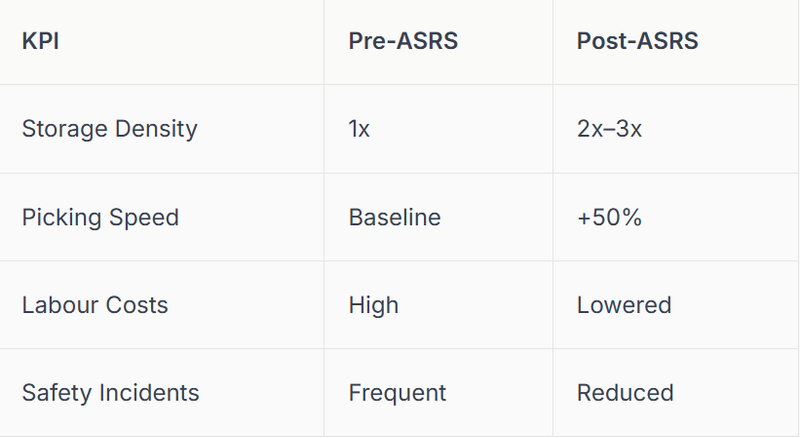
These results highlight why the asrs warehouse is increasingly seen as a strategic investment for future-ready supply chains.
Lessons Learned and Best Practices
Experience shows that successful asrs warehouse projects depend on several best practices. Thorough planning and phased rollouts help businesses minimise disruption and manage risks. Continuous improvement, including regular system optimisation, ensures the technology delivers sustained value.
Change management is critical. Engaging staff early, providing robust training, and communicating the benefits of automation all contribute to smoother adoption and higher morale. Insights from projects like the Planning and implementing ASRS at University of Limerick reveal the importance of addressing operational challenges and aligning technology with business goals.
Ultimately, organisations that invest in robust planning, embrace innovation, and foster a culture of adaptation are best positioned to maximise the potential of asrs warehouse technology.
As you look ahead to 2026 and consider the rapid changes in warehouse technology, it’s clear that automation is no longer a luxury—it’s essential for staying competitive and meeting rising demand. With ASRS solutions, you gain the ability to optimise space, boost accuracy, and reduce labour costs, all while future proofing your operations for scalable growth. If you’re ready to put expert insights into action and streamline your warehouse for the challenges ahead, now’s the perfect time to take the next step.