

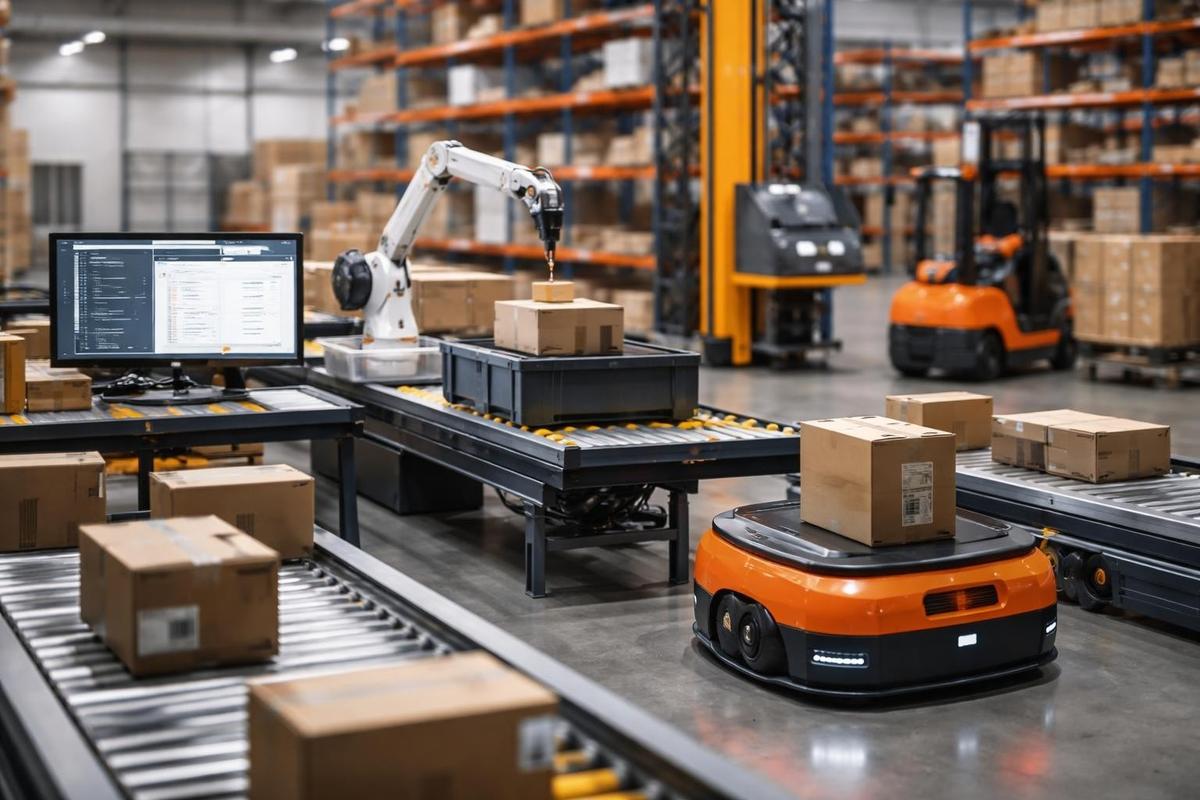
Automate Warehousing: Complete Guide for 2026
Share on
The pressure to deliver faster, manage tighter margins, and scale operations efficiently has never been greater for logistics and supply chain businesses. Traditional manual warehousing simply cannot keep pace with rising order volumes, labour shortages, and customer expectations for same-day or next-day delivery. To remain competitive, organisations across 3PL, e-commerce, manufacturing, and FMCG sectors are turning to intelligent automation solutions that fundamentally transform how warehouses operate. When you automate warehousing processes, you unlock significant improvements in accuracy, throughput, and operational resilience whilst reducing long-term costs and workplace injuries.
Understanding Modern Warehouse Automation
Modern warehouse automation extends far beyond simple conveyor systems or forklifts. Today's solutions integrate robotics, artificial intelligence, warehouse management systems, and Internet of Things sensors to create intelligent, self-optimising operations.
The scope of automation encompasses several critical areas. Goods-to-person systems bring products directly to picking stations, eliminating unproductive walking time. Autonomous mobile robots transport materials throughout facilities without fixed infrastructure. Automated storage and retrieval systems maximise vertical space whilst improving inventory accuracy. Intelligent software platforms orchestrate these physical systems, making real-time decisions about optimal routing, resource allocation, and task prioritisation.
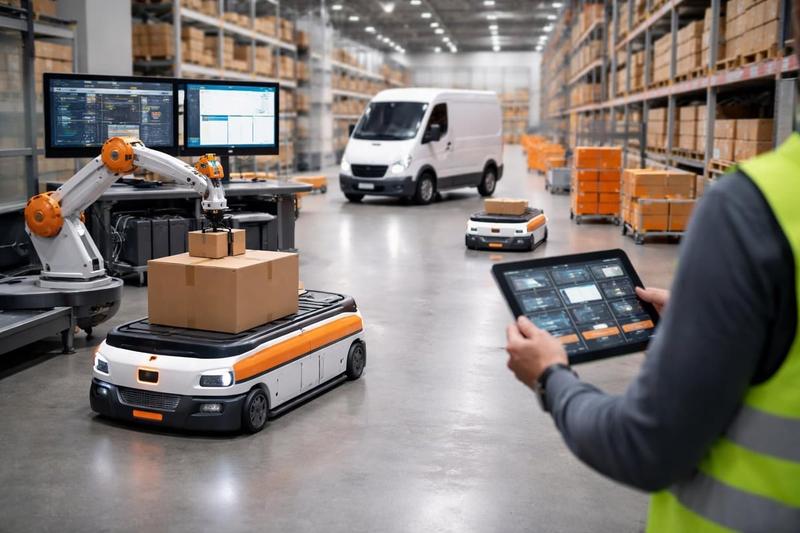
When businesses automate warehousing operations, they typically see immediate improvements across multiple performance metrics. According to market research, the global warehouse automation sector is projected to reach USD 41,256.04 million by 2028, driven by organisations seeking to enhance operational efficiency and mitigate labour cost pressures.
Key Technologies Driving Automation
Several technological advances have converged to make warehouse automation more accessible and effective:
- Robotic arms with advanced vision systems can identify, grasp, and manipulate diverse product types
- Collaborative robots (cobots) work safely alongside human operators without extensive safety caging
- Autonomous mobile robots (AMRs) navigate dynamically using sensors and mapping technology
- Warehouse execution systems (WES) provide real-time orchestration across multiple automation technologies
- Cloud-based platforms enable rapid deployment and centralised management across multiple facilities
Recent developments in machine learning have achieved a 20% reduction in pick failure rates in large-scale robotic warehouse fleets, demonstrating how software intelligence amplifies hardware capabilities.
Strategic Benefits of Warehouse Automation
The decision to automate warehousing delivers advantages that extend throughout the entire supply chain ecosystem. These benefits accumulate over time, creating compounding returns on automation investments.
Operational Efficiency and Throughput
Automated systems operate continuously with consistent performance levels. Unlike manual operations affected by fatigue, shift changes, or training variations, robotic systems maintain steady throughput rates around the clock.
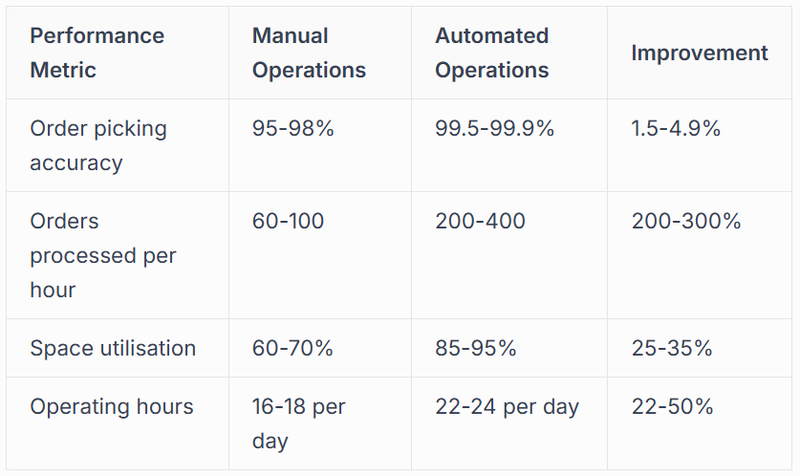
These efficiency gains translate directly to faster order fulfilment, reduced customer wait times, and the capacity to handle peak demand periods without temporary labour scaling.
Labour Optimisation and Safety
Warehouse automation addresses two of the industry's most pressing challenges: labour availability and workplace safety. Rather than replacing workers entirely, automation typically redeploys staff to higher-value activities requiring human judgment and problem-solving capabilities.
Repetitive tasks like picking, packing, and transporting heavy items contribute significantly to workplace injuries. When you automate warehousing functions involving repetitive motion or heavy lifting, you reduce injury rates whilst simultaneously improving employee satisfaction through more engaging work assignments.
Amazon's expansion of warehouse robotics has focused specifically on technologies that reduce worker injuries whilst enhancing operational efficiency through robotic arms and autonomous carts.
Scalability and Flexibility
Modern automation solutions offer modular architectures that grow with your business requirements. Starting with a focused automation deployment in high-volume picking operations allows organisations to validate ROI before expanding to additional processes.
The ability to rapidly reconfigure automated systems supports seasonal fluctuations, product line changes, and facility expansions without the lengthy onboarding periods required for manual workforce scaling. This flexibility proves particularly valuable for e-commerce and 3PL operations experiencing volatile demand patterns.
Implementation Approaches for Different Operations
Successfully implementing warehouse automation requires matching technology capabilities to specific operational requirements, facility constraints, and business objectives.
Starting Small with Targeted Automation
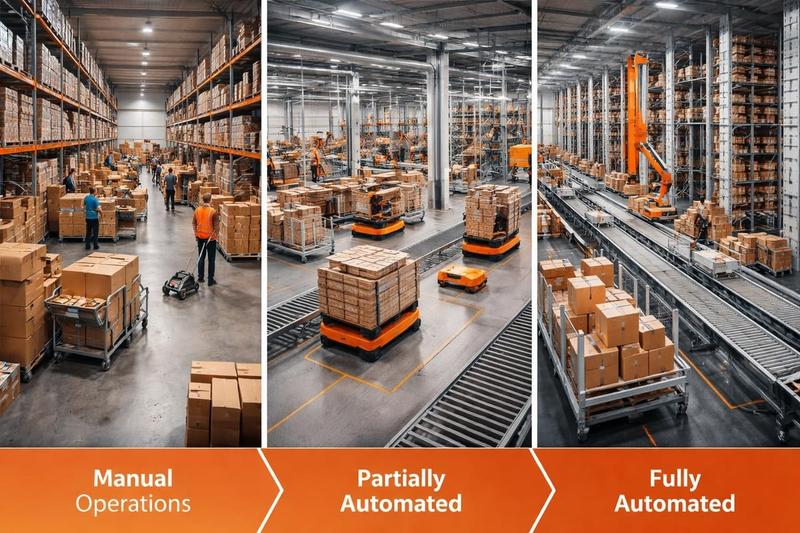
Many organisations achieve the best outcomes by beginning with focused automation in specific high-impact areas rather than attempting facility-wide transformation immediately.
Picking automation delivers some of the fastest returns because picking typically represents 50-60% of warehouse labour costs. Goods-to-person systems, pick-to-light technologies, and collaborative mobile robots can dramatically improve picking productivity whilst reducing training requirements.
For businesses exploring how to automate warehousing without massive capital commitments, modular solutions provide an accessible entry point. The Automate-X GTP Starter Grid offers small and medium enterprises in Australia and New Zealand a practical pathway to begin their automation journey with goods-to-person technology that doesn't require complete facility reconfiguration.
Integration with Existing Systems
Successful automation projects require seamless integration between new robotic systems and existing warehouse management software, enterprise resource planning platforms, and transportation management systems.
Modern warehouse execution systems serve as the orchestration layer, translating high-level orders from WMS platforms into specific robotic tasks whilst monitoring performance and managing exceptions. This middleware approach allows organisations to automate warehousing operations whilst preserving investments in existing software infrastructure.
Research into robotic mobile fulfillment systems demonstrates that optimised station configurations can reduce robot requirements and order turnover time, highlighting the importance of thoughtful system design beyond simply adding robotic units.
Industry-Specific Considerations
Different sectors require tailored automation approaches based on unique operational characteristics:
- E-commerce and 3PL operations prioritise flexibility and peak capacity handling for variable SKU profiles
- FMCG and food & beverage facilities require food-safe materials, temperature control, and high-velocity throughput
- Pharmaceutical warehousing demands serialisation, chain-of-custody tracking, and contamination prevention
- Cold storage operations need robotics designed for temperature extremes and energy efficiency
Understanding these sector-specific requirements ensures automation investments deliver maximum value within your operational context. Resources like those exploring automation's role in transforming logistics provide valuable insights into industry-wide trends affecting warehouse operations.
Technology Selection and ROI Considerations
Choosing the right automation technologies requires balancing immediate capabilities against long-term scalability, total cost of ownership, and alignment with strategic business objectives.
Evaluating Automation Technologies
Not all automation solutions suit every operation. The optimal technology mix depends on multiple factors:
- Order profile characteristics: SKU count, order size distribution, and velocity patterns
- Facility constraints: Building dimensions, floor loading capacity, and expansion possibilities
- Product attributes: Size, weight, fragility, and handling requirements
- Volume projections: Current throughput and anticipated growth trajectories
- Integration requirements: Compatibility with existing systems and processes
When businesses automate warehousing operations, conducting thorough analysis of these factors prevents costly mismatches between technology capabilities and operational needs.
Calculating Return on Investment
Comprehensive ROI analysis extends beyond simple payback periods to encompass total value creation:
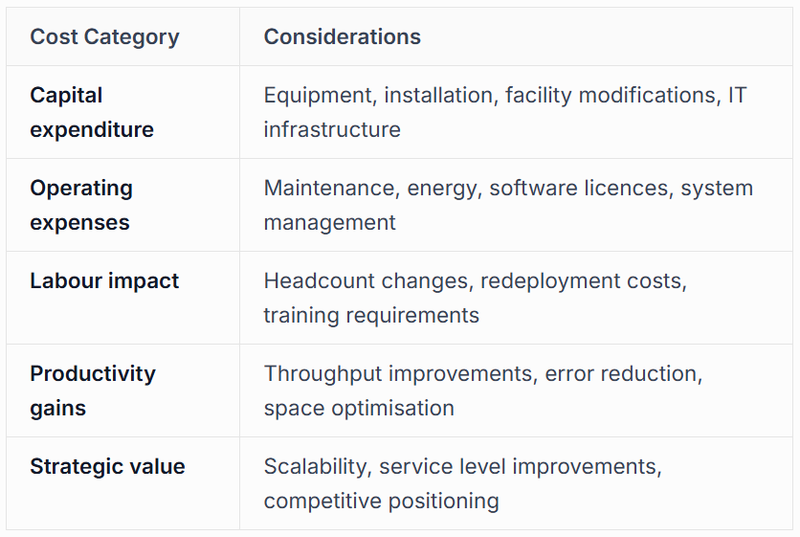
Most warehouse automation projects targeting high-volume operations achieve payback within 18-36 months, with some goods-to-person implementations delivering returns in under 18 months when labour savings and throughput gains are substantial.
Managing Implementation Risk
Successful automation projects manage risk through phased deployment, comprehensive testing, and stakeholder engagement throughout the implementation lifecycle.
Pilot programmes validate technology performance in actual operating conditions before full-scale rollout. Simulation modelling identifies potential bottlenecks and optimises system configurations before physical installation. Change management processes ensure workforce readiness and buy-in across operational teams.
Organisations should also consider vendor stability, local support availability, and upgrade pathways when selecting automation partners. The decision to automate warehousing represents a multi-year commitment requiring ongoing collaboration with technology providers.
Advanced Automation Capabilities
Leading-edge warehouse automation now incorporates artificial intelligence, advanced sensors, and sophisticated orchestration algorithms that continuously optimise operations.
Artificial Intelligence and Machine Learning
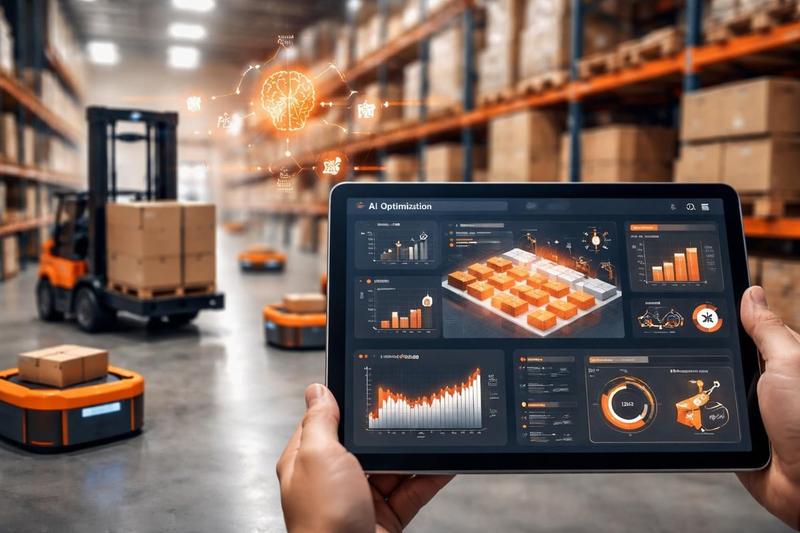
AI-powered systems analyse historical patterns and real-time conditions to make intelligent decisions about task allocation, robot routing, and inventory positioning.
Predictive maintenance algorithms analyse sensor data to identify potential equipment failures before they occur, reducing unplanned downtime. Dynamic slotting optimisation continuously adjusts product locations based on velocity changes and order patterns. Intelligent task interleaving maximises robot utilisation by combining multiple tasks into efficient sequences.
These capabilities transform automation from fixed-logic systems into adaptive platforms that improve performance over time through continuous learning.
Sensory Technology and Physical Intelligence
Recent advances in tactile sensing and physical manipulation expand the range of products and tasks suitable for automation. Research into Tactile Mobile Manipulators demonstrates how integrating tactile sensors with mobile robots improves handling of diverse products in cooperative transportation tasks.
This enhanced physical intelligence allows automated systems to handle products previously requiring human dexterity, expanding automation applicability across broader SKU ranges including fragile, irregular, or deformable items.
Digital Twin Technology
Digital twins create virtual replicas of physical warehouse operations, enabling simulation, optimisation, and testing without disrupting actual operations. Facilities can model different automation configurations, test new processes, or train staff using accurate virtual environments.
IoT-based testbeds for cyber-physical systems demonstrate frameworks for evaluating warehouse automation technologies in controlled environments before deployment, reducing implementation risk and accelerating time-to-value.
Building the Business Case
Securing organisational support and investment for warehouse automation requires compelling business cases that address financial, operational, and strategic dimensions.
Quantifying the Opportunity
Start by documenting current performance baselines across relevant metrics: labour costs, throughput capacity, accuracy rates, space utilisation, and customer service levels. Identify specific pain points where manual operations create bottlenecks, errors, or constraints on business growth.
When you automate warehousing operations, improvements typically manifest across multiple areas simultaneously:
- Direct labour cost reduction through productivity improvements and task automation
- Improved accuracy reducing returns, rework, and customer service costs
- Enhanced throughput enabling revenue growth without proportional facility expansion
- Better space utilisation deferring or eliminating expensive facility expansion projects
- Service level improvements supporting premium pricing and customer retention
Addressing Stakeholder Concerns
Different stakeholder groups focus on distinct aspects of automation initiatives. Financial executives prioritise ROI, payback periods, and cash flow implications. Operations leaders emphasise reliability, flexibility, and performance improvements. Workforce representatives value job security, training opportunities, and workplace safety.
Successful business cases address each perspective with relevant data and mitigation strategies for identified concerns. Emphasising workforce redeployment to higher-value roles rather than headcount reduction often generates broader organisational support.
Learning from Implementation Examples
Examining real-world automation deployments provides valuable insights into practical implementation approaches and achievable outcomes. Warehouse automation case studies across various industries demonstrate diverse solution configurations and results, whilst global implementation projects showcase proven approaches across different operational scales and complexities.
These references help organisations benchmark expectations, identify potential challenges, and refine implementation strategies based on lessons learned from comparable deployments.
Future Trends Shaping Warehouse Automation
The warehouse automation landscape continues evolving rapidly as emerging technologies mature and operational requirements become more demanding.
Autonomous Coordination and Swarm Intelligence
Next-generation systems employ decentralised decision-making where individual robots coordinate autonomously rather than relying entirely on centralised control systems. This swarm intelligence approach improves resilience, scalability, and responsiveness to dynamic conditions.
Sustainability and Energy Efficiency
Environmental considerations increasingly influence automation decisions. Energy-efficient robotics, regenerative braking systems, and optimised routing algorithms reduce operational carbon footprints whilst lowering utility costs. Cold storage operations particularly benefit from automation solutions that minimise door openings and optimise temperature management.
Hybrid Human-Robot Collaboration
Rather than viewing automation as human replacement, leading approaches focus on optimal collaboration between human capabilities and robotic precision. Augmented reality systems guide workers through complex tasks, whilst cobots handle physically demanding components of shared workflows.
The ability to automate warehousing selectively, preserving human involvement where judgment and adaptability add value, creates more resilient and flexible operations than either fully manual or fully automated extremes.
Modern warehouse operations demand levels of speed, accuracy, and scalability that manual processes simply cannot sustain in today's competitive logistics environment. By strategically implementing automation technologies matched to your specific operational requirements, you can dramatically improve performance whilst building foundations for long-term growth and adaptability. Automate-X combines advanced robotics, intelligent software, and expert system integration to help logistics and supply chain businesses across Australia and New Zealand transform their warehouse operations with proven automation solutions tailored to your industry and growth objectives.