

Meet Gino 1: The World's First "Warehouse-Native" Humanoid Robot Geek+
Share on
For the last decade, the conversation around warehouse automation in New Zealand and Australia has focused almost entirely on mobility. We have watched Automated Guided Vehicles (AGVs) and Autonomous Mobile Robots (AMRs) revolutionize how goods move across the warehouse floor.
But despite these massive leaps in warehouse automation solutions, a glaring gap has remained. When an AMR brings a shelf to a packing station, who—or what—physically picks the item off that shelf?
While we have successfully deployed robotic arm picking stations for high-volume, uniform goods, the complex, messy reality of handling mixed SKUs and unpredictable packaging has largely remained a manual task. In fact, industry data shows that highly flexible operations like order picking and putaway still account for over 50% of operating costs in modern warehouses.
That changes today.
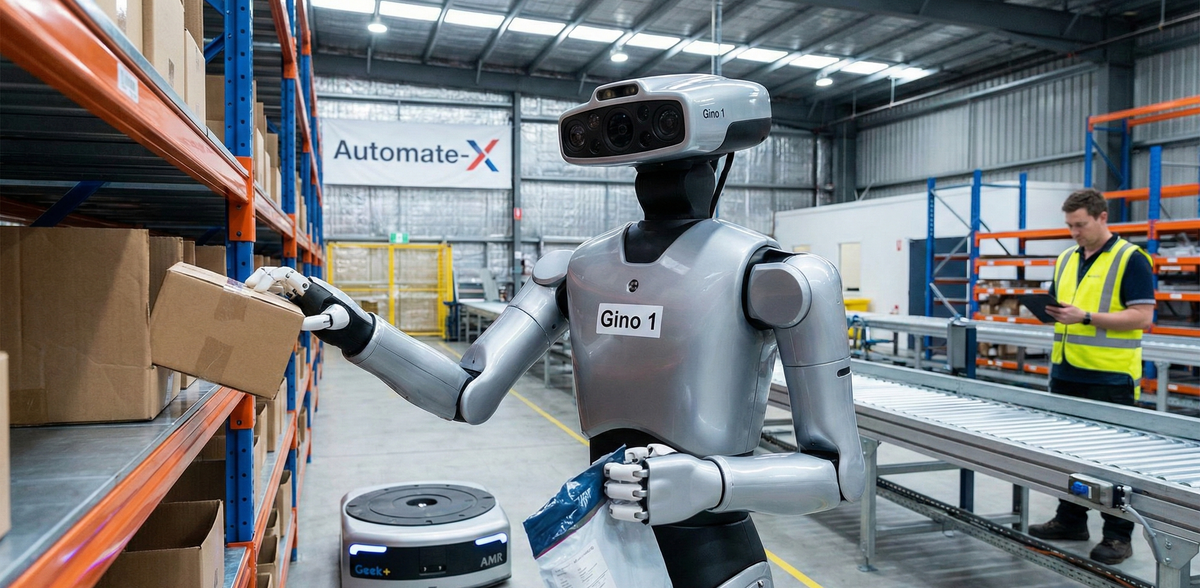
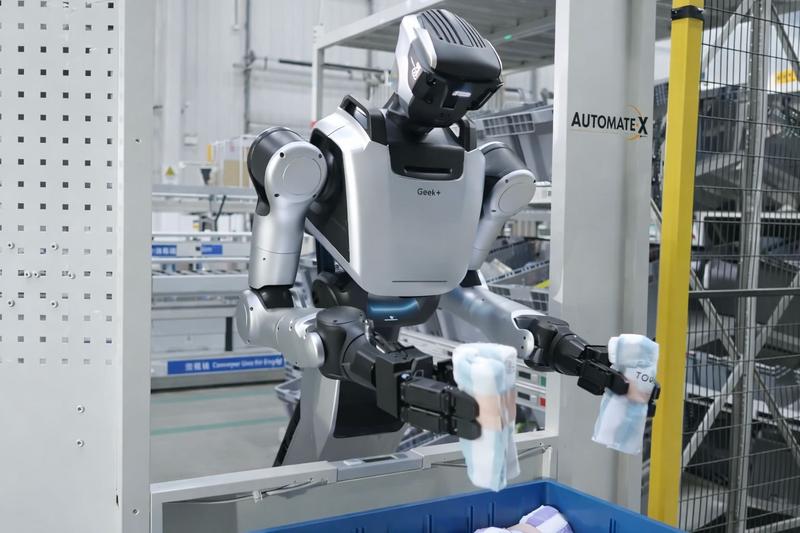
Our technology partner, Geek+, has officially unveiled Gino 1 (W-02590), the world’s first general-purpose humanoid robot built specifically for logistics. At Automate-X, we believe this is the missing link that finally bridges the gap between automated transport and fully unmanned fulfilment.
The Missing Link in the Modern Distribution Centre
Currently, many facilities operate on a split model: robots handle 60% of the work (moving pallets and totes), while humans handle the remaining 40% (the dexterous picking, sorting, and packing).
Traditional industrial robots are often essentially disembodied arms bolted to a floor. They are highly efficient but lack versatility. If a conveyor belt backs up or a box is slightly crushed, a traditional robotic arm throws an error code and stops.
Gino 1 is designed to be "warehouse-native." It wasn't built to be a generic research project; it was built to work a shift. It steps directly into the workflows designed for humans, eliminating the need for expensive, facility-wide retrofits.
Under the Hood: What Makes Gino 1 Different?
We’ve all seen viral videos of back-flipping robots. While impressive, acrobatic feats do not pick orders in a distribution centre in South Auckland or Western Sydney. Gino 1 is engineered strictly for industrial productivity, boasting a fully self-developed hardware stack that addresses the most painful bottlenecks in logistics.
Dexterous Manipulation for Mixed SKUs
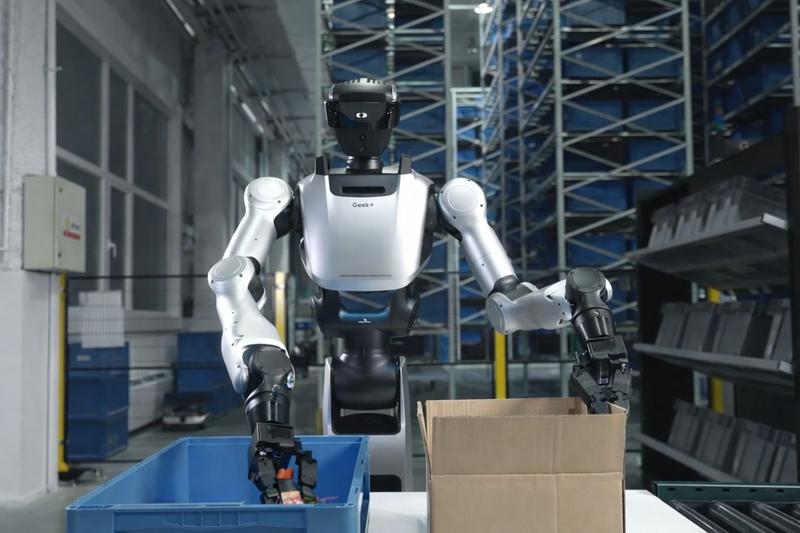
The end of the Gino 1 robot arm is equipped with a three-finger dexterous hand featuring seven active degrees of freedom. This allows it to balance gripping flexibility with sheer reliability, meaning it can handle everything from rigid cardboard boxes to shapeless polybags.
Furthermore, the robot features two 14-degree-of-freedom arms with full-joint force control. This ensures it doesn't crush fragile items and can safely interact with its environment. With a maximum load capacity of 20 kg per arm, it comfortably meets the payload requirements for standard warehouse operations.
Multi-Dimensional Visual Intelligence
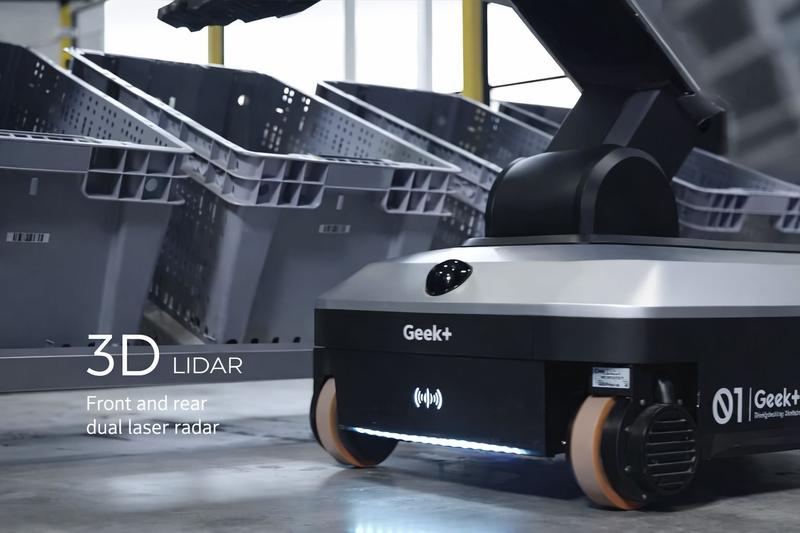
A warehouse is a highly dynamic environment. To navigate it, the Gino 1 head is equipped with a triple-eye primary vision system combined with front-and-back fisheye cameras. This grants the robot 360-degree environmental awareness.
It doesn't stop there. The robot also features a binocular camera built directly into the palm of its hand, alongside tactile sensors. This multi-eye vision provides the precise, close-range object recognition required to identify barcodes, verify SKUs, and perform visual quality inspections on the fly.
The "Geek+ Brain" and VLA Architecture
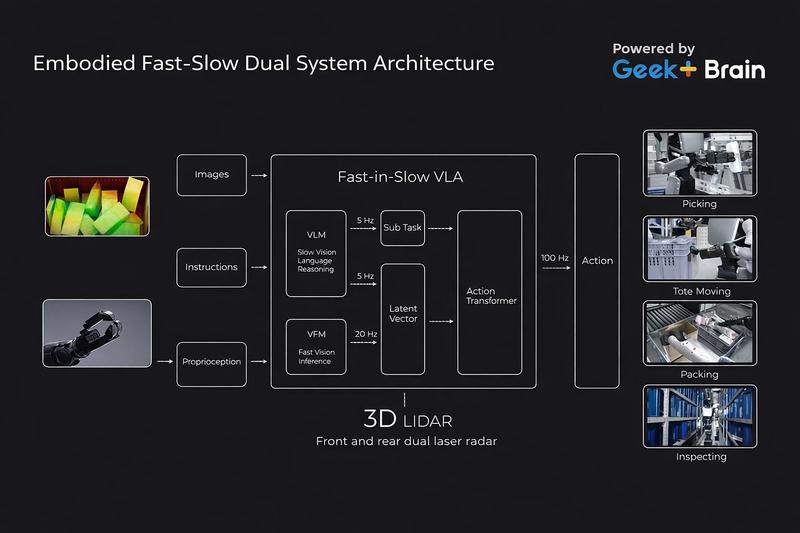
Hardware is useless without intelligence. Gino 1 is powered by the Geek+ Brain, an embodied intelligence system trained on petabytes of real-world logistics data and large-scale simulations.
It operates on a Vision-Language-Action (VLA) fast-slow collaborative cognitive architecture. In simple terms: it uses "slow" thinking to plan high-level tasks (like determining the most efficient picking route) and "fast" thinking to execute real-time physical movements (like adjusting its grip if an item starts to slip).
Solving the ANZ Labour and Safety Crisis
Our region faces a unique set of macroeconomic challenges. With aging populations, a persistent labour shortage, and high wage costs, finding staff for repetitive, physically demanding roles is becoming harder every year. Here is how humanoid automation addresses the local landscape:
Redeploying the Human Workforce
Gino 1 allows local businesses to automate core, monotonous tasks—such as single-item picking, box handling, and container unloading. This isn't about eliminating jobs wholesale; it is about shifting humans away from monotonous strain. As we integrate these systems, we see entry-level manual roles transition into technical and supervisory roles. Human workers become "fleet managers," overseeing the robots and focusing on complex problem-solving.
Eradicating Workplace Injuries
In New Zealand and Australia, we adhere to some of the strictest safety standards in the world. Manual handling, repetitive lifting, and navigating crowded warehouse aisles are leading causes of musculoskeletal injuries and costly workers' compensation claims.
The Gino 1 is designed to collaborate safely alongside humans, meeting the strict intent of ISO 10218-1 standards for industrial robots. By absorbing the physical toll of warehouse logistics, humanoid robots directly support the safety mandates of organizations like WorkSafe NZ and Safe Work Australia.
Seamless Integration: The Multi-Agent Ecosystem
The true power of Gino 1 lies in its interoperability. The era of siloed automation is over. As your local experts in system integration, Automate-X does not just drop a robot into your facility and walk away; we orchestrate an ecosystem.
Geek+ has outlined a blueprint for "multi-agent full-domain collaboration." This means we can deploy Gino 1 to work seamlessly in concert with your existing fleet of P-Series or RoboShuttle AMRs.
- The Legs: The AMR clusters handle the mobile operations, retrieving inventory and moving it across the facility.
- The Hands: Gino 1 acts as the operational intelligence, taking over the flexible, high-complexity picking and packing tasks.
All of this is synchronized through a single Warehouse Execution System (WES), creating an uninterrupted flow of data and physical goods.
The Future is Collaborative
The launch of Gino 1 signals a critical transition in our industry: from "mobile intelligence" (moving things) to "operational intelligence" (doing things). Most importantly, this is not prototype technology. Gino 1 has mature mass-production capabilities and is designed for immediate, commercially viable deployment with a rapid Return on Investment (ROI).
For logistics providers, retailers, and manufacturers looking to future-proof their supply chains, the question is no longer if humanoid robots will enter the warehouse, but how soon you can integrate them to gain a competitive edge.
The technology to achieve a truly unmanned, 24/7 fulfilment centre is finally here.
Contact Automate-X today to schedule a consultation and discuss how humanoid robotics can fit into your facility's long-term automation strategy.