


Productivity Automation for Modern Warehouses
Share on
The modern warehouse faces unprecedented pressure to deliver faster, more accurately, and at lower costs than ever before. As e-commerce growth continues to reshape distribution requirements and labour shortages persist across logistics operations, businesses are increasingly turning to technology-driven solutions that fundamentally transform how work gets done. Productivity automation represents a strategic shift from manual, repetitive processes to intelligent, integrated systems that maximize output while minimizing errors and operational costs. For logistics and supply chain operations across Australia and New Zealand, understanding and implementing these automated solutions has become essential for maintaining competitive advantage and supporting sustainable growth.
Understanding Productivity Automation in Warehouse Environments
Productivity automation encompasses the strategic deployment of technology to execute tasks, manage workflows, and optimize operations with minimal human intervention. In warehouse settings, this extends far beyond simple mechanization to include sophisticated systems that learn, adapt, and make intelligent decisions based on real-time operational data.
Core Components of Warehouse Automation Systems
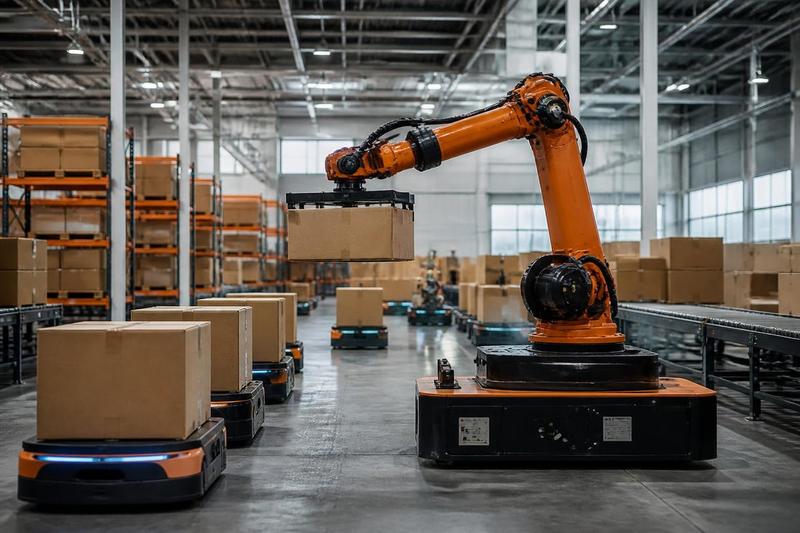
Modern warehouse automation relies on several interconnected technologies working in harmony. Robotics platforms handle physical material movement, from automated guided vehicles for forklift operations to autonomous mobile robots that navigate complex warehouse layouts. Warehouse management software serves as the central nervous system, coordinating activities across receiving, storage, picking, packing, and shipping operations.
The integration layer connects these physical and digital systems, enabling seamless data exchange and coordinated action. Sensors, vision systems, and IoT devices provide continuous operational feedback, whilst machine learning algorithms optimize routing, inventory placement, and resource allocation. This comprehensive approach to task automation transforms isolated improvements into systemic productivity gains.
Measuring Productivity Gains Through Automation
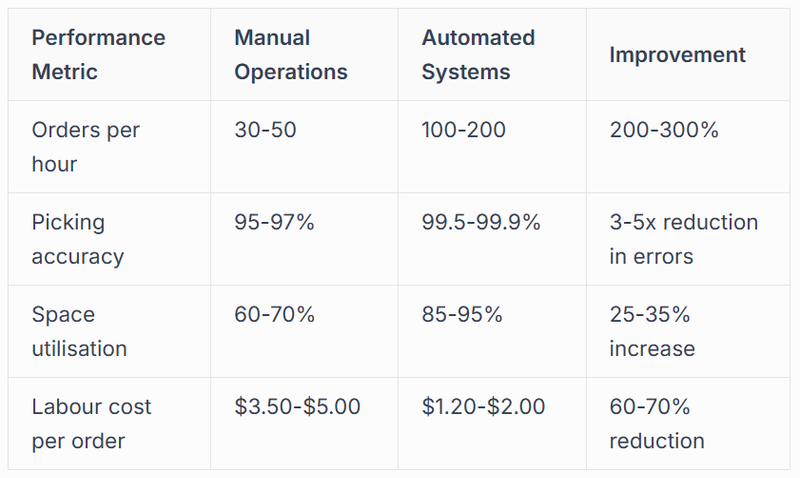
Quantifying the impact of productivity automation requires examining multiple performance dimensions. Order fulfillment speed typically improves by 40-60% as automated systems eliminate manual walking time and reduce search effort. Accuracy rates often exceed 99.5%, dramatically reducing costly returns and rework associated with picking errors.
Labour productivity metrics reveal equally compelling improvements. Automated systems enable existing staff to manage significantly higher throughput volumes, with studies showing productivity increases of 200-300% in well-designed implementations. Space utilisation improves through vertical storage capabilities and optimised layout configurations that would be impractical with manual operations.
Strategic Implementation of Productivity Automation
Successful automation initiatives require careful planning, realistic assessment of operational requirements, and staged implementation approaches that minimize disruption whilst building organizational capabilities.
Identifying High-Impact Automation Opportunities
The most effective automation strategies target operations where manual processes create significant bottlenecks, quality issues, or cost pressures. Picking operations in high-volume distribution centres represent prime candidates, particularly where SKU proliferation and order complexity strain manual systems. Repetitive material handling tasks that require constant attention but offer little value from human judgement provide excellent automation returns.
Cold storage and hazardous material environments deliver additional benefits by removing workers from challenging conditions whilst maintaining operational consistency. Peak season operations that require rapid scaling present another strategic opportunity, as automation provides flexible capacity without the challenges of recruiting and training temporary workers.
When evaluating automation opportunities, consider both immediate operational pain points and strategic business objectives. Planning successful automation implementation requires alignment between technology capabilities and actual business requirements, avoiding the temptation to automate for automation's sake.
Building a Scalable Automation Roadmap
Warehouse automation succeeds when implemented as a phased journey rather than an all-or-nothing transformation. Begin with well-defined pilot projects that address specific operational challenges whilst building internal expertise and demonstrating tangible results. These initial implementations provide valuable learning opportunities and generate organizational confidence for broader deployment.
Recommended implementation phases:
- Assessment and baseline measurement of current productivity metrics
- Pilot implementation in controlled operational zone
- Refinement based on real-world performance data
- Expansion to additional operational areas
- Integration of advanced capabilities and optimization features
For businesses seeking an accessible entry point, solutions like the Automate-X GTP Starter Grid provide a practical pathway to begin warehouse automation without overwhelming existing operations or requiring massive capital investment. This approach enables organizations to experience automation benefits firsthand whilst developing the operational expertise needed for larger-scale implementations.
Integration Challenges and Solutions
Productivity automation delivers maximum value when systems work together seamlessly, yet integration remains one of the most significant implementation challenges. Legacy warehouse management systems may lack modern APIs or data exchange capabilities, requiring middleware solutions or system upgrades to enable effective automation.
Establishing a reliable data repository as the foundation for automation strategies ensures consistent system behavior and enables accurate decision-making. Data quality issues-duplicate SKUs, inaccurate inventory records, poorly structured location hierarchies-create automation failures that undermine productivity gains.
Address these challenges through systematic data cleansing initiatives before automation deployment, ongoing data governance processes that maintain information accuracy, and standardized interfaces that simplify system integration. Testing protocols should validate not just individual system functionality but end-to-end workflow performance under realistic operational conditions.
Advanced Productivity Automation Technologies
As warehouse automation matures, emerging technologies are expanding the boundaries of what automated systems can accomplish, enabling new levels of productivity and operational flexibility.
Artificial Intelligence and Machine Learning Applications
Modern productivity automation increasingly incorporates AI capabilities that enhance system intelligence and adaptability. Demand forecasting algorithms optimize inventory positioning, placing fast-moving products in accessible locations whilst relegating slow movers to dense storage. Route optimization continuously refines picking paths based on real-time order profiles and resource availability.
Predictive maintenance systems monitor equipment performance patterns, scheduling interventions before failures occur and maximizing system uptime. Computer vision enables automated quality inspection, identifying damaged products or packaging issues without human review. These intelligent automation capabilities transform static automation systems into adaptive platforms that continuously improve operational performance.
Natural language processing creates more intuitive system interfaces, allowing warehouse staff to interact with automation platforms through conversational queries rather than complex software navigation. This accessibility reduces training requirements and enables broader organizational engagement with automated systems.
Collaborative Automation and Human-Robot Teams
The most sophisticated productivity automation strategies recognize that humans and robots possess complementary strengths. Collaborative systems leverage robotic speed, precision, and endurance for repetitive tasks whilst preserving human flexibility, problem-solving capabilities, and judgement for exceptional situations.
Goods-to-person systems exemplify this collaborative approach, bringing inventory to stationary picking stations where workers efficiently process orders without wasted travel time. The automation handles material movement while humans apply judgement to product selection, quality assessment, and exception handling. This division of labour typically delivers higher productivity than fully manual or fully automated alternatives.
Benefits of collaborative automation approaches:
- Improved worker satisfaction through elimination of tedious walking and searching
- Greater system flexibility for handling product variety and special requirements
- Reduced implementation complexity compared to fully lights-out automation
- Enhanced productivity during workforce transitions and training periods
- Better accommodation of seasonal demand fluctuations
Operational Excellence Through Automated Systems
Achieving sustainable productivity gains requires moving beyond technology implementation to develop operational practices that maximize automation system potential.
Continuous Optimization and Performance Management
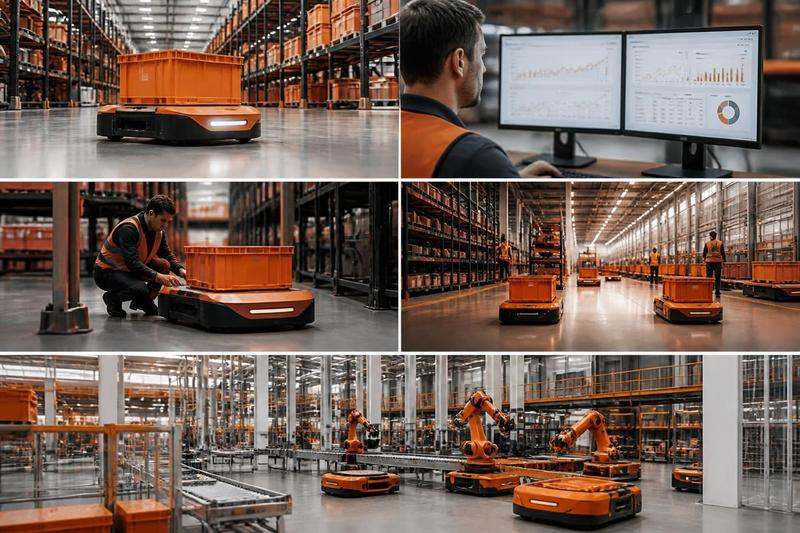
Productivity automation generates vast quantities of operational data that enable unprecedented insight into warehouse performance. Effective operations establish monitoring dashboards that track key performance indicators in real-time, automated alerting systems that flag performance degradations before they become critical issues, and regular analysis cycles that identify optimization opportunities.
Performance management should examine both system-level metrics-throughput rates, error frequencies, equipment utilisation-and process-level details that reveal improvement opportunities. ASRS system performance in warehouse environments depends heavily on factors like inventory slotting strategies, maintenance practices, and operational policies that technology alone cannot optimize.
Create feedback loops that connect performance data to continuous improvement initiatives. When automation systems reveal bottlenecks or inefficiencies, develop action plans that address root causes rather than symptoms. This disciplined approach to operational excellence ensures that productivity automation delivers sustained benefits rather than one-time improvements.

Change Management and Workforce Development
Technology implementation represents only one dimension of successful productivity automation. Organizational change management often determines whether automation initiatives achieve their potential or fall short due to resistance, misunderstanding, or inadequate skill development.
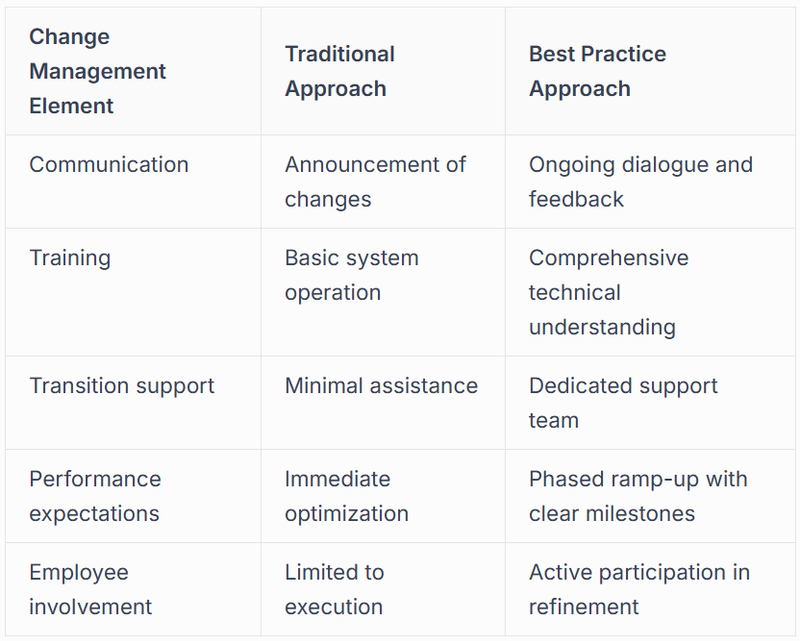
Transparent communication about automation objectives, impacts, and timelines builds trust and reduces uncertainty. Emphasize how automation eliminates tedious tasks whilst creating opportunities for more engaging, higher-value work. Many warehouse workers welcome relief from constant walking and repetitive lifting when automation handles these physically demanding activities.
Invest in comprehensive training programs that develop technical skills and operational understanding. Workers should understand not just how to operate automated systems but why systems behave as they do and how to recognize performance issues. This deeper knowledge enables frontline staff to contribute meaningfully to system optimization and troubleshooting efforts.
Financial Justification and Return on Investment
Productivity automation requires substantial capital investment, making rigorous financial analysis essential for securing organizational support and ensuring project success.
Calculating Comprehensive Automation Benefits
Effective ROI analysis extends beyond simple labour cost reductions to capture the full spectrum of automation benefits. Direct labour savings represent the most visible benefit, calculated by comparing manual labour requirements against automated system staffing needs. However, these calculations must account for the technical staff needed to maintain and optimize automated systems.
Indirect benefits often exceed direct labour savings in well-designed implementations. Error reduction delivers savings through decreased returns processing, reduced customer service demands, and improved customer retention. Faster order fulfillment enables premium shipping options and competitive service levels that drive revenue growth. Space optimization defers or eliminates expensive facility expansions, representing substantial capital avoidance.
Key ROI components for warehouse automation:
- Direct labour cost reduction from eliminated manual tasks
- Improved throughput enabling revenue growth without facility expansion
- Error reduction minimizing returns, rework, and customer service costs
- Enhanced safety reducing injury-related expenses and insurance premiums
- Energy efficiency from optimized material movement and lighting
- Extended equipment life through consistent, controlled operation
Managing Implementation Costs and Risks
Productivity automation projects carry inherent risks that prudent planning and project management practices can substantially mitigate. Scope creep represents one of the most common cost overruns, occurring when organizations continually expand automation capabilities during implementation. Establish clear project boundaries and defer enhancements to subsequent phases unless absolutely essential.
Integration complexity frequently exceeds initial estimates, particularly in environments with multiple legacy systems or custom software modifications. Budget contingency for integration challenges and consider phased approaches that limit simultaneous system connections. Technology obsolescence risks can be managed through selecting vendors with demonstrated upgrade paths and avoiding highly proprietary platforms that limit future flexibility.
Understanding factors influencing productivity in automated operations helps set realistic performance expectations and avoid disappointment when systems require optimization periods before achieving target efficiency. Most warehouse automation implementations require 6-12 months of refinement to reach optimal performance levels.
Industry-Specific Automation Considerations
Different warehouse operations face unique productivity challenges that influence optimal automation approaches, technology selection, and implementation strategies.
E-commerce and 3PL Operations
E-commerce fulfillment demands exceptional speed and accuracy across highly variable order profiles. Single-item orders require different handling than bulk shipments, creating complexity that flexible automation systems must accommodate. Peak season volume fluctuations can triple normal throughput requirements, necessitating scalable solutions that maintain efficiency across demand ranges.
Third-party logistics providers face additional complexity from serving multiple clients with distinct operational requirements, product characteristics, and service expectations. Automation systems must support client-specific workflows whilst maintaining operational efficiency through shared infrastructure. Returns processing adds another layer of complexity, requiring systems that handle inbound inspection, disposition decisions, and inventory reintegration.
Manufacturing and FMCG Distribution
Manufacturing distribution centers prioritize reliability and consistency, supporting production schedules that depend on timely component availability. Automation systems in these environments must deliver predictable performance with minimal disruption, as manufacturing delays cascade through entire production networks with costly consequences.
FMCG operations handling consumer packaged goods manage enormous SKU variety across products with varying shelf lives, storage requirements, and handling characteristics. First-in-first-out rotation becomes critical for perishable products, requiring automation systems that track lot numbers and expiration dates whilst optimizing picking efficiency. High-velocity operations in this sector benefit substantially from productivity automation that maintains quality control whilst scaling to peak demand periods.
Pharmaceutical and Cold Storage Facilities
Pharmaceutical warehouses operate under stringent regulatory requirements governing product handling, storage conditions, and chain-of-custody documentation. Automation systems must maintain complete traceability whilst supporting serialization requirements and providing environmental control throughout storage and handling processes. Productivity gains must be achieved without compromising compliance or product integrity.
Cold storage operations present unique challenges from temperature maintenance, equipment reliability in harsh conditions, and worker safety in extreme environments. Automation delivers particular value by minimizing human exposure to cold environments whilst maintaining consistent temperature control. Energy efficiency becomes critical, as cold storage represents one of the most expensive warehouse operating environments.
Productivity automation has evolved from an optional efficiency initiative to a strategic imperative for warehouse operations seeking to remain competitive in demanding logistics environments. The integration of robotics, intelligent software, and advanced analytics creates operational capabilities that manual processes simply cannot match, whilst improving worker satisfaction through elimination of repetitive, physically demanding tasks. Automate-X specializes in designing and implementing these intelligent warehouse automation solutions, combining modern robotics, warehouse software, and system integration expertise to help logistics and supply chain businesses streamline operations, improve productivity, and enable scalable growth tailored to your specific operational requirements.