

AMR Warehouse Automation: Transforming Modern Operations
Share on
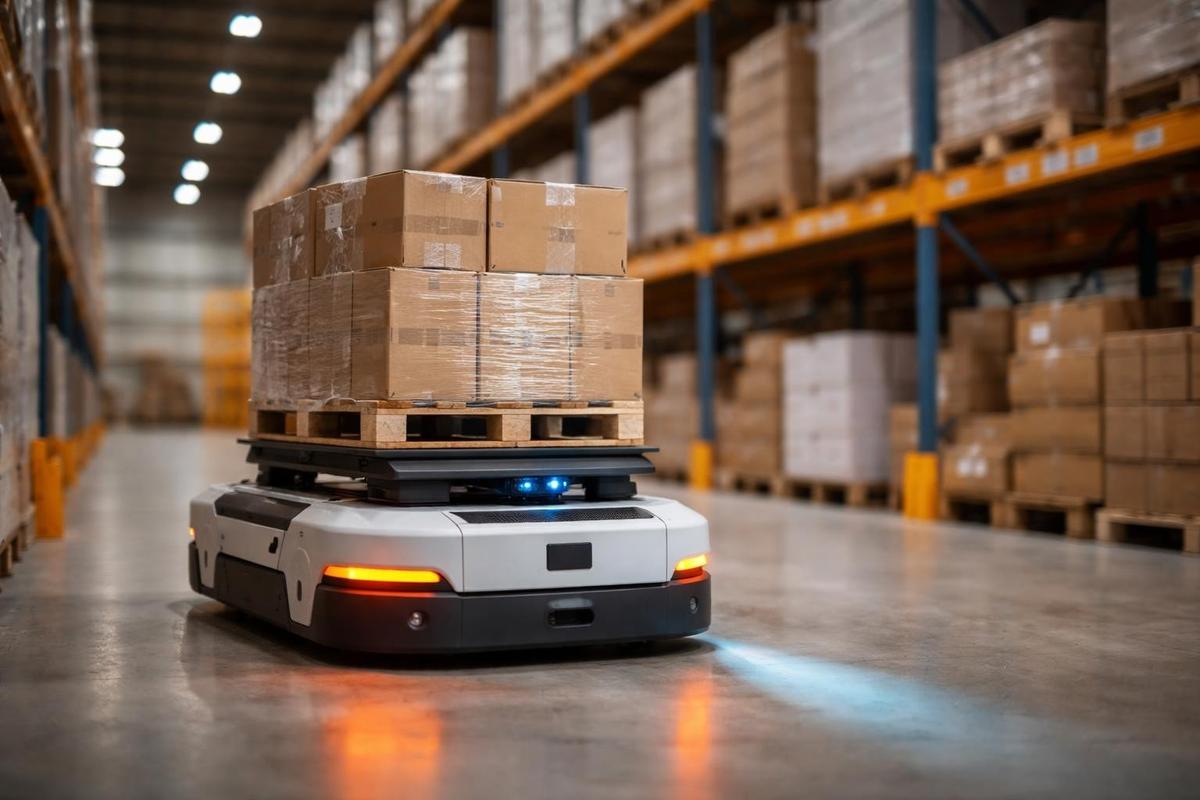
The logistics landscape is experiencing a fundamental shift as warehouses embrace autonomous mobile robots to handle material movement, inventory management, and order fulfillment. AMR warehouse automation represents a sophisticated approach to operational efficiency, leveraging advanced robotics that navigate independently through dynamic environments without requiring fixed infrastructure. Unlike traditional automation systems that demand extensive modifications to existing facilities, autonomous mobile robots offer flexibility, scalability, and rapid deployment capabilities that align with the evolving demands of modern supply chain operations.
Understanding AMR Technology and Core Capabilities
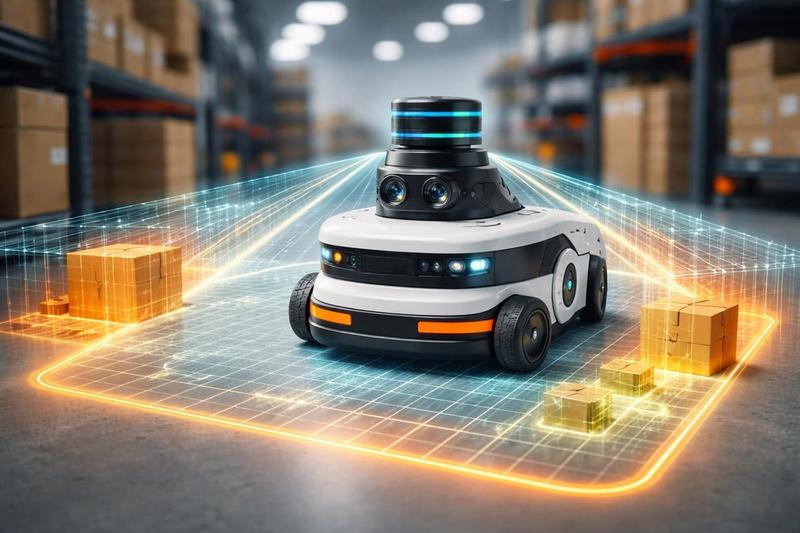
Autonomous mobile robots utilise a combination of sensors, cameras, and sophisticated software algorithms to navigate warehouse environments safely and efficiently. These intelligent machines create dynamic maps of their surroundings, detect obstacles in real-time, and calculate optimal routes to their destinations without human intervention or physical guidance infrastructure.
The technology behind AMR warehouse automation differs significantly from earlier automated guided vehicles that relied on magnetic strips, wires, or reflective tape embedded in floors. Modern AMRs employ simultaneous localisation and mapping (SLAM) technology, allowing them to understand their position within a facility whilst continuously updating their environmental awareness.
Key Technical Components
Navigation Systems
AMRs integrate multiple navigation technologies to ensure precise movement throughout warehouse spaces:
- LiDAR sensors that measure distances using laser pulses
- 3D cameras providing depth perception and object recognition
- Inertial measurement units tracking position and orientation
- Ultrasonic sensors detecting nearby objects and obstacles
- Wheel encoders monitoring precise distance travelled
Intelligence and Decision-Making
The computational core of AMR warehouse automation processes vast amounts of sensory data in milliseconds, enabling robots to make split-second decisions about route optimisation, collision avoidance, and task prioritisation. Machine learning algorithms continuously improve performance by analysing historical patterns and adapting to changing warehouse conditions.
Operational Applications Across Warehouse Functions
AMRs enhance warehouse logistics by automating repetitive material handling tasks that traditionally consumed significant labour resources whilst introducing potential for human error. These versatile robots adapt to multiple operational scenarios across inbound receiving, storage, picking, packing, and outbound shipping processes.
Goods-to-Person Picking
One of the most impactful applications involves transporting inventory from storage locations directly to stationary picking stations. Rather than workers walking extensive distances throughout the warehouse to collect items, AMRs deliver shelving units, bins, or totes to ergonomic workstations where staff efficiently pick items for orders.
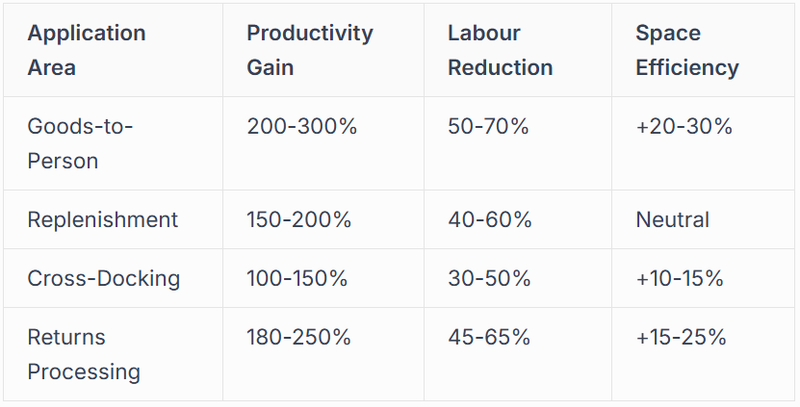
This transformation dramatically increases picking rates whilst reducing physical strain on warehouse personnel. Facilities implementing AMR warehouse automation for goods-to-person operations typically achieve productivity improvements of 200-300% compared to traditional pick-and-pack methods.
Inventory Replenishment and Put-Away
AMRs excel at moving received inventory from dock areas to designated storage locations based on warehouse management system instructions. The robots navigate efficiently between receiving zones and storage aisles, transporting pallets, containers, or individual items according to optimal slotting strategies.
Dynamic Sortation and Cross-Docking
For distribution centres handling high volumes of mixed SKUs, AMRs provide flexible sortation capabilities without requiring fixed conveyor infrastructure. Robots can transport items between receiving and shipping docks, automatically routing products according to destination, carrier, or delivery priority.
This flexibility proves particularly valuable for operations experiencing seasonal fluctuations or rapid growth, as AMR fleets scale up or down according to demand without requiring permanent infrastructure investments.
Comparing AMRs with Alternative Automation Technologies
Understanding how AMRs differ from traditional automated guided vehicles helps businesses select appropriate automation strategies for their specific operational requirements. Each technology offers distinct advantages depending on facility layout, throughput demands, and budget constraints.
Autonomous Mobile Robots versus AGVs
Navigation Flexibility
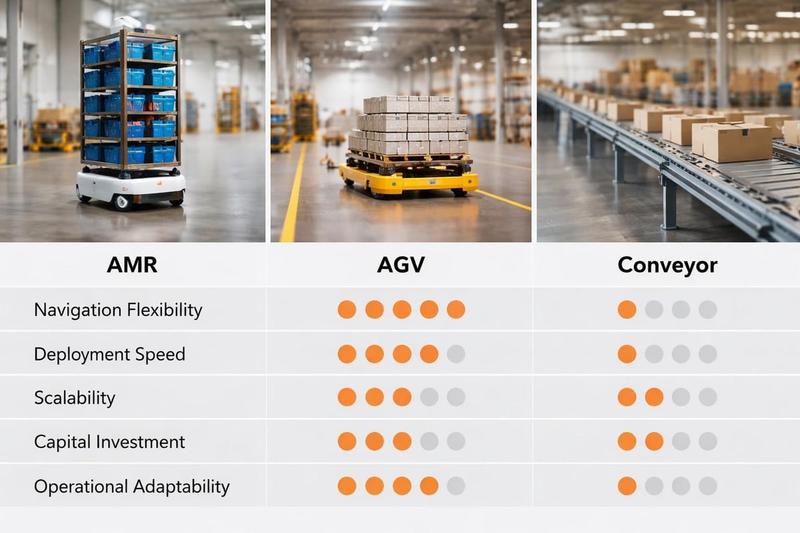
AMRs navigate dynamically without fixed guidance infrastructure, recalculating routes instantly when encountering obstacles or changes in the environment. AGVs follow predetermined paths using magnetic tape, wire guidance, or laser targeting, requiring infrastructure modifications and offering limited route flexibility.
Deployment Speed
Implementing AMR warehouse automation typically requires weeks rather than months, as robots simply need to map the existing facility and integrate with warehouse management systems. AGV installations demand extensive site preparation including infrastructure installation and facility modifications.
Scalability Considerations
- AMRs can be added incrementally to fleets without system reconfiguration
- Route changes occur through software updates rather than physical modifications
- Robots share workspace safely with human workers and traditional equipment
- Fleet size adjusts quickly to accommodate seasonal demand fluctuations
AMRs versus Conveyor Systems
Fixed conveyor infrastructure excels at moving large volumes along predetermined paths with minimal per-unit operating costs. However, conveyors lack flexibility, consume significant floor space, and require substantial capital investment with lengthy implementation timelines.
AMR warehouse automation complements or replaces conveyors in scenarios demanding routing flexibility, frequent layout changes, or phased automation implementation. Many facilities deploy hybrid approaches, using conveyors for high-volume fixed routes whilst AMRs handle variable paths and lower-volume movements.
Integration with Warehouse Management Systems
The true power of AMR technology emerges through seamless integration with warehouse management systems and other enterprise software platforms. This connectivity transforms AMRs from simple transport devices into intelligent components of comprehensive warehouse orchestration systems.
Data Exchange and Task Management
Warehouse management systems communicate continuously with AMR fleet management software, transmitting task assignments, priority updates, and inventory location data. Robots report completion status, location information, and performance metrics back to the WMS, creating closed-loop visibility throughout material handling operations.
This bidirectional data flow enables sophisticated optimisation algorithms that consider multiple variables when assigning tasks to specific robots:
- Current robot location and battery status
- Task urgency and priority ranking
- Optimal route efficiency calculations
- Workstation availability and worker readiness
- Traffic patterns and congestion prediction
Real-Time Adaptation and Optimisation
Advanced AMR warehouse automation systems incorporate artificial intelligence capabilities that analyse historical performance data to continuously improve operational efficiency. Machine learning algorithms identify patterns in task completion times, route efficiency, and resource utilisation, automatically adjusting parameters to enhance future performance.
Fleet management software monitors overall system performance, balancing workloads across available robots whilst ensuring battery management, maintenance scheduling, and traffic flow optimisation occur proactively rather than reactively.
Financial Considerations and Return on Investment
Evaluating AMR warehouse automation from a financial perspective requires analysing multiple cost categories, productivity improvements, and operational benefits that contribute to overall return on investment calculations.
Capital Investment Components
Initial System Costs
- Robot units with navigation and safety systems
- Fleet management software and WMS integration
- Charging infrastructure and battery management
- Initial site mapping and configuration services
- Staff training and change management programmes
Ongoing Operational Expenses
Monthly or annual costs include software licensing fees, maintenance contracts, spare parts inventory, electricity consumption, and periodic system upgrades. These expenses typically represent 10-15% of initial capital investment annually.
Productivity and Cost Savings
Labour cost reduction represents the most significant financial benefit, with facilities typically achieving 40-70% reduction in material handling labour requirements. However, comprehensive ROI calculations should also consider:
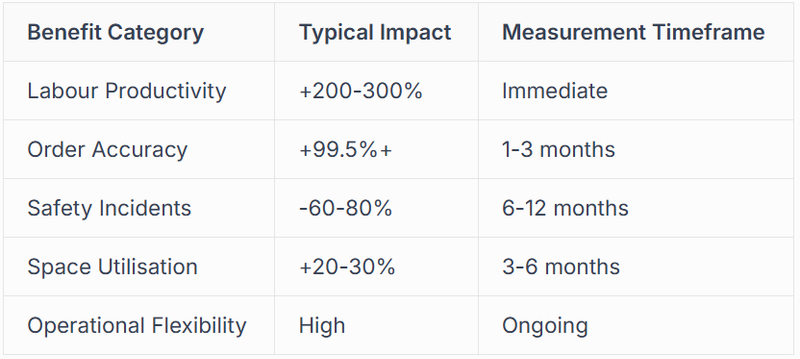
Payback Period Expectations
Most warehouse operations implementing AMR warehouse automation achieve payback within 18-36 months, depending on labour costs, throughput volumes, and operational complexity. High-volume facilities with expensive labour markets often see returns within 12-18 months, whilst smaller operations or those with lower labour costs may experience 24-36 month payback periods.
For businesses starting their automation journey, solutions like the Automate-X GTP Starter Grid provide accessible entry points that deliver meaningful productivity improvements with lower initial capital requirements and faster implementation timelines.
Implementation Strategies and Best Practices
Successful AMR deployment requires careful planning, realistic expectation setting, and structured change management to ensure smooth integration with existing operations and workforce acceptance.
Phased Deployment Approach
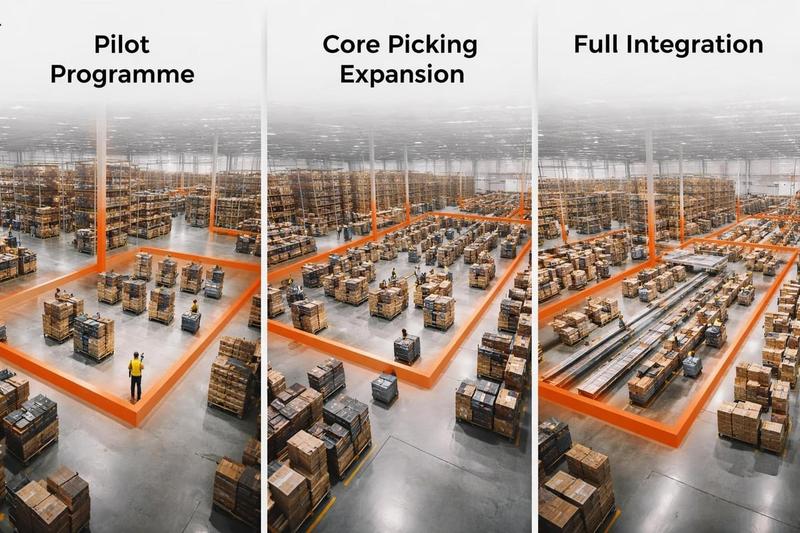
Rather than attempting warehouse-wide automation simultaneously, leading organisations implement AMR warehouse automation through structured phases:
Phase One: Pilot Programme
Deploy a small AMR fleet in a confined area handling specific tasks such as replenishment or returns processing. This approach allows operational staff to gain familiarity with the technology whilst identifying integration challenges and optimisation opportunities before broader rollout.
Phase Two: Expansion to Core Processes
After validating performance and refining processes during the pilot, expand AMR deployment to high-impact areas like goods-to-person picking or primary material movement corridors. Monitor performance metrics closely and adjust fleet size, routing algorithms, and task assignments based on operational data.
Phase Three: Full Integration
Complete the automation vision by extending AMR coverage across remaining warehouse zones whilst optimising fleet composition, implementing advanced AI-driven orchestration, and achieving seamless coordination between robots, human workers, and other automation systems.
Workforce Training and Change Management
Preparing Teams for Automation
Successful implementation requires addressing workforce concerns transparently whilst providing comprehensive training on robot operation, safety protocols, and emergency procedures. Emphasis should focus on how AMRs eliminate physically demanding tasks, allowing workers to focus on higher-value activities requiring human judgment and dexterity.
Developing New Skill Sets
- Robot fleet monitoring and performance analysis
- Basic troubleshooting and error resolution
- Traffic flow optimisation and route management
- Integration with warehouse management systems
- Continuous improvement and data-driven decision-making
Safety Features and Regulatory Compliance
Modern AMR warehouse automation incorporates multiple safety systems ensuring robots operate safely alongside human workers, traditional material handling equipment, and other warehouse infrastructure.
Obstacle Detection and Collision Avoidance
AMRs employ redundant safety systems including 360-degree sensors, emergency stop capabilities, and predictive collision avoidance algorithms. When detecting obstacles in their path, robots automatically slow down, stop, or navigate around impediments whilst maintaining safe clearance distances.
Safety zones around robots adjust dynamically based on speed, load weight, and surrounding activity levels. Higher speeds trigger larger safety perimeters, ensuring adequate stopping distance under all operating conditions.
Regulatory Standards and Certification
International Safety Standards
AMR manufacturers design systems to comply with international safety regulations including ISO 3691-4 for industrial trucks and their systems, and ANSI/RIA R15.08 for industrial mobile robots. These standards specify requirements for:
- Emergency stop functionality and accessibility
- Maximum speed limits in various operational scenarios
- Safety-rated monitored stop capabilities
- Personnel detection and protective field monitoring
- Clear visual and audible warning systems
Facility-Specific Safety Protocols
Beyond manufacturer-provided safety features, warehouse operators should establish comprehensive safety procedures including designated robot pathways, pedestrian crossing zones, clear signage, and regular safety audits. Staff training must emphasise awareness of robot operations and appropriate interaction protocols.
Future Developments and Emerging Capabilities
The evolution of AMR warehouse automation continues accelerating as manufacturers integrate emerging technologies including enhanced artificial intelligence, collaborative manipulation capabilities, and advanced fleet coordination algorithms.
Enhanced Manipulation and Handling
Next-generation AMRs increasingly incorporate robotic arms and sophisticated gripping systems, enabling autonomous picking, packing, and palletising without human intervention. These capabilities expand AMR applications beyond transport to encompass complete order fulfillment workflows.
Collaborative Robot Integration
Hybrid systems combining mobile platforms with collaborative robotic arms create versatile automation solutions capable of adapting to diverse tasks. These systems handle piece-picking from shelves, case stacking, quality inspection, and packaging operations whilst navigating dynamically throughout warehouse environments.
Swarm Intelligence and Coordinated Operations
Advanced fleet management systems increasingly employ swarm intelligence principles, enabling large robot populations to self-organise and optimise performance collectively. Rather than central control systems directing individual robots, swarm approaches allow autonomous agents to coordinate activities through local interactions and simple rule sets.
This distributed intelligence approach delivers several advantages:
- Enhanced system resilience as no single point of failure exists
- Improved scalability as additional robots integrate seamlessly
- More efficient route optimisation through real-time collaboration
- Adaptive response to unexpected disruptions or demand surges
Predictive Maintenance and Self-Optimisation
Industrial automation solutions increasingly leverage predictive analytics to anticipate maintenance requirements before failures occur. AMRs monitor component performance continuously, identifying wear patterns and anomalies that indicate impending issues, then automatically scheduling maintenance during low-activity periods.
Machine learning algorithms analyse performance across entire fleets, identifying optimisation opportunities and automatically implementing improvements to routing algorithms, task assignment logic, and energy management strategies.
Sector-Specific Applications and Case Studies
Different warehouse environments present unique operational challenges and opportunities for AMR warehouse automation, requiring tailored approaches that address industry-specific requirements.
E-Commerce and Omnichannel Fulfillment
The explosive growth of online retail creates unprecedented demands for rapid order processing, accuracy, and flexibility. AMRs enable e-commerce warehouses to handle massive SKU diversity, support same-day delivery commitments, and manage peak season volume spikes without proportional labour increases.
Facilities processing tens of thousands of daily orders deploy large AMR fleets handling goods-to-person picking, automated sortation by carrier and destination, and returns processing. The technology proves particularly valuable for operations experiencing 3-5x volume variations between normal periods and peak seasons.
Third-Party Logistics and Multi-Client Operations
3PL providers managing inventory for multiple clients face constant operational changes as customer requirements evolve, product mixes shift, and contractual arrangements adjust. The flexibility of AMR warehouse automation aligns perfectly with this dynamic environment, allowing rapid reconfiguration without infrastructure modifications.
Successful 3PL implementations demonstrate how AMRs support client-specific workflows, segregated inventory management, and variable service level requirements within shared warehouse spaces.
Pharmaceutical and Cold Storage Environments
Temperature-controlled facilities benefit significantly from AMR deployment, as robots operate reliably in challenging environments whilst reducing human exposure to extreme temperatures. Pharmaceutical applications leverage AMRs for lot tracking, expiry date management, and compliance documentation alongside standard material handling functions.
The precision and traceability of AMR warehouse automation supports stringent regulatory requirements whilst enabling batch tracking, quarantine management, and automated quality control processes.
AMR warehouse automation delivers transformative operational improvements across diverse logistics environments, combining flexible navigation, intelligent decision-making, and seamless system integration to enhance productivity whilst reducing labour dependency and operational costs. Whether you're managing high-volume e-commerce fulfillment, multi-client 3PL operations, or specialised industry requirements, Automate-X combines modern robotics, warehouse software, and system integration expertise to design and implement scalable automation solutions tailored to your specific operational challenges and growth objectives.