

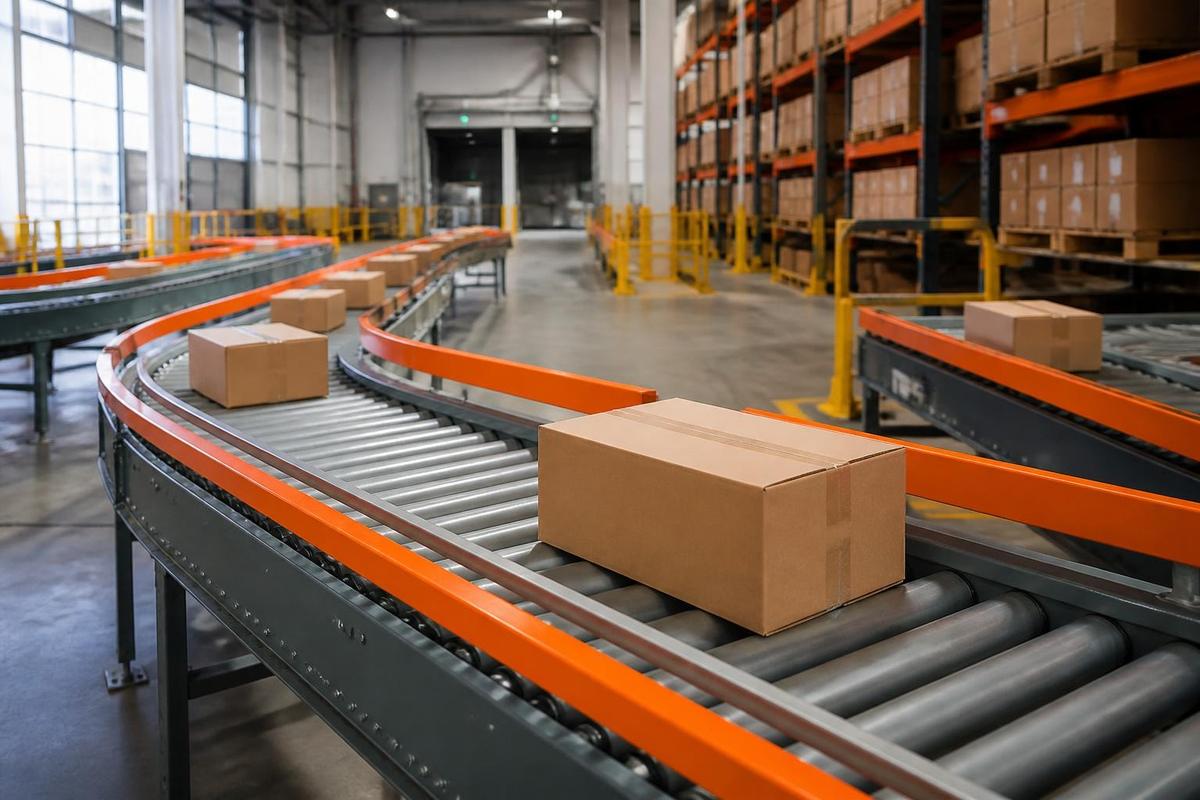
Conveyor Line Systems for Modern Warehouses
Share on
Modern warehouse operations demand efficient, reliable material handling systems that can keep pace with increasing throughput requirements and customer expectations. A conveyor line serves as the backbone of automated warehousing, connecting receiving docks to storage zones, picking stations to packing areas, and dispatch points to loading bays. As logistics operations scale in 2026, understanding how to design, implement, and maintain these critical systems becomes essential for competitive advantage. The right conveyor line configuration can transform warehouse productivity, reduce labour costs, and create the foundation for advanced automation technologies.
Understanding Conveyor Line Fundamentals
A conveyor line represents more than just a single belt or roller system. It encompasses an interconnected network of material handling equipment designed to move products through predetermined pathways with consistent speed, direction, and control. These systems range from simple straight-line configurations to complex multi-level networks incorporating merge points, diverters, sortation equipment, and accumulation zones.
The core purpose remains constant: eliminate manual transportation of goods between operational zones. This automation reduces labour requirements, minimises product damage, improves throughput consistency, and creates predictable material flow patterns that enable better planning and resource allocation.
Key Components and Infrastructure
Every conveyor line system comprises several essential elements working in coordination:
- Drive mechanisms that power belt or roller movement through motors and gearboxes
- Control systems managing speed, direction, and integration with warehouse management software
- Sensors and switches detecting product presence, jams, and operational status
- Structural frameworks providing stable mounting for conveyor sections and components
- Safety equipment including emergency stops, guards, and warning systems
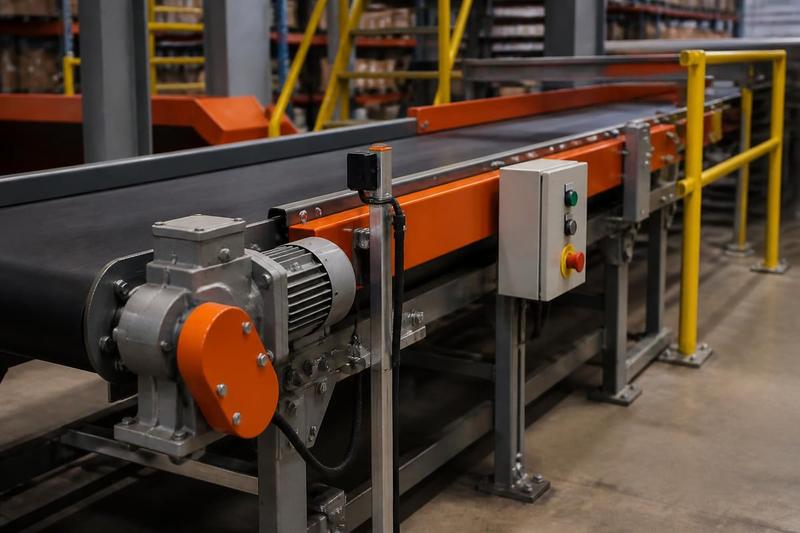
The integration of these components determines overall system performance. Industrial robotics (https://automate-x.nz/our-solutions/industrial-robotics) increasingly works alongside conveyor infrastructure, with robotic pick-and-place units, palletisers, and sortation systems relying on consistent product delivery from conveyor networks.
Conveyor Line Configuration Strategies
Selecting the appropriate layout configuration directly impacts operational efficiency, space utilisation, and future scalability. Different conveyor line layouts serve distinct operational requirements, and understanding these options enables better design decisions.
Straight-Line Systems
The simplest configuration moves products in a single direction between two points. Straight-line conveyors excel in facilities with linear workflows, such as production lines feeding packing stations or receiving docks connecting to sortation areas. These systems offer straightforward installation, minimal maintenance complexity, and predictable material flow.
However, straight-line configurations consume significant floor space and provide limited flexibility for routing changes. They work best when operational zones align naturally along a single axis.
L-Shaped and Curved Configurations
When warehouse layouts require directional changes, L-shaped and curved conveyor sections become necessary. These configurations enable material flow around obstacles, between perpendicular operational zones, or through multi-directional routing scenarios.
Curved sections introduce additional engineering considerations:
- Product stability during turns requires appropriate speed control
- Belt or roller design must accommodate lateral forces
- Merge and divert points often occur at corners
- Maintenance access becomes more critical in complex geometries
Modern warehouse automation increasingly uses sophisticated curved configurations to maximise floor space utilisation whilst maintaining efficient material flow patterns.
Integration With Warehouse Systems
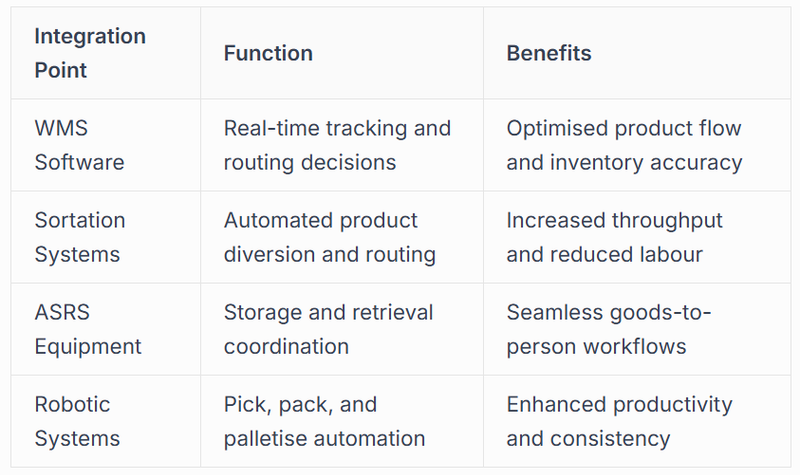
A conveyor line rarely operates in isolation. Maximum value emerges when conveyors integrate seamlessly with warehouse management systems (WMS), automated storage and retrieval systems (ASRS), and other material handling equipment. This integration creates cohesive operational environments where information and physical goods flow synchronously.
Data Communication Standards
Modern conveyor lines communicate using industrial protocols including Ethernet/IP, Profinet, and Modbus. These standards enable real-time data exchange between conveyor controllers, WMS platforms, and supervisory control and data acquisition (SCADA) systems. This connectivity supports:
- Dynamic speed adjustments based on downstream capacity
- Predictive maintenance alerts triggered by sensor data
- Product tracking through barcode scanners and RFID readers
- Automated routing decisions based on order priorities
The automation businesses leading warehouse innovation in 2026 prioritise seamless system integration as a core design principle rather than an afterthought.
Maintenance Best Practices
Conveyor line reliability directly impacts warehouse productivity. Equipment failures create cascading delays, order fulfilment bottlenecks, and increased operational costs. Implementing comprehensive maintenance programmes prevents these disruptions whilst extending equipment lifespan and optimising return on investment.
Preventive Maintenance Schedules
Structured maintenance intervals address wear patterns before they cause failures. Best practices for conveyor belt maintenance recommend multiple inspection frequencies:
Daily tasks include visual inspections for unusual noises, vibrations, or product jams. Operators should check emergency stop functionality and verify proper belt tracking.
Weekly activities involve checking belt tension, inspecting drive components for wear, and cleaning accumulation zones where debris tends to collect.
Monthly procedures include detailed roller inspections, lubrication of bearings and drive components, and verification of sensor alignment and calibration.
Quarterly reviews should assess structural integrity, electrical connections, and control system performance whilst updating maintenance documentation.
A comprehensive maintenance plan for conveyors and sorters should document all activities, track component replacement histories, and identify recurring issues requiring engineering solutions.
Common Failure Modes
Understanding typical failure patterns enables proactive intervention:
- Belt misalignment causing edge wear and tracking problems
- Bearing failures from inadequate lubrication or contamination
- Motor overheating due to excessive loading or poor ventilation
- Sensor malfunction from dirt accumulation or physical damage
- Drive chain wear reducing power transmission efficiency
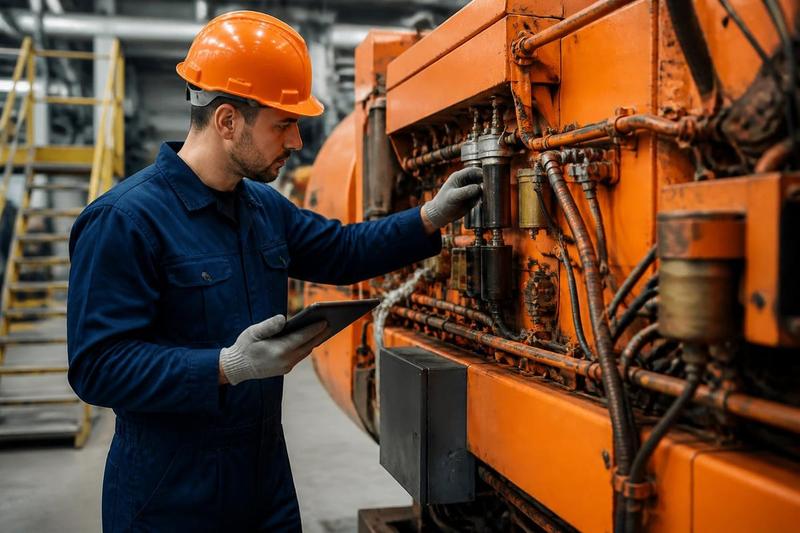
These conveyor maintenance tips emphasise that consistent attention to basic maintenance fundamentals prevents the majority of unexpected failures and extends operational life significantly.
Performance Optimisation Techniques
Beyond basic functionality, conveyor line systems can be tuned for maximum efficiency. Performance optimisation addresses throughput capacity, energy consumption, product handling quality, and operational flexibility.
Speed and Throughput Management
Conveyor speed represents a critical balance. Higher speeds increase theoretical throughput but may compromise product stability, increase wear rates, and create handling challenges at transfer points. Optimal speed depends on:
- Product characteristics including weight, dimensions, and fragility
- Accumulation requirements at merge and sortation points
- Downstream process capabilities and cycle times
- System length and available acceleration zones
Variable frequency drives (VFDs) enable dynamic speed adjustments based on real-time operational requirements. This flexibility reduces energy consumption during low-demand periods whilst maintaining capacity during peak operations.
Energy Efficiency Strategies
Modern conveyor lines incorporate multiple energy-saving features. Zero-pressure accumulation reduces motor strain when products queue. Regenerative braking captures energy during deceleration. Sleep modes power down inactive zones whilst maintaining rapid restart capability.
Implementing these strategies typically reduces energy consumption by 20-40% compared to conventional continuous-run configurations. The speed automation advances driving warehouse innovation in 2026 increasingly prioritise sustainability alongside productivity metrics.
Scalability and Future-Proofing
Warehouse requirements evolve continuously. E-commerce growth, product mix changes, and throughput increases demand conveyor line systems capable of adaptation without complete replacement. Designing for scalability from the initial implementation protects long-term investment value.
Modular Design Principles
Modular conveyor architecture uses standardised section lengths, connection interfaces, and control modules. This standardisation enables:
- Adding capacity through parallel lanes without redesigning existing infrastructure
- Extending line length by inserting additional sections at predetermined connection points
- Upgrading components individually rather than replacing entire systems
- Reconfiguring layouts to accommodate changing operational requirements
Expansion considerations:
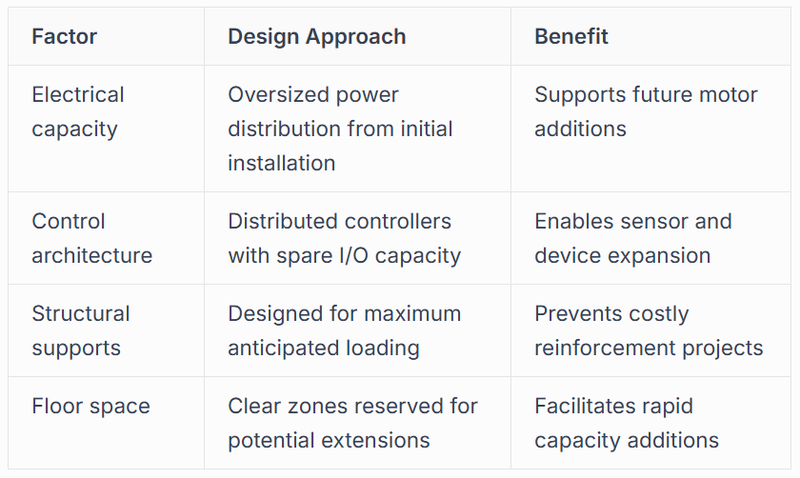
For businesses starting their automation journey, the Automate-X GTP Starter Grid provides a scalable entry point that integrates effectively with conveyor infrastructure whilst enabling progressive automation expansion.
Technology Integration Readiness
Future conveyor line capabilities will increasingly leverage artificial intelligence, machine vision, and advanced robotics. Designing systems with open communication protocols, spare sensor mounting points, and flexible control architectures ensures compatibility with emerging technologies.
The robotics and manufacturing sector demonstrates how conveyor systems serve as integration platforms for collaborative robots, automated quality inspection systems, and dynamic routing algorithms that optimise material flow in real-time.
Return on Investment Analysis
Justifying conveyor line investments requires comprehensive financial analysis extending beyond initial capital costs. Total cost of ownership includes installation, maintenance, energy consumption, and operational efficiency gains measured over expected equipment lifespan.
Direct Cost Components
Initial investment encompasses equipment purchase, installation labour, structural modifications, electrical infrastructure, and control system integration. These costs vary significantly based on system complexity, with simple straight-line configurations starting around $15,000 per metre whilst sophisticated multi-level sortation systems may exceed $50,000 per metre.
Ongoing operational costs include:
- Scheduled maintenance labour and replacement parts
- Energy consumption for motors and control systems
- Periodic component upgrades and technology refreshes
- Training for operators and maintenance personnel
Conveyor maintenance best practices significantly impact long-term cost profiles. Well-maintained systems typically achieve 15-20 year operational lifespans, whilst neglected equipment may require major overhauls or replacement within 7-10 years.
Productivity and Efficiency Gains
The primary financial justification emerges from operational improvements. Conveyor lines typically deliver:
- 40-60% reduction in product transportation labour requirements
- 25-35% improvement in throughput capacity through consistent material flow
- 50-70% decrease in product damage from reduced manual handling
- 15-25% improvement in order accuracy through automated routing
- Enhanced workplace safety with fewer manual material handling injuries
These benefits compound over time. A distribution centre processing 10,000 orders daily might save 8-12 full-time positions through conveyor automation, generating annual labour savings of $600,000-$900,000 whilst simultaneously improving throughput and accuracy.
Industry-Specific Applications
Different operational environments present unique conveyor line requirements. Understanding these variations ensures appropriate system selection and configuration for specific applications.
E-Commerce and 3PL Operations
High-volume fulfilment environments prioritise throughput capacity, sortation accuracy, and integration with goods-to-person systems. Conveyor lines in these facilities typically incorporate:
- High-speed sortation diverters routing products to packing stations
- Accumulation zones buffering products during peak demand periods
- Automated dimensioning and weighing systems for shipping optimisation
- Dense storage integration enabling seamless ASRS connectivity
The explosive growth demonstrated by facilities like the DHL's automated warehouse in Auckland showcases how conveyor infrastructure enables rapid scaling to meet market demands.
Food and Beverage Manufacturing
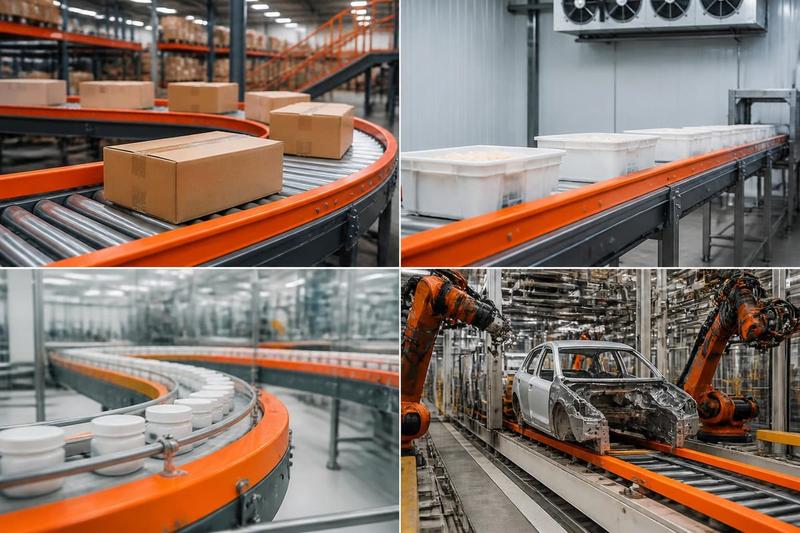
Temperature-controlled environments, hygiene requirements, and product handling sensitivity characterise food and beverage conveyor applications. Stainless steel construction, washdown capability, and gentle product transfer mechanisms become essential specifications.
Successful implementations like Tip Top Ice Cream's facility demonstrate how specialised conveyor designs accommodate stringent food safety standards whilst maintaining production efficiency.
Pharmaceutical and Healthcare Logistics
Regulatory compliance, product traceability, and contamination prevention drive pharmaceutical conveyor specifications. These systems incorporate comprehensive tracking capabilities, validated cleaning procedures, and environmental controls maintaining product integrity throughout transportation.
Selection and Procurement Strategies
Choosing the right conveyor line partner significantly impacts project success. Beyond equipment specifications, evaluating system integrators requires assessing technical expertise, local support capabilities, and long-term partnership potential.
Vendor Evaluation Criteria
Effective vendor selection considers multiple factors:
- Proven experience in similar operational environments and throughput requirements
- Technical capabilities including system design, control integration, and commissioning services
- Local support availability for maintenance, emergency repairs, and parts supply
- Scalability approach ensuring future expansion compatibility
- Financial stability supporting long-term warranty and service commitments
Request detailed case studies, customer references, and site visits to operational installations. Observe actual system performance under production conditions rather than relying solely on specification sheets and sales presentations.
Implementation Planning
Successful conveyor line projects require comprehensive planning addressing timeline coordination, operational disruption minimisation, and systematic commissioning. Critical planning elements include:
- Detailed facility layout drawings with dimensional verification
- Utility infrastructure assessment for power and network connectivity
- Phased installation schedules maintaining operational continuity
- Comprehensive testing protocols validating system performance
- Operator training programmes building competency before go-live
Implementing an effective conveyor line system transforms warehouse operations through improved efficiency, reduced labour requirements, and enhanced scalability for future growth. By focusing on appropriate configuration selection, comprehensive maintenance programmes, and strategic system integration, logistics operations position themselves for long-term competitive advantage. Automate-X combines deep warehouse automation expertise with proven system integration capabilities to design, implement, and support conveyor line solutions tailored to your specific operational requirements. Contact our team to explore how intelligent warehouse automation can drive your business forward.