

Freezer Automation: Transforming Cold Storage Operations
Share on
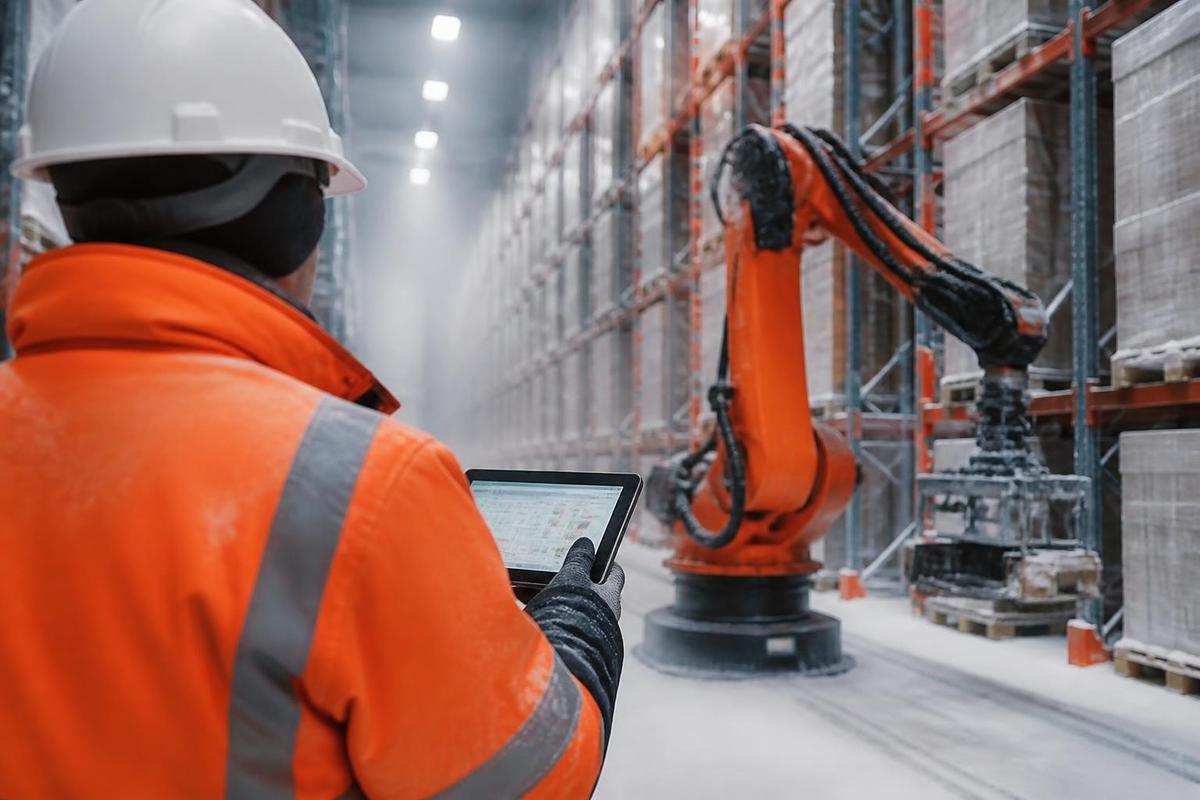
The cold storage sector faces unique operational challenges that traditional warehouse solutions simply cannot address. Temperature extremes, condensation, ice buildup, and the physical demands on both equipment and personnel create a complex operational environment. Freezer automation has emerged as the definitive solution for businesses operating in sub-zero conditions, transforming how cold storage facilities manage inventory, optimize space, and maintain profitability. From pharmaceuticals requiring strict temperature control to frozen food distribution centres handling high-volume throughput, automated freezer systems deliver measurable improvements in efficiency, accuracy, and worker safety.
The Business Case for Automating Cold Storage
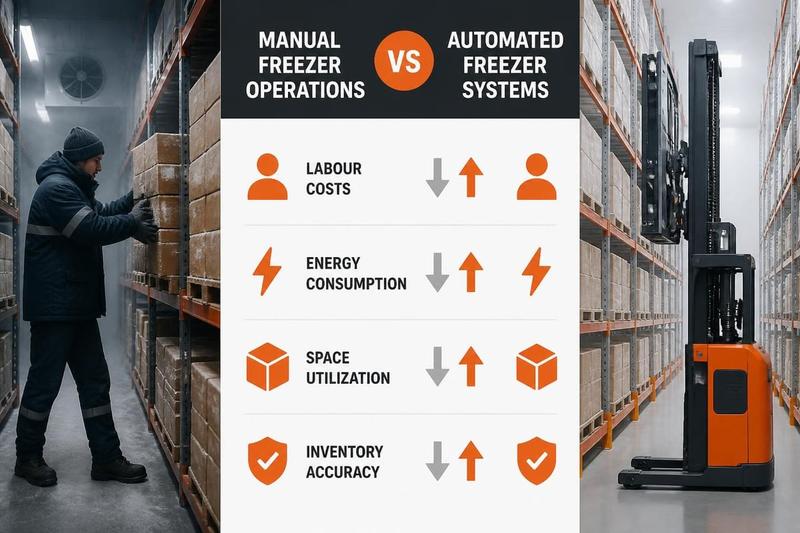
Operating a manual freezer warehouse presents substantial financial and operational burdens that extend far beyond typical ambient temperature facilities. Labour costs multiply when factoring in protective equipment requirements, reduced worker productivity in extreme cold, and higher turnover rates among staff working in harsh conditions.
Energy consumption represents another critical cost driver. Manual operations require frequent door openings, extended lighting periods, and prolonged human presence-all factors that increase refrigeration loads. Freezer automation minimizes these inefficiencies by reducing human traffic, optimizing lighting only where needed, and executing tasks faster than manual counterparts.
Key Financial Drivers
The return on investment for freezer automation stems from multiple sources:
- Labour cost reduction: Automated systems eliminate or significantly reduce the need for workers in sub-zero environments
- Energy efficiency: Reduced door openings and optimized environmental controls cut refrigeration expenses by 20-40%
- Space optimization: High-density automated storage achieves 85-90% cube utilization versus 60-65% for manual operations
- Inventory accuracy: Automated tracking eliminates the 2-3% shrinkage typical in manual cold storage
- Product quality: Consistent temperature maintenance and reduced handling preserve product integrity
Consider the example of Beef Products Inc., which implemented high-density automated freezer storage to enhance both food safety and operational efficiency. Their system demonstrates how large-scale automation delivers measurable improvements across multiple performance metrics simultaneously.
Technology Components in Modern Freezer Automation
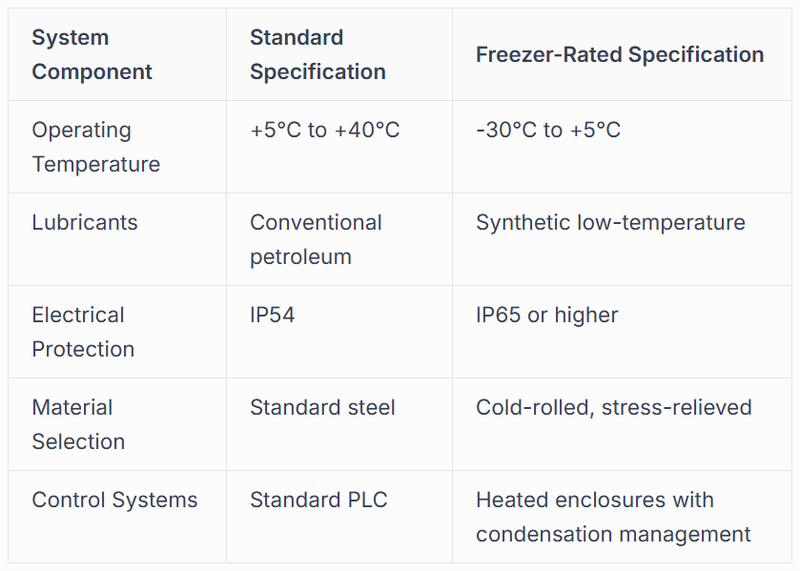
Successful freezer automation requires specialized equipment designed to function reliably in extreme temperatures. Standard warehouse automation technology simply cannot withstand the thermal stress, condensation, and ice formation inherent to sub-zero environments.
Automated Storage and Retrieval Systems for Cold Environments
Automated Storage and Retrieval System technology adapted for freezer applications incorporates specialized components rated for continuous operation at temperatures as low as -30°C. These systems utilize modified lubricants, heating elements in critical areas, and materials selected for dimensional stability across extreme temperature ranges.
The Arctic Series from Prime Robotics exemplifies purpose-built cold warehouse automation, designed specifically for -20°F environments. Such systems address unique challenges including ice accumulation on guidance systems, condensation-related electrical risks, and the brittleness of standard materials at extreme cold.
Robotic Solutions and Mobile Automation
Autonomous mobile robots represent another critical component in comprehensive freezer automation strategies. Warehouse AMR technology designed for cold storage incorporates battery systems optimized for low-temperature performance, as lithium-ion batteries lose significant capacity in freezer conditions.
These robots navigate frozen aisles, transport pallets between storage and processing areas, and integrate seamlessly with other automation technologies. However, successful deployment requires careful consideration of floor conditions, as ice buildup can interfere with navigation systems and create safety hazards.
Equipment selection also extends to supporting infrastructure. Commercial vehicles from suppliers like Fortis Motor Group play essential roles in cold chain logistics, while specialized equipment like freezer-rated forklift tires from manufacturers such as OTR TIRE THAI ensure reliable performance in challenging conditions.
Implementation Strategies and Planning Considerations
Deploying freezer automation demands meticulous planning that addresses both technical requirements and operational workflows. The complexity exceeds typical warehouse automation projects due to environmental factors and the critical nature of temperature-controlled inventory.
Facility Design and Infrastructure
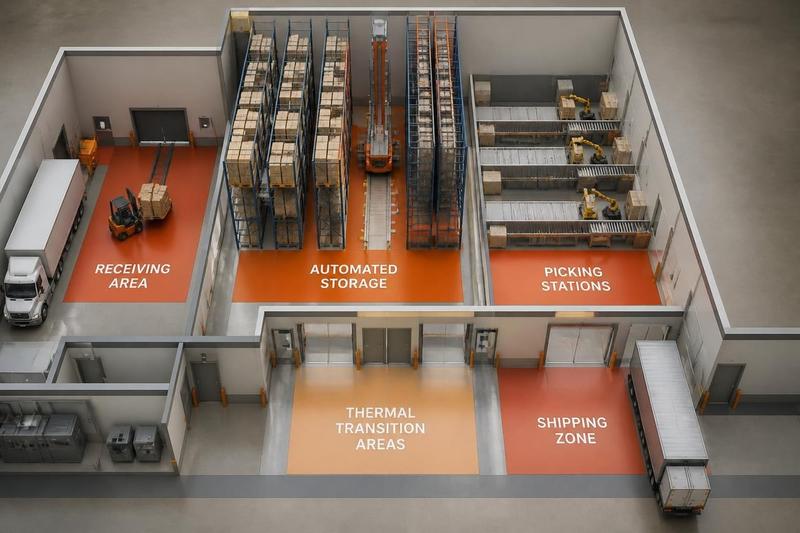
Successful automation begins with proper facility design. Ceiling heights must accommodate vertical storage systems, floor flatness specifications become more stringent for automated guided vehicles, and power infrastructure requires redundancy to prevent temperature excursions during outages.
The transition zone between ambient and freezer areas presents particular challenges. This vestibule space requires careful environmental management to prevent ice formation while minimizing cold air escape. Automated systems must navigate this thermal boundary repeatedly without performance degradation.
Integration with Warehouse Management Systems
Software automation provides the intelligence layer that coordinates physical automation equipment with business processes. Warehouse management systems designed for cold storage incorporate specialized functionality including first-expired-first-out rotation, temperature zone management, and cold chain documentation.
Real-time inventory visibility becomes particularly critical in freezer operations where product value and safety concerns amplify the cost of errors. Modern systems track each pallet's location, temperature history, and age, automatically prioritizing picks to minimize waste and ensure product quality.
The Dot Foods case study illustrates how AS/RS integration with sophisticated warehouse management systems can dramatically increase cold storage efficiency in food distribution operations.
Operational Benefits and Performance Improvements
Organizations implementing freezer automation consistently report substantial operational improvements across multiple dimensions. These benefits compound over time as systems optimize and staff expertise develops.
Throughput and Productivity Gains
Automated systems operate continuously without fatigue, breaks, or shift changes. A single AS/RS crane can execute 40-60 storage or retrieval cycles per hour-far exceeding manual forklift operators who average 15-20 cycles in freezer conditions when accounting for protective equipment, rest periods, and reduced visibility.
Blue Bell Creameries' automated freezer implementation achieved dramatic increases in both storage capacity and throughput, demonstrating how automation enables cold storage operations to scale without proportional facility expansion.
- Initial assessment: Baseline current throughput, accuracy, and cost metrics
- System design: Engineer automation solution matching capacity requirements and growth projections
- Phased implementation: Deploy systems in stages to maintain operational continuity
- Integration testing: Validate all interfaces between automation equipment and enterprise systems
- Staff training: Develop competencies in system operation, troubleshooting, and maintenance
- Performance optimization: Fine-tune parameters based on actual operating data
- Continuous improvement: Monitor metrics and adjust workflows to maximize return on investment
Safety and Workforce Improvements
Removing workers from sub-zero environments eliminates exposure to cold-related health risks including hypothermia, frostbite, and repetitive strain injuries exacerbated by cold temperatures. Automation also reduces forklift accidents, falls on icy surfaces, and impacts from falling frozen products.
The remaining workforce transitions to higher-value roles in system monitoring, maintenance, and quality control-typically in temperature-controlled offices or service areas. This shift improves job satisfaction, reduces turnover, and enables recruitment of skilled technical personnel rather than manual labourers willing to work in extreme cold.
Industry-Specific Applications and Use Cases
Different sectors leverage freezer automation to address their unique operational requirements and regulatory constraints. Understanding these variations helps organizations identify relevant best practices and technology selections.
Food and Beverage Distribution
Frozen food distributors face intense pressure on margins combined with strict food safety requirements. Freezer automation enables these operations to reduce costs while improving traceability and compliance documentation.
The Midfield Group's automated meat processing facility demonstrates integration of freezing, storage, and palletizing automation in a cohesive system that maximizes efficiency from production through dispatch.
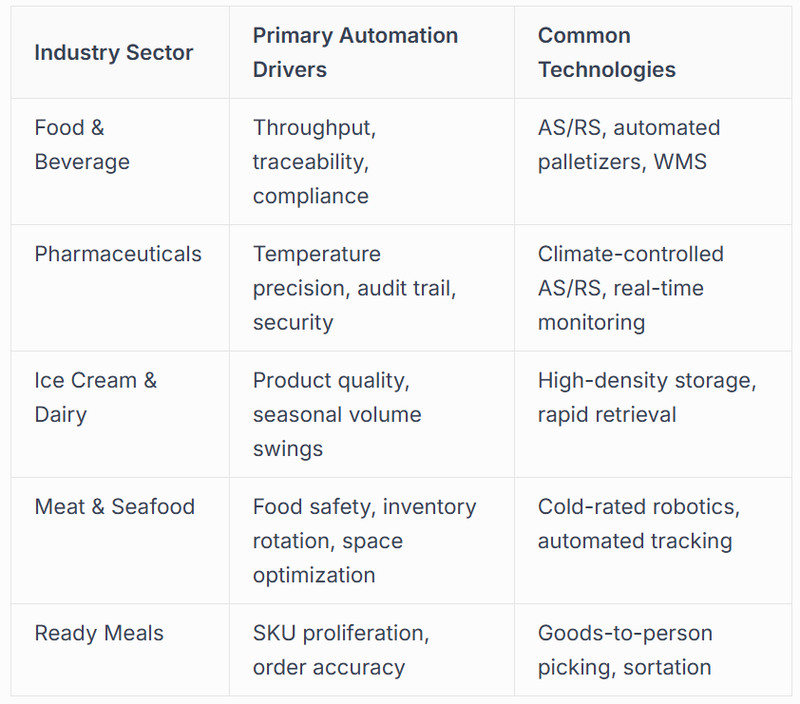
Pharmaceutical and Healthcare Products
Pharmaceutical cold storage demands exceptional temperature control and complete traceability. Automated systems provide the precision and documentation required by regulatory bodies while enabling the rapid response necessary for critical medical supplies.
These facilities often implement redundant refrigeration, backup power systems, and continuous temperature monitoring with automatic alerts-all integrated with automation control systems to ensure product integrity regardless of operational status.
Starting Your Automation Journey
Small and medium enterprises often hesitate to pursue freezer automation due to perceived complexity and capital requirements. However, scalable entry-level solutions enable businesses to begin automation in focused areas before expanding to comprehensive systems.
The Automate-X GTP Starter Grid provides an accessible entry point for warehouses ready to automate picking processes. While designed for ambient conditions, understanding goods-to-person principles prepares organizations for eventual cold storage automation deployment. Starting with manageable automation projects builds internal expertise and demonstrates return on investment, creating momentum for larger freezer automation initiatives.
Energy Efficiency and Sustainability Considerations
Environmental and economic pressures increasingly drive cold storage operators to prioritize energy efficiency. Freezer automation delivers substantial sustainability benefits through multiple mechanisms.
Automated systems minimize air exchange by reducing door openings and optimizing traffic patterns. Each door opening releases cold air and introduces warm, humid air that increases refrigeration load. Some facilities report 30-40% energy savings through automation-driven door management alone.
Advanced systems incorporate energy recovery, LED lighting activated only in occupied zones, and occupancy sensors that enhance energy efficiency in freezer cases. These technologies compound savings beyond the direct benefits of reduced human presence.
Predictive Maintenance and System Reliability
Automated freezer systems generate continuous operational data that enables predictive maintenance approaches. Monitoring motor current, cycle times, and temperature sensors identifies developing issues before failures occur-critical in environments where downtime risks product loss.
Modern systems incorporate sophisticated diagnostics:
- Vibration analysis detects bearing wear and mechanical imbalances
- Thermal imaging identifies electrical hot spots and insulation failures
- Performance trending reveals gradual degradation requiring attention
- Automated lubrication systems ensure consistent maintenance in areas difficult for manual service
This proactive approach minimizes unplanned downtime while optimizing maintenance labour deployment across critical systems.
Future Developments in Cold Storage Automation
The trajectory of freezer automation points toward increasingly sophisticated systems incorporating artificial intelligence, advanced robotics, and novel storage concepts. Research continues into specialized technologies for intermittent power scenarios and extreme cold applications, as evidenced by academic work on backup controllers for intermittently-powered systems.
Machine learning algorithms increasingly optimize storage location assignments, predict demand patterns, and balance workload across equipment to maximize throughput while minimizing energy consumption. These systems learn from historical data to anticipate seasonal patterns, promotional impacts, and operational anomalies.
Collaborative robots designed for safe human interaction in cold environments represent another emerging capability. These systems enable hybrid operations where automation handles bulk movements while humans execute complex picks or quality inspections-combining automation efficiency with human judgment.
The integration of blockchain technology for cold chain documentation, IoT sensors for granular environmental monitoring, and digital twin simulations for operational optimization all indicate expanding capabilities for freezer automation in coming years.
Freezer automation transforms cold storage from a cost centre plagued by inefficiency into a competitive advantage delivering superior performance, safety, and profitability. Whether you operate a pharmaceutical facility requiring precise temperature control or a high-volume food distribution centre, modern automation technologies address the unique challenges of sub-zero environments. Automate-X combines advanced robotics, intelligent software, and system integration expertise to design and implement freezer automation solutions tailored to your specific operational requirements, enabling scalable growth while optimizing every aspect of your cold storage performance.