

Storage and Retrieval System Guide for Modern Warehouses
Share on
The modern warehouse faces unprecedented pressure to deliver faster, store more, and operate with minimal error rates. As e-commerce volumes surge and consumer expectations tighten delivery windows, manual storage processes simply cannot keep pace. A storage and retrieval system (AS/RS) represents a fundamental shift in how warehouses manage inventory, combining robotics, intelligent software, and precision engineering to automate the movement and placement of goods. For logistics providers, manufacturers, and distribution centres across Australia and New Zealand, understanding these systems has become essential for maintaining competitive advantage in 2026.
Understanding Storage and Retrieval System Architecture
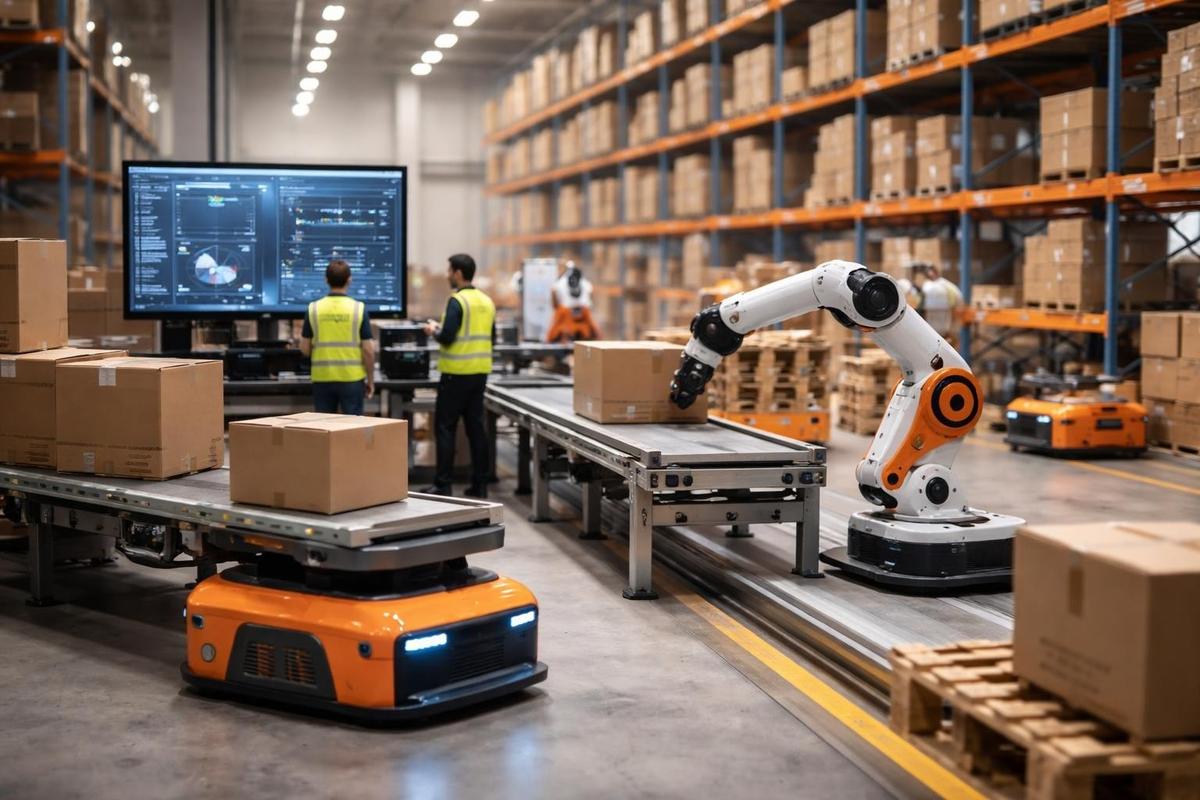
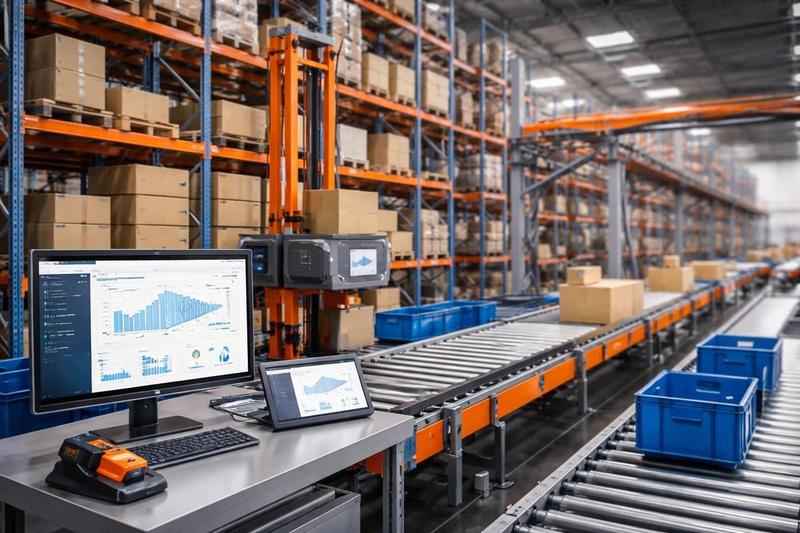
An automated storage and retrieval system comprises several integrated components working in concert to manage inventory with minimal human intervention. At its core, the system consists of storage structures (racks or grids), retrieval mechanisms (shuttles, cranes, or robots), conveyance systems, and control software that orchestrates the entire operation.
Core Components and Their Functions
The physical infrastructure typically includes high-density racking systems designed to maximise vertical space utilisation. These structures can reach heights of 30 metres or more, transforming wasted overhead space into productive storage volume. Retrieval mechanisms vary depending on system type, ranging from traditional stacker cranes that move along fixed aisles to autonomous mobile robots that navigate flexible grid layouts.
Control systems serve as the brain of any storage and retrieval system. These software platforms manage inventory locations, optimise retrieval sequences, coordinate multiple machines simultaneously, and integrate with broader warehouse management systems (WMS) to ensure seamless operations across the facility.
- Storage media: Fixed racks, mobile shelving, or modular grids
- Handling equipment: Stacker cranes, shuttles, conveyors, or robotic arms
- Control software: WMS integration, inventory tracking, task optimisation
- Safety systems: Emergency stops, collision avoidance, access controls
- Power infrastructure: Continuous or battery-powered operation systems
Types of Storage and Retrieval Systems for Different Applications
Selecting the appropriate system type depends heavily on operational requirements, product characteristics, throughput demands, and available capital. Understanding these distinctions enables informed decision-making when evaluating warehouse automation investments.
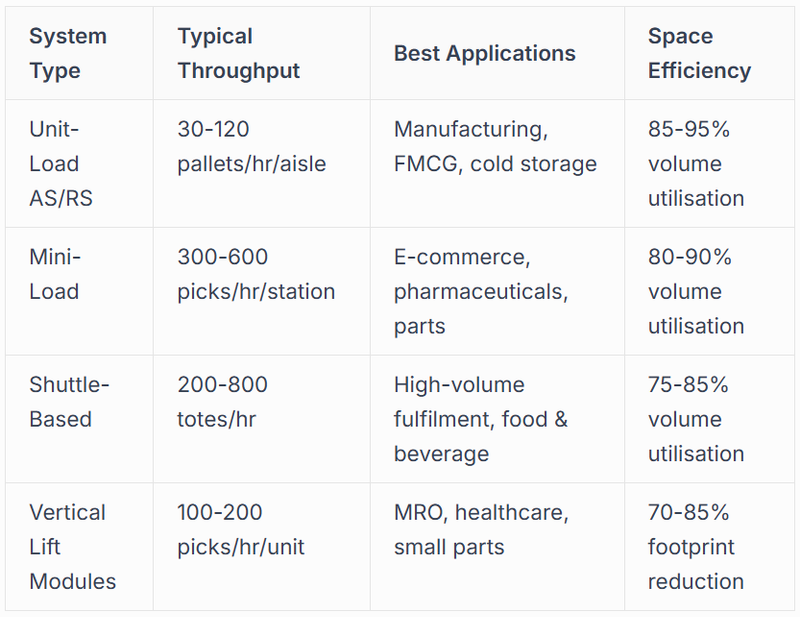
Unit-Load AS/RS
These systems handle full pallets or large containers, making them ideal for high-volume operations moving standardised loads. Unit-load systems excel in manufacturing, FMCG, and bulk distribution environments where products arrive and depart on pallets. Stacker cranes travel along fixed rails, reaching storage positions with precision measured in millimetres.
Performance metrics for unit-load systems typically range from 30 to 120 transactions per hour per aisle, depending on rack height, load weight, and acceleration capabilities. The systems prove particularly valuable for cold storage applications where minimising human exposure to extreme temperatures delivers significant safety and productivity benefits.
Mini-Load and Tote Systems
Designed for smaller items, cartons, or totes, mini-load systems serve e-commerce fulfilment centres, pharmaceutical distribution, and parts warehousing. These compact storage and retrieval system configurations often incorporate goods-to-person picking stations where operators process orders without walking the warehouse floor.
Throughput advantages become apparent in high-SKU environments. By bringing products directly to stationary pickers, mini-load systems can achieve 300 to 600 picks per hour per workstation, dramatically outperforming traditional pick-to-cart methods. Research shows these systems reduce picker travel time by up to 90%, translating directly into labour cost savings.
Shuttle-Based Systems
Shuttle technology represents newer storage and retrieval system innovation, using independent carriers that move horizontally within storage levels while lifts provide vertical transportation. This architecture offers exceptional scalability, as additional shuttles can be deployed to increase throughput without redesigning the entire system.
Vertical Lift Modules and Carousels
Vertical lift modules (VLMs) and horizontal/vertical carousels suit operations with limited floor space but available ceiling height. These enclosed systems protect inventory from dust and damage while delivering items to an ergonomic access point. Pharmaceutical operations particularly value the security and environmental control these systems provide.
Operational Benefits Driving AS/RS Adoption
The decision to implement a storage and retrieval system stems from quantifiable operational improvements that impact the bottom line. Forward-thinking organisations recognise these systems as strategic assets rather than mere equipment purchases.
Space Optimisation and Capacity Expansion
Real estate costs continue climbing across major distribution markets in Sydney, Melbourne, Auckland, and Brisbane. AS/RS technology can increase storage density by 40% to 85% compared with conventional racking, allowing businesses to defer costly facility expansions or accommodate growth within existing footprints. This density advantage comes from eliminating wide picking aisles, maximising vertical space, and reducing safety clearances required for forklift operations.
A comprehensive guide to warehouse automation demonstrates how vertical storage strategies transform underutilised overhead space into productive capacity. For cold storage operations where refrigeration costs run high, this density translates into substantial energy savings.
Labour Efficiency and Ergonomics
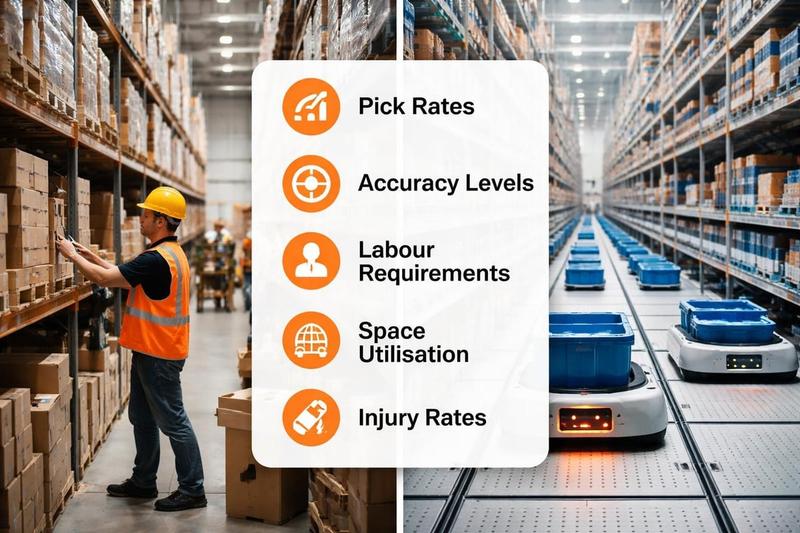
Warehouse labour shortages plague the logistics sector, with vacancy rates exceeding 8% in some Australian markets throughout 2025. A properly designed storage and retrieval system addresses this challenge by reducing labour requirements for storage and picking operations by 50% to 70%. More importantly, remaining staff focus on value-added activities rather than walking kilometres daily searching for products.
Ergonomic benefits cannot be overstated. Repetitive bending, reaching, and lifting contribute to musculoskeletal injuries that increase workers' compensation costs and absenteeism. Goods-to-person configurations eliminate these risk factors, bringing products to comfortable working height and reducing injury rates by up to 65%.
Accuracy and Inventory Control
Manual processes inherently introduce errors. Even experienced warehouse staff achieve picking accuracy rates of only 95% to 98%, meaning two to five errors per hundred picks. These mistakes create customer dissatisfaction, returns processing costs, and expedited shipping expenses to correct problems.
Automated systems routinely achieve 99.9% accuracy or better, reducing picking errors by 90% or more. This precision stems from elimination of human mistakes, barcode verification at every transaction, and systematic location management that prevents misplaced inventory.
- Typical accuracy improvement: 95-98% (manual) to 99.9%+ (automated)
- Inventory visibility: Real-time location tracking for every SKU
- Cycle counting efficiency: Continuous automated counts versus periodic manual audits
- Stock rotation: Automated FIFO/FEFO enforcement for date-sensitive products
For organisations seeking to begin their automation journey, the Automate-X GTP Starter Grid provides an accessible entry point for small and medium businesses looking to automate picking processes without overwhelming capital investment.

Implementation Considerations for Successful Deployment
Installing a storage and retrieval system represents a significant capital commitment and operational transformation. Careful planning separates successful implementations from problematic ones.
Operational Analysis and Sizing
Proper system specification begins with thorough analysis of current and projected operations. Key parameters include daily throughput requirements (inbound receipts, outbound orders, inventory turns), SKU count and velocity distribution, product dimensions and weights, and peak versus average demand patterns.
According to insights from the National Academies on warehouse automation, many organisations underestimate growth projections, resulting in systems that reach capacity sooner than anticipated. Building 30% to 50% overhead capacity ensures the system accommodates future expansion without immediate additional investment.
Integration with Existing Systems
A storage and retrieval system cannot operate in isolation. Seamless integration with warehouse management systems, enterprise resource planning (ERP) platforms, and transportation management systems ensures data flows correctly throughout the supply chain. Integration complexity often determines implementation timeline more than physical installation.
Data synchronisation requires careful attention to inventory transactions, order details, receiving confirmations, and shipping notifications. Developing robust middleware or API connections between systems prevents the data inconsistencies that plague poorly integrated automation projects.
Building and Infrastructure Requirements
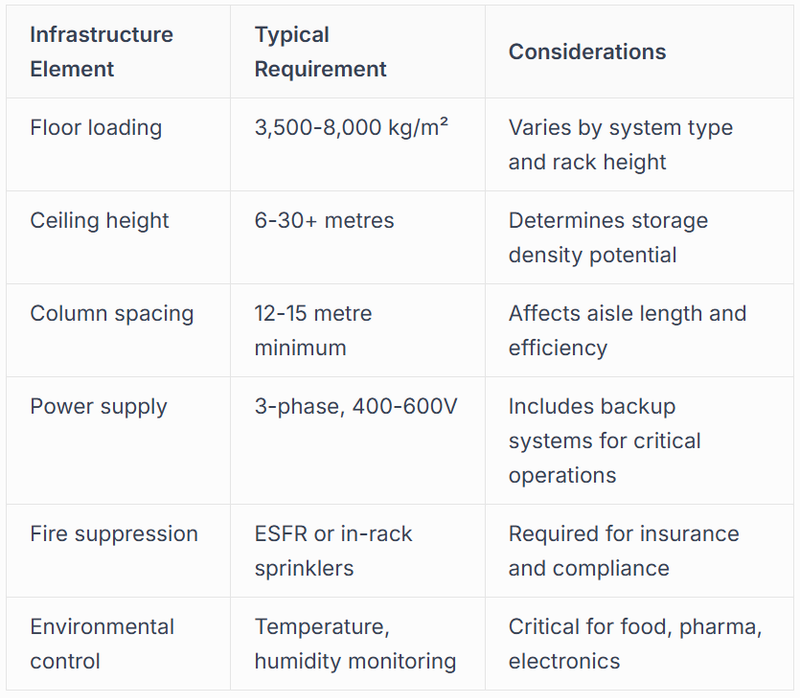
Physical facility modifications often accompany AS/RS installations. Floor loading capacity must support concentrated equipment weight, with some systems requiring reinforced concrete slabs rated for 5,000 kg per square metre or higher. Ceiling heights determine maximum rack elevation, while column spacing affects aisle layout options.
Advanced Technologies Enhancing System Performance
Innovation continues transforming storage and retrieval system capabilities, with recent developments addressing traditional limitations and opening new application possibilities.
Artificial Intelligence and Machine Learning
Modern control systems increasingly incorporate AI algorithms that optimise storage locations based on product velocity, predict demand patterns to pre-position inventory, and learn from historical data to improve retrieval sequencing. Research on optimising bin arrangement in robotic storage systems demonstrates how intelligent location assignment reduces average retrieval times by 15% to 25%.
Machine learning models analyse millions of transactions to identify patterns invisible to human operators. These insights drive continuous improvement in slotting strategies, ensuring fast-moving products occupy easily accessible positions while slower items move to less convenient locations.
Robotics and Collaborative Systems
The convergence of AS/RS technology with autonomous mobile robots (AMRs) creates flexible hybrid systems. Rather than fixed infrastructure alone, these approaches combine permanent storage with mobile robots that transport goods between stations. This flexibility proves valuable in dynamic environments where product mix changes frequently or seasonal variations create dramatic demand swings.
For businesses exploring broader AMR implementation strategies, understanding how these technologies complement traditional AS/RS becomes increasingly important in 2026.
Digital Twin and Simulation
Before committing millions to physical infrastructure, leading organisations now create digital twins-virtual replicas of proposed systems that allow testing different configurations, throughput scenarios, and operational strategies. Simulation identifies bottlenecks, validates capacity assumptions, and optimises layout decisions before breaking ground.
Studies focusing on enhancing automated storage efficiency under uncertainty highlight how simulation-based optimisation improves system design, particularly for grid-based storage operating at maximum capacity where small inefficiencies cascade into significant performance degradation.
Industry-Specific Applications and Considerations
Different sectors leverage storage and retrieval system capabilities in ways tailored to their unique operational requirements and regulatory environments.
E-commerce and Omnichannel Retail
The explosion of online shopping demands systems capable of processing thousands of individual item picks daily. E-commerce operations benefit from mini-load and shuttle systems that support high-velocity picking for single-unit orders while maintaining accuracy essential for customer satisfaction.
Omnichannel complexity requires systems that seamlessly handle both bulk store replenishment and individual consumer orders from the same inventory pool. Advanced storage and retrieval system configurations separate these workflows, preventing interference between large-batch store orders and urgent individual shipments.
Pharmaceutical and Healthcare
Regulatory compliance drives pharmaceutical AS/RS adoption. These systems provide complete chain-of-custody tracking, environmental monitoring, and lot/serial number management required by regulatory authorities. Temperature-controlled modules maintain products within specified ranges while automated FEFO (first-expired, first-out) rotation prevents waste from expiry.
Security features including restricted access, audit trails, and controlled substance tracking make AS/RS essential infrastructure for pharmaceutical distribution. The systems' accuracy also reduces costly medication errors that create patient safety risks and liability exposure.
Food and Beverage Distribution
Temperature control, batch tracking, and rapid throughput define food and beverage requirements. Cold storage AS/RS operations minimise human exposure to freezer environments while maximising cubic storage in expensive refrigerated space. Automated systems maintain inventory rotation critical for managing shelf-life limitations.
Fresh produce distributors increasingly deploy storage and retrieval system technology to accelerate order processing during narrow overnight windows when products move from grower to retailer. Research on warehouse optimisation for enhanced storage and retrieval efficiency demonstrates how clustering algorithms and dynamic routing improve performance in these time-sensitive applications.
Manufacturing and Automotive
Just-in-time manufacturing demands reliable parts availability without excess inventory investment. AS/RS technology supports lean manufacturing by storing thousands of component SKUs in minimal space while delivering parts to production lines precisely when needed. The systems' accuracy prevents costly line stoppages caused by wrong-part delivery or stock-outs.
Automotive operations particularly value the ability to manage complex part variations, with some vehicle assembly facilities tracking 30,000+ unique components. Automated storage provides the density and retrieval speed that make this complexity manageable.
Financial Justification and ROI Considerations
While a storage and retrieval system requires substantial capital investment, the business case often proves compelling when all factors receive consideration.
Capital Costs and Investment Ranges
System costs vary dramatically based on type, size, and complexity. Entry-level vertical lift modules start around $100,000 NZD, while comprehensive unit-load installations for large distribution centres may exceed $15 million. Shuttle-based systems typically fall between $2 million and $8 million depending on configuration.
Total cost of ownership extends beyond equipment purchase to include installation, integration, training, and ongoing maintenance. Realistic budgeting allocates 15% to 25% of hardware costs for integration and another 3% to 5% annually for maintenance and support.
Payback Periods and Cost Savings
Labour savings typically drive financial justification, though the complete picture includes multiple factors:
- Direct labour reduction: 50-70% fewer staff for storage/retrieval operations
- Space savings: Deferred facility expansion worth $500-$1,200 per square metre
- Accuracy improvements: Reduced error costs, returns processing, expedited shipping
- Productivity gains: Higher throughput from existing staff
- Inventory optimisation: Better stock management reduces carrying costs
- Safety benefits: Lower injury rates decrease workers' compensation expenses
Comprehensive analyses typically show payback periods of 3 to 7 years, with faster returns in high-labour-cost markets or operations experiencing rapid growth. The benefits of automating warehouses with AS/RS include improvements in reliability and safety that contribute to positive ROI beyond pure cost reduction.
Risk Mitigation Through Phased Implementation
Rather than transforming entire operations overnight, many organisations pursue phased approaches that reduce risk and demonstrate value before expanding. Initial zones might automate highest-velocity products or most labour-intensive processes, proving the concept and building internal expertise before broader rollout.
This strategy also addresses the challenge of operating existing warehouse processes while new systems come online. Phased implementations maintain business continuity and allow learning from early phases to inform subsequent expansions.
Maintaining and Optimising System Performance
Even the most sophisticated storage and retrieval system requires ongoing attention to deliver sustained value. Proactive maintenance and continuous optimisation separate high-performing operations from those that struggle with reliability issues.
Preventive Maintenance Strategies
Equipment reliability directly impacts warehouse operations. An AS/RS failure can halt order processing, creating costly delays and customer service problems. Structured preventive maintenance programmes include daily operator checks, weekly detailed inspections, monthly component servicing, and annual comprehensive overhauls.
Predictive maintenance technologies monitor vibration, temperature, power consumption, and performance metrics to identify developing problems before failures occur. Sensors detect bearing wear, hydraulic leaks, or electrical anomalies, triggering maintenance interventions during planned downtime rather than emergency repairs during peak operations.
Modern systems often include remote monitoring capabilities allowing equipment suppliers to track performance, diagnose issues, and schedule service proactively. This approach reduces unplanned downtime by 40% to 60% compared with reactive maintenance strategies.
Performance Monitoring and Continuous Improvement
Key performance indicators (KPIs) provide visibility into system effectiveness and identify optimisation opportunities. Essential metrics include throughput rates, cycle times, equipment utilisation, error rates, and energy consumption. Comparing actual performance against design specifications reveals whether the system delivers expected value.
Advanced approaches like deep reinforcement learning for efficient retrieval in multi-deep storage systems address challenges such as lane blockages that degrade performance over time. These AI-driven optimisation techniques continuously improve retrieval strategies as inventory patterns evolve.
Those interested in deeper technical understanding of these systems may find value in exploring AS/RS system warehouse implementation approaches and best practices.
Storage and retrieval system technology has evolved from niche industrial automation into essential infrastructure for competitive warehouse operations across e-commerce, manufacturing, pharmaceuticals, and distribution sectors. The combination of space optimisation, labour efficiency, accuracy improvements, and scalability makes these systems increasingly attractive as operational pressures intensify. Whether you're managing a growing 3PL operation, expanding e-commerce fulfilment capacity, or seeking to optimise manufacturing logistics, Automate-X delivers intelligent warehouse automation solutions tailored to your specific requirements, combining modern robotics, warehouse software, and system integration expertise to streamline operations and enable sustainable growth.