


Guide to Custom Automation Solutions: Transform Your Business 2026
Share on
In 2026, businesses that invest in custom automation solutions are setting the pace for innovation and redefining industry benchmarks. These tailored technologies are transforming operations, driving sustainable growth, and ensuring resilience in an evolving marketplace. This guide delivers a clear roadmap to help you evaluate, implement, and optimise custom automation solutions for meaningful business transformation. Explore the fundamentals, step-by-step implementation, emerging technology trends, ROI analysis, real-world case studies, and strategic insights for long-term success. Discover how to gain a competitive edge and take decisive action with a practical, results-driven approach.
Understanding Custom Automation Solutions
Custom automation solutions are transforming how businesses operate in 2026, offering a tailored approach that sets them apart from generic, off-the-shelf systems. Unlike standard automation, custom automation solutions are specifically designed to integrate seamlessly with unique workflows, scale as operations grow, and adapt to changing market needs. Core elements include integration with existing technologies, scalability, and adaptability for future requirements. Examples span bespoke robotics, advanced process instrumentation, and customised software. Industry leaders highlight the value of aligning automation with business objectives, as seen in competitor case studies. For further insights, visit the Industrial automation and robotics overview page.
What Are Custom Automation Solutions?
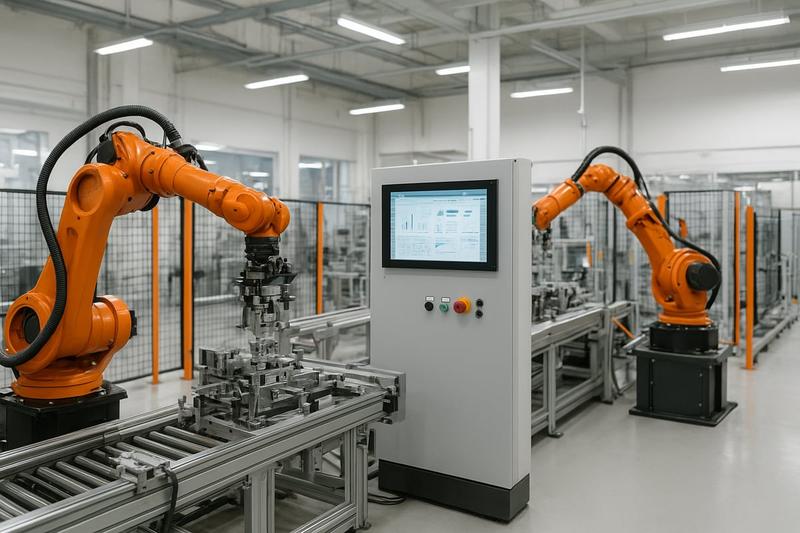
Custom automation solutions differ from off-the-shelf systems because they are engineered for the specific needs of an organisation. These solutions focus on integrating with existing processes, ensuring scalability, and providing adaptability for future changes.
Key elements include:
- Seamless integration with IT and operational infrastructure
- Scalability to accommodate business growth
- Adaptability to unique or evolving workflows
Examples include bespoke robotics for assembly lines, tailored process instrumentation, and industry-specific software. Industry leaders report that custom automation solutions deliver measurable improvements when aligned with business goals and supported by experienced partners.
Key Benefits for Modern Businesses
Implementing custom automation solutions delivers a range of significant benefits for modern businesses. Increased productivity and throughput help teams achieve more in less time. Error reduction and consistent quality lead to fewer defects and improved customer satisfaction.
Other advantages include:
- Labour cost savings through process optimisation
- Enhanced safety for workers through automation of hazardous tasks
- Real-time monitoring for data-driven decision-making
For instance, pharmaceutical and logistics sectors have achieved measurable gains in efficiency and compliance using custom automation solutions. These results highlight the transformative potential for companies ready to embrace tailored automation.
Common Applications Across Industries
Custom automation solutions are now found in diverse sectors, driving innovation and efficiency. In manufacturing, they power robotics, automated assembly, and quality control. Logistics companies rely on warehouse automation, order fulfilment systems, and inventory tracking.
Key industry applications:
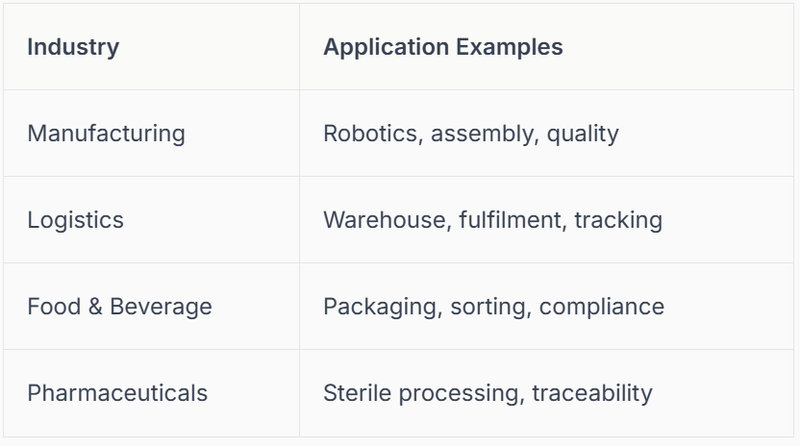
Customisation also benefits FMCG, automotive, and cold storage operations. According to recent industry data, automation adoption rates continue to rise, with custom automation solutions leading the way in flexible and scalable deployments.
Why 2026 Is a Pivotal Year
The year 2026 marks a turning point for custom automation solutions, as digital transformation accelerates across industries. Advances in artificial intelligence, IoT, and robotics have made bespoke automation more accessible than ever.
Key factors shaping this shift:
- Ongoing labour shortages and increasing operational costs
- Rising customer expectations for speed and accuracy
- Evolving regulations and the need for resilient supply chains
Market forecasts project significant investment in automation by 2026, reflecting the urgency for businesses to adapt. Custom automation solutions are essential for staying competitive and future-proofing operations in a rapidly changing environment.
Step-by-Step Guide to Implementing Custom Automation
Embarking on a journey toward custom automation solutions can transform your business operations and future-proof your organisation. Following a structured, proven process ensures success, minimises risk, and helps you realise the full potential of automation. Let’s break down each critical step.
Step 1: Assessing Your Business Needs
The first step in adopting custom automation solutions is a thorough assessment of your current operations. Start by mapping out workflows across departments to identify bottlenecks, repetitive tasks, and inefficiencies. Engage stakeholders from multiple teams to ensure every pain point is addressed.
Set clear objectives for automation, focusing on desired outcomes such as cost reduction, improved quality, or faster turnaround times. For example, a distribution centre comparing manual picking to automated systems may discover significant time and accuracy gains. Through careful analysis, you lay the groundwork for tailored custom automation solutions that fit your unique business needs.
Step 2: Solution Design and Vendor Selection
Designing the right solution begins with collaboration between your team, automation consultants, and engineers. Define technical requirements, such as integration points with existing software or machinery, and ensure solutions are scalable and adaptable.
When evaluating vendors, prioritise those with industry expertise and a proven track record in delivering custom automation solutions. Assess whether a build, buy, or hybrid approach is most suitable. Reviewing Custom Automation Case Studies can provide valuable insights into successful partnerships and solution outcomes across various sectors.
Step 3: Prototyping and Testing
Before full-scale deployment, build a prototype or pilot system to validate the solution in real-world conditions. Simulate daily operations and stress-test the system to uncover any potential issues. Use feedback from operators and stakeholders to make iterative improvements.
Compliance with industry standards is critical at this stage. For instance, testing robotic picking in a third-party logistics warehouse helps ensure the custom automation solutions meet both operational and regulatory requirements. This step minimises risk and refines the solution before rollout.
Step 4: Deployment and Integration
Deploying custom automation solutions requires careful planning to avoid disrupting ongoing operations. Implement phased rollouts, starting with a single line or department, then expanding as confidence grows. Integrate the new system with existing IT and OT infrastructure, such as warehouse management or ERP systems.
Comprehensive staff training is essential for smooth adoption. Address change management concerns proactively to build buy-in and reduce resistance. Ensure robust data security measures are in place, and monitor initial performance closely to address issues quickly and maintain reliability.
Step 5: Optimisation and Scaling
Once deployed, custom automation solutions should be continually optimised using operational data. Analyse system performance, identify opportunities for adjustment, and expand automation to additional processes or sites as needed.
Leverage AI and machine learning for predictive maintenance and continuous improvement. Plan for future scalability by designing modular systems that adapt to changing business needs. For example, manufacturing sites often scale from single-line to multi-line automation, maximising long-term benefits.
Step 6: Measuring Impact and ROI
To demonstrate the value of your custom automation solutions, establish clear KPIs such as productivity, accuracy, cost savings, and safety improvements. Benchmark performance before and after implementation to quantify gains.
Regularly gather feedback from stakeholders and end-users to ensure the system continues to meet business objectives. Communicate results to leadership using data-driven reports, and reference industry benchmarks to validate your ROI. This ongoing measurement process secures support for future automation initiatives and continuous investment.
Technology Trends Shaping Custom Automation in 2026
The technology landscape in 2026 is evolving at a rapid pace, with innovations reshaping how businesses deploy custom automation solutions. Staying ahead of these trends is key for companies aiming to transform operations, remain competitive, and future-proof their investment.
Artificial Intelligence and Machine Learning
Artificial intelligence is at the core of custom automation solutions in 2026, enabling smarter, self-optimising systems. Machine learning algorithms analyse vast data streams to predict maintenance needs, optimise workflows, and enhance quality control.
Adaptive robotics now learn from their environment, adjusting tasks in real time for greater efficiency. AI-driven anomaly detection ensures consistent product quality and minimises costly errors. For example, AI-powered warehouse picking systems can quickly adapt to changing order patterns, boosting throughput.
For an in-depth look at AI’s transformative role, see Machine learning in manufacturing.
Industrial Internet of Things (IIoT)
The Industrial Internet of Things is transforming custom automation solutions by connecting machines, sensors, and devices across entire facilities. IIoT enables real-time data collection and analysis, which supports predictive maintenance, energy monitoring, and immediate fault detection.
Remote monitoring and diagnostics become effortless, allowing teams to manage multiple sites from a central location. Enhanced supply chain visibility leads to more agile decision-making and faster response times. Competitors leveraging IIoT report significant gains in process instrumentation and operational uptime.
This interconnected approach allows businesses to unlock new efficiencies and drive continuous improvement.
Advanced Robotics and Collaborative Automation
Robotics technology has advanced rapidly, making custom automation solutions more flexible and human-centric. Collaborative robots, or cobots, now work safely alongside human operators, handling repetitive or hazardous tasks while employees focus on higher-value activities.
Flexible robotic arms and Automated Guided Vehicles (AGVs) adjust quickly to new products or process changes. Safety improvements, such as advanced sensors and intuitive interfaces, reduce risks and enable seamless integration.
In pharmaceutical assembly, collaborative automation supports sterile handling requirements and improves consistency, demonstrating the real-world impact of these innovations.
Cloud Integration and Edge Computing
Cloud integration is a game-changer for custom automation solutions, providing scalable control and analytics platforms accessible from anywhere. Businesses benefit from centralised data storage, advanced reporting, and secure remote management.
Edge computing complements cloud systems by processing data locally for rapid decision-making and low-latency responses. This combination ensures system resilience and supports real-time automation control.
With cloud and edge technologies, companies can scale automation projects confidently, knowing their infrastructure supports growth and adaptability.
Sustainable and Energy-Efficient Automation
Sustainability is now a core focus, with custom automation solutions designed for energy efficiency and resource optimisation. Automated systems feature advanced monitoring to track energy use and identify opportunities for savings.
Green manufacturing practices are easier to implement, reducing waste and aligning with regulatory requirements. Automated reporting streamlines compliance, and businesses can benefit from incentives for sustainable operations.
By prioritising energy efficiency and sustainability, companies not only lower costs but also strengthen their market reputation and long-term resilience.
Evaluating ROI and Business Impact
Investing in custom automation solutions is a strategic decision that can reshape a business’s future. However, to secure leadership buy-in and maximise long-term value, it’s essential to thoroughly evaluate the return on investment (ROI) and overall business impact. This section breaks down the core aspects of ROI analysis, performance improvement, competitive positioning, and common pitfalls to ensure your automation journey is both measurable and sustainable.
Cost-Benefit Analysis of Custom Automation
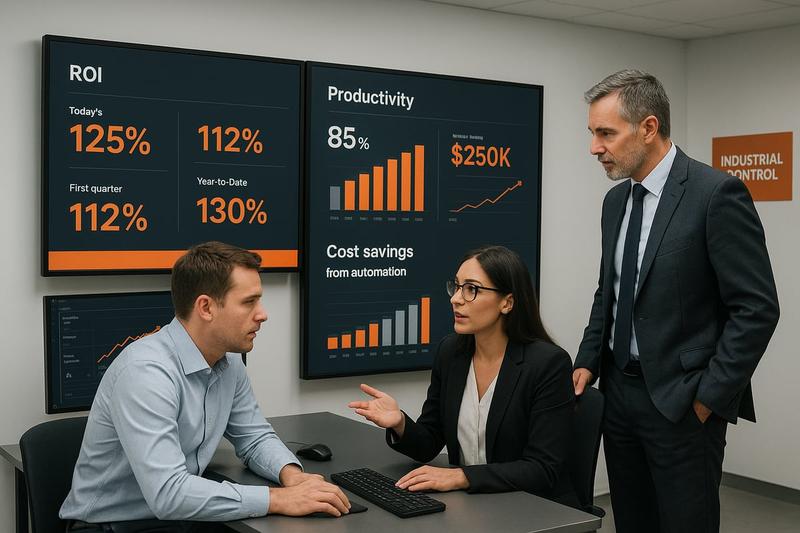
A robust cost-benefit analysis sets the foundation for any custom automation solutions project. Initial investment can be significant, covering design, hardware, integration, and staff training. However, these costs are offset by long-term gains in efficiency, reduced downtime, and fewer manual errors.
Consider both direct cost savings, such as lower labour expenses, and indirect benefits like improved product quality. Calculating total cost of ownership and payback period is critical. For instance, logistics or manufacturing operations often see ROI within two to three years. According to the Industrial Automation Market Analysis 2026, businesses adopting custom automation solutions are projected to experience higher operational margins and sustained growth through 2026.
Operational Performance Improvements
Custom automation solutions consistently deliver measurable improvements in operational performance. Businesses report increased throughput, faster cycle times, and enhanced consistency in product quality. For example, food and beverage producers implementing automated lines have achieved significant reductions in waste and rework.
A summary of operational improvements:
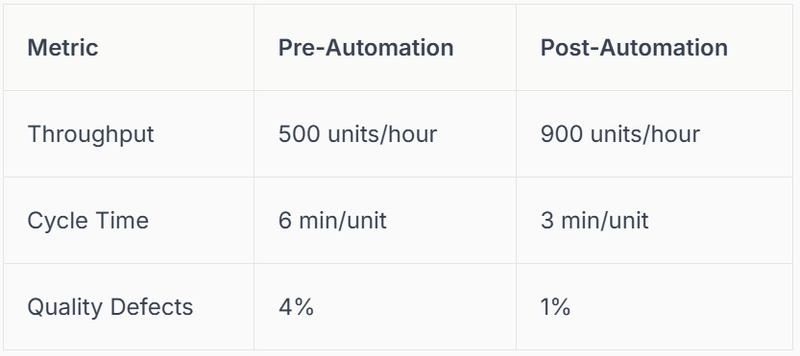
Additionally, automation reduces workplace injuries by minimising manual handling. Custom automation solutions also support compliance by enabling precise data capture and traceability.
Competitive Advantage and Market Agility
The right custom automation solutions empower organisations to respond quickly to market changes. Automated processes enable rapid scaling during peak demand and facilitate product customisation for niche markets.
E-commerce fulfilment centres, for example, leverage automation to adapt to seasonal spikes, maintaining delivery speed and accuracy. Supply chain resilience is strengthened as automation mitigates risks linked to labour shortages and fluctuating demand. With custom automation solutions, businesses can launch new offerings faster, gaining a clear edge over competitors stuck with manual or off-the-shelf systems.
Common Pitfalls and How to Avoid Them
Despite the benefits, some businesses encounter challenges when deploying custom automation solutions. Underestimating the need for change management can hinder adoption. Integration issues with legacy systems may disrupt operations if not addressed early.
To avoid these pitfalls:
- Prioritise comprehensive staff training and ongoing support.
- Conduct thorough integration testing with existing platforms.
- Address cybersecurity and data privacy from the outset.
- Learn from failed automation projects by reviewing case studies and seeking expert advice.
By proactively managing these risks, businesses ensure their custom automation solutions deliver sustainable, long-term value.
Real-World Case Studies and Success Stories
From manufacturing to pharmaceuticals, custom automation solutions are delivering measurable value across industries. The following real-world examples illustrate how tailored technology is transforming operations, improving performance, and setting new benchmarks for success.
Innovative Automation: customised automation solutions for the industry [Use Case]
Manufacturing Sector: Bespoke Robotics Integration
A leading manufacturer faced bottlenecks in their assembly line, limiting productivity and increasing operational costs. By implementing custom automation solutions such as bespoke robotics and process instrumentation, the company streamlined repetitive tasks and improved quality control.
These solutions were tailored to fit unique production needs, integrating seamlessly with existing workflows. As a result, they achieved a 25% increase in throughput, a 15% reduction in defects, and faster time to market. Competitor case studies in pharmaceutical manufacturing further support the effectiveness of custom automation solutions in driving consistent, high-quality output.
Logistics and Warehousing: Automated Fulfilment Centres
In the logistics sector, a major third-party logistics provider modernised its fulfilment centre by deploying custom automation solutions. Advanced ASRS (Automated Storage and Retrieval Systems) and conveyor technologies were integrated to optimise order picking and inventory management.
Staff were upskilled for oversight roles, and real-time data enabled higher accuracy and responsiveness. Order accuracy improved by 30%, while labour costs dropped significantly. Industry adoption rates of warehouse automation, as detailed in 7 ways logistics automation is transforming 2026, show that custom automation solutions are quickly becoming the standard for competitive logistics operations.
Food & Beverage: Process Automation for Compliance
A New Zealand food processing company sought to meet strict regulatory standards and improve product traceability. They selected custom automation solutions for packaging, sorting, and continuous compliance monitoring.
These systems ensured every product was tracked from production to delivery, reducing the risk of recalls and boosting consumer confidence. The company saw a 20% reduction in compliance-related incidents and achieved faster, more efficient throughput. Custom automation solutions have proven essential for maintaining quality and regulatory adherence in the food and beverage sector.
Pharmaceuticals: Lab and Production Automation
Pharmaceutical manufacturers require sterile, compliant, and highly accurate operations. By leveraging custom automation solutions for sterile processing, lab automation, and integration with Manufacturing Execution Systems (MES), companies achieved higher data integrity and reduced manual intervention.
These tailored systems delivered faster time-to-market and improved safety for both products and staff. As highlighted in Automation in pharma sector, custom automation solutions are now critical for meeting complex regulatory requirements and ensuring competitive advantage in pharmaceutical production.
Strategic Considerations for Long-Term Automation Success
Achieving long-term success with custom automation solutions involves more than just implementation. Businesses must adopt a forward-thinking approach that prioritises innovation, adaptability, and ongoing improvement. These strategic considerations will help you sustain value and maintain a competitive edge as technology and market demands evolve.
Building a Culture of Innovation and Change
Embedding custom automation solutions into your organisation starts with leadership. Visionary leaders set the tone for a culture that embraces innovation and continuous improvement. Clear communication about the benefits and future potential of automation helps reduce resistance and encourages buy-in across all levels.
Employee engagement is crucial. Upskilling and involving staff in automation projects fosters ownership and trust. Cross-functional collaboration can break down silos, enabling better problem-solving and creative thinking. Companies that champion a culture of innovation often see smoother transitions and greater long-term benefits from custom automation solutions.
Future-Proofing Your Automation Investments
The pace of technological change means your custom automation solutions must be designed with flexibility in mind. Modular systems allow for easier upgrades and expansions, helping you stay ahead of industry trends and avoid costly overhauls.
Partner with vendors who prioritise research and innovation. Regularly review your technology roadmap to identify opportunities for improvement. According to the U.S. Manufacturers' Automation Adoption Report, companies that proactively invest in scalable and adaptable automation are better positioned to navigate future disruptions. Making future-proofing a core part of your custom automation solutions strategy will safeguard your investments.
Data Security, Privacy, and Compliance
As you deploy custom automation solutions, protecting sensitive data becomes paramount. With increasing connectivity and integration, the risk of cyber threats grows. Implement robust cybersecurity protocols, including network segmentation, regular audits, and employee training on security best practices.
Meeting evolving regulatory requirements is another critical factor. Choose automation platforms that support compliance tracking and reporting. For organisations in highly regulated sectors, dependable and secure automation is essential. Explore research like the Flexible Development of Dependability Services to better understand how custom automation solutions can be designed for maximum reliability and compliance.
Custom vs. Off-the-Shelf: Making the Right Choice
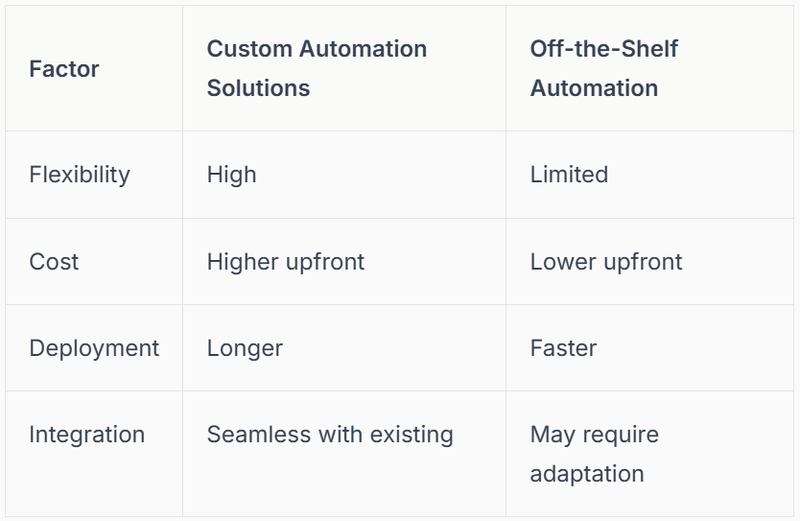
When considering automation, weigh the pros and cons of custom automation solutions versus off-the-shelf options. Custom solutions offer flexibility and alignment with unique business processes, while off-the-shelf products may deliver faster deployment and lower upfront costs.
A hybrid approach can sometimes provide the best of both worlds, allowing businesses to customise critical areas while leveraging proven standard modules. Evaluate your organisation’s needs, resources, and long-term goals before deciding. In logistics, for example, hybrid solutions can be phased in to minimise risk and ensure a smooth transition.
Maximising Employee Value in Automated Operations
Introducing custom automation solutions is not about replacing people but empowering them. As automation takes over repetitive tasks, employees can be repositioned into more valuable roles such as system oversight, maintenance, and optimisation.
Upskilling programmes are essential for helping staff transition into these new responsibilities. This shift not only improves job satisfaction but also enhances retention and innovation. For example, warehouse staff can become automation supervisors, ensuring that your custom automation solutions continue to operate efficiently and adapt to changing business needs.
Continuous Improvement and Scaling
Sustained success with custom automation solutions depends on ongoing optimisation. Establish regular feedback loops with employees and monitor performance metrics to identify areas for improvement.
Use analytics to guide decision-making and plan for future scaling. As highlighted in recent industry reports, businesses that treat automation as an evolving journey rather than a one-off project achieve greater returns and resilience. Staying informed about market trends and learning from peer experiences will position your organisation to expand automation effectively and maximise impact.
As we’ve explored, embracing custom automation can truly transform your warehouse operations, streamline your supply chain, and set your business up for scalable growth in 2026 and beyond. If you’re ready to take the next step towards improved productivity, cost savings, and future readiness, now is the perfect time to act. Let’s work together to move your business forward with intelligent automation tailored to your needs.
Start Your Automation Journey
and discover how you can stay ahead of the competition while building a smarter, more resilient operation.