

Warehouse Automation Companies: 2026 Selection Guide
Share on
The global logistics landscape has shifted dramatically as businesses seek competitive advantages through technology-driven efficiency. Warehouse automation companies now play a pivotal role in transforming distribution and fulfillment operations, offering solutions that range from basic mechanisation to fully autonomous facilities. With warehouse automation market growth accelerating, organisations across logistics, e-commerce, pharmaceuticals, and manufacturing sectors increasingly rely on specialised providers to navigate complex implementation challenges and deliver measurable operational improvements.
Understanding the Warehouse Automation Ecosystem
The warehouse automation sector encompasses a diverse range of providers, each offering distinct capabilities and technological approaches. When evaluating potential partners, organisations must understand the fundamental differences between solution categories.
Hardware-Focused Providers
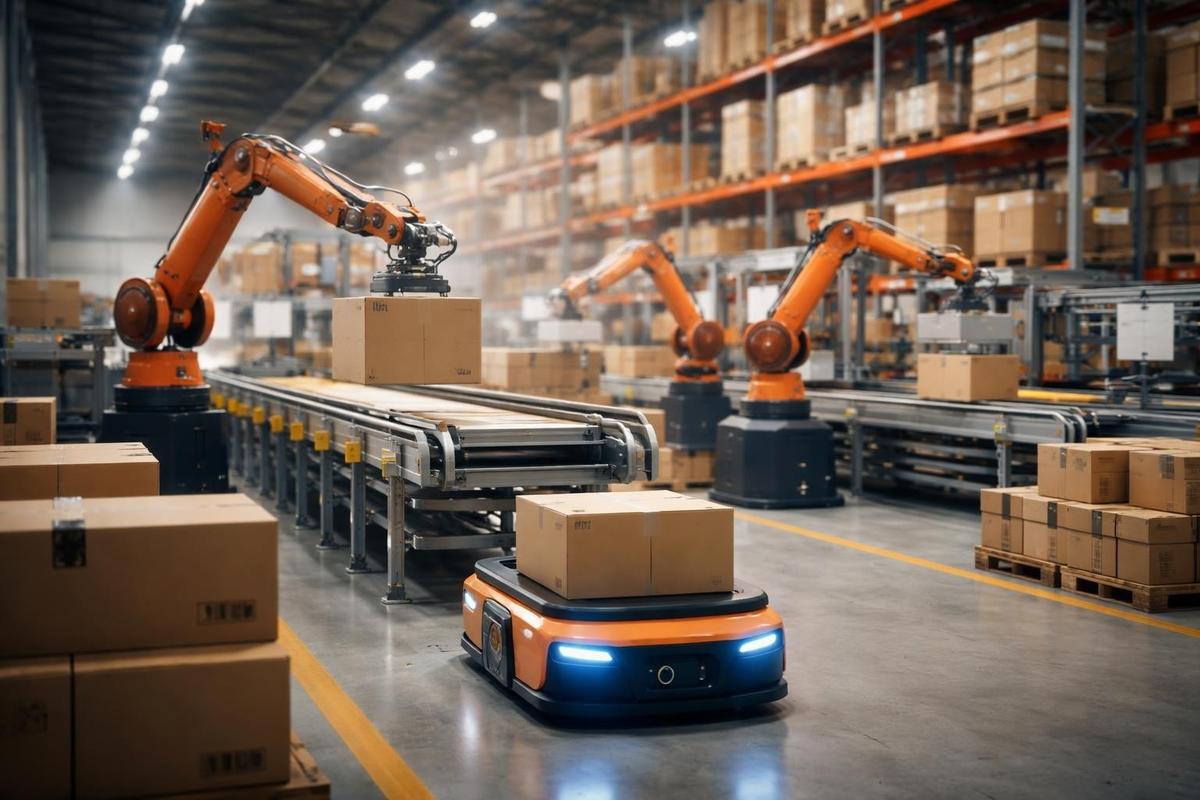
Companies specialising in physical automation equipment form the foundation of warehouse modernisation efforts. These providers manufacture and implement:
- Automated storage and retrieval systems (AS/RS) for high-density storage
- Conveyor networks and sortation equipment
- Robotic picking arms and palletising units
- Autonomous mobile robots (AMRs) and automated guided vehicles (AGVs)
Hardware vendors typically offer robust engineering capabilities and proven mechanical solutions. Their expertise lies in designing systems that withstand demanding operational environments whilst delivering consistent performance across multi-shift operations.
Software and Control System Specialists
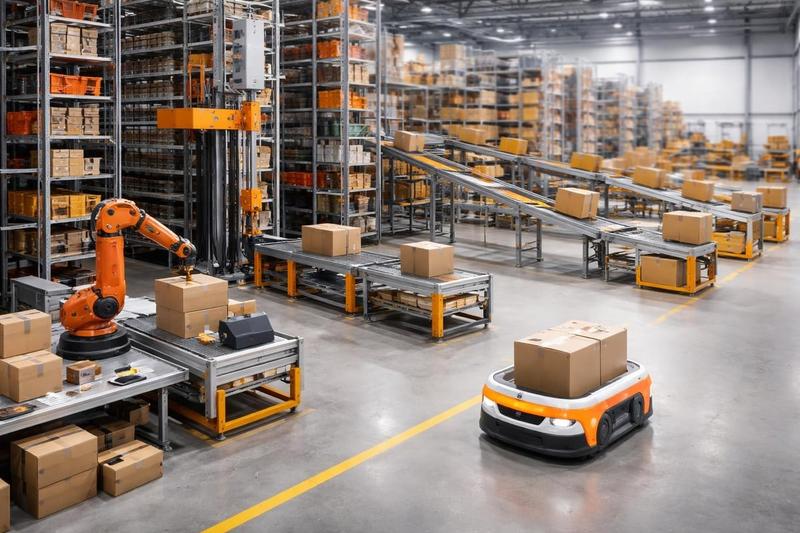
Integration between physical equipment and intelligent software separates functional automation from truly transformative solutions. Modern warehouse automation requires sophisticated warehouse control systems (WCS) and warehouse management systems (WMS) that orchestrate complex workflows.
Software-focused warehouse automation companies deliver:
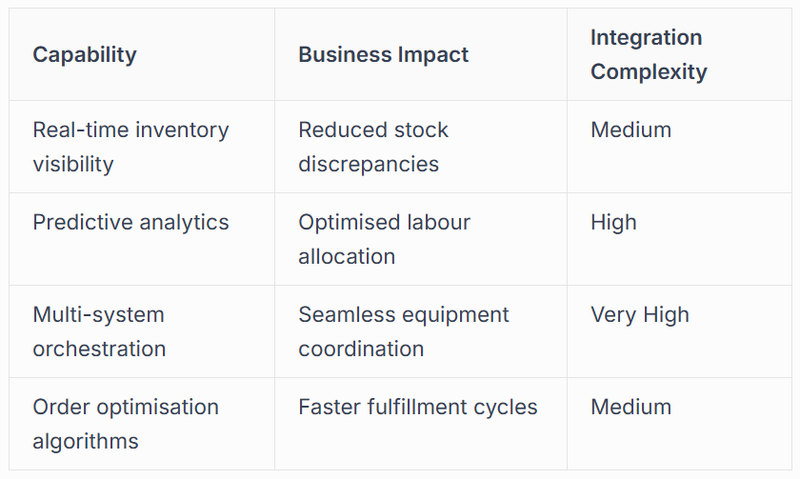
These providers often partner with hardware manufacturers to create comprehensive solutions that maximise return on investment through intelligent operational decision-making.
Full-Service Integration Partners
Comprehensive warehouse automation companies offer end-to-end capabilities spanning consultation, design, implementation, and ongoing support. This approach proves particularly valuable for organisations undertaking significant transformation initiatives.
Full-service providers manage project complexity by coordinating multiple technology components, ensuring compatibility, and delivering single-source accountability. Their expertise in goods-to-person systems and integrated solutions reduces implementation risk whilst accelerating time-to-value.
Key Selection Criteria for Automation Partners
Choosing the right automation partner requires systematic evaluation across multiple dimensions. Organisations that approach vendor selection strategically achieve superior outcomes and avoid costly missteps.
Technical Capabilities and Innovation
Leading warehouse automation companies distinguish themselves through ongoing investment in research and development. Warehouse automation trends for 2025 highlight the accelerating pace of technological advancement, making innovation capacity a critical selection factor.
Evaluate potential partners on:
- Proprietary technology development and intellectual property portfolio
- Integration capabilities with existing enterprise systems
- Scalability architecture supporting future growth requirements
- Artificial intelligence and machine learning deployment experience
- Robotics-as-a-Service (RaaS) and flexible deployment models
The most capable providers demonstrate not just current technical competence but also strategic vision for emerging technologies and their practical application in warehouse environments.
Industry-Specific Experience
Operational requirements vary significantly across sectors, making domain expertise essential. Warehouse automation companies serving pharmaceutical operations face different challenges than those focused on e-commerce fulfillment or food and beverage distribution.
Sector-specific considerations include temperature control requirements, regulatory compliance frameworks, product handling characteristics, and throughput patterns. Providers with relevant industry experience deliver solutions optimised for specific operational contexts rather than generic approaches requiring extensive customisation.
Implementation Methodology and Support
Technical excellence means little without effective implementation practices. The delivery approach warehouse automation companies employ directly impacts project outcomes, timeline adherence, and operational disruption.
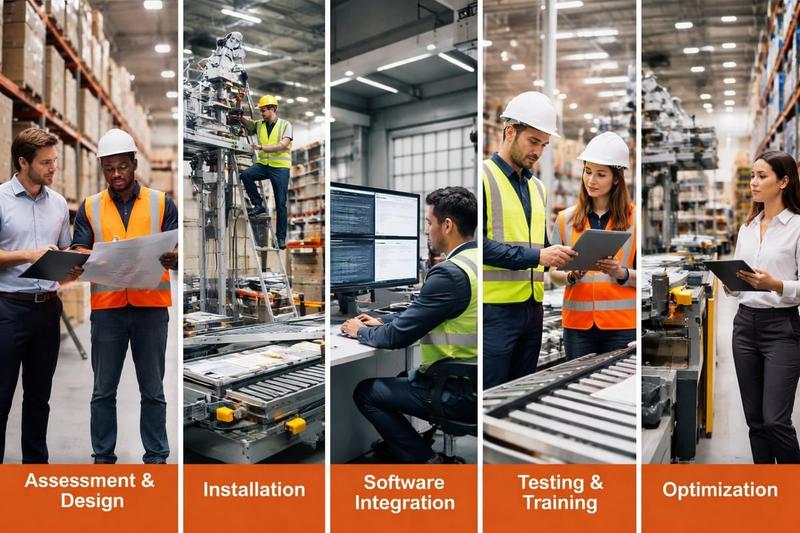
Strong implementation partners provide:
- Comprehensive site assessment and operational analysis
- Detailed simulation and capacity modelling
- Phased deployment strategies minimising business interruption
- Extensive operator training and change management support
- Ongoing maintenance and system optimisation services
Post-implementation support quality often differentiates successful long-term partnerships from transactional vendor relationships. Automated storage and retrieval systems require sustained technical support to maintain peak performance and adapt to evolving business requirements.
Technology Categories Offered by Leading Providers
Understanding the breadth of available automation technologies helps organisations identify providers matching their specific requirements. Modern warehouse automation companies typically offer solutions across several core categories.
Autonomous Mobile Robots and AGVs
Mobile robotics represent one of the fastest-growing segments within warehouse automation. These systems provide flexible material movement without fixed infrastructure investment required by traditional conveyor networks.
AMR capabilities include collaborative operation alongside human workers, dynamic path planning, and adaptability to changing facility layouts. Amazon's expansion of warehouse robots demonstrates large-scale adoption by industry leaders, validating the technology's maturity and effectiveness.
AGVs offer proven reliability for repetitive transport tasks along defined routes, whilst newer AMR platforms provide enhanced flexibility through artificial intelligence-driven navigation. Both technologies continue advancing rapidly, with warehouse automation companies developing increasingly sophisticated solutions.
Storage and Retrieval Systems
High-density storage automation transforms warehouse space utilisation and retrieval efficiency. Leading providers offer various configurations addressing different operational profiles:
- Vertical lift modules maximising cubic space in facilities with height constraints
- Horizontal carousels optimising pick efficiency for small-part operations
- Shuttle systems delivering scalable capacity across multiple aisles
- Crane-based AS/RS handling pallets and containers at high throughput
The selection among these technologies depends on SKU characteristics, order profiles, throughput requirements, and facility constraints. Experienced warehouse automation companies conduct detailed analysis to recommend optimal configurations.
Picking Automation Solutions
Order fulfillment represents the most labour-intensive warehouse function, making picking automation particularly impactful. Essential order picking system options continue expanding as technology matures and costs decline.
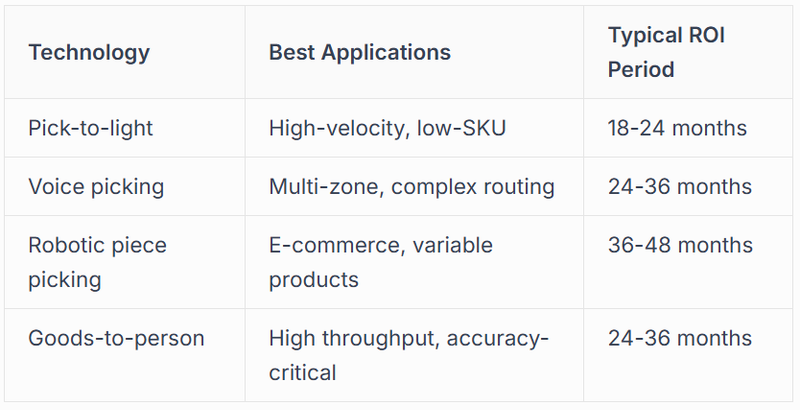
Advanced picking systems integrate seamlessly with warehouse management platforms, enabling intelligent order batching, zone optimisation, and real-time performance monitoring.
Conveyor and Sortation Equipment
Material handling infrastructure remains fundamental despite advances in mobile robotics. Industrial conveyor systems provide reliable, high-capacity transport for facilities processing significant volumes.
Modern sortation systems incorporate:
- Cross-belt sorters for fragile item handling
- Tilt-tray systems supporting high-speed operations
- Bombay sorters for cost-effective basic sortation
- Sliding-shoe sorters balancing speed and product protection
Warehouse automation companies increasingly combine traditional conveyor networks with robotic systems, creating hybrid solutions that leverage each technology's strengths whilst mitigating individual limitations.
Regional Considerations for Australia and New Zealand
Organisations operating in the Australia-New Zealand region face unique considerations when selecting warehouse automation partners. Geographic factors, market dynamics, and regulatory environments influence provider selection and solution design.
Local Support Infrastructure
Remote geography makes local technical support and spare parts availability critical success factors. Warehouse automation companies with established regional presence offer faster response times and better understanding of local operational contexts.
Service network quality determines system uptime and long-term operational reliability. Providers maintaining technicians, training facilities, and inventory within Australia and New Zealand deliver superior support compared to those servicing the region from distant headquarters.
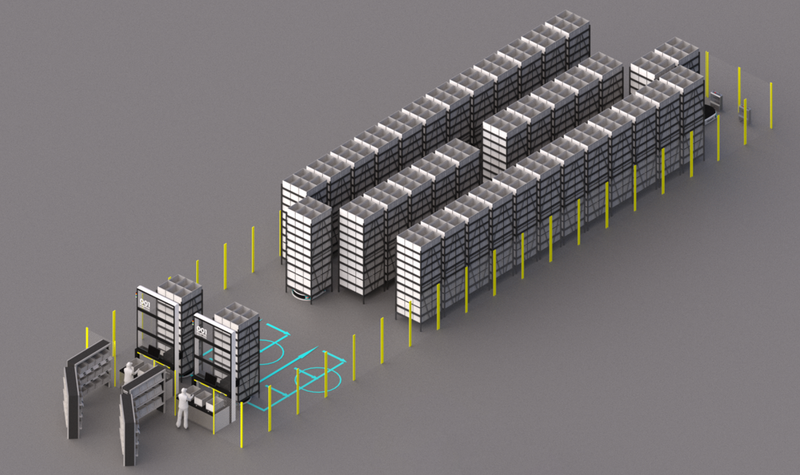
For small to medium businesses starting their automation journey, accessible entry points become particularly important. The Automate-X GTP Starter Grid offers organisations an easy, low-cost approach to warehouse automation, specifically designed for businesses in Australia and New Zealand seeking to modernise picking processes without overwhelming complexity or investment.
Scalability and Growth Alignment
Regional businesses often operate across multiple facilities with plans for geographic expansion. Warehouse automation companies capable of supporting multi-site implementations whilst accommodating business growth deliver sustained value beyond initial projects.
Consider providers offering:
- Modular solutions enabling incremental capacity additions
- Standardised platforms deployable across multiple locations
- Cloud-based control systems centralising multi-site management
- Flexible financial models supporting phased investment
Intralogistics solutions designed for scalability prevent premature technology obsolescence and protect automation investments as business requirements evolve.
Regulatory and Standards Compliance
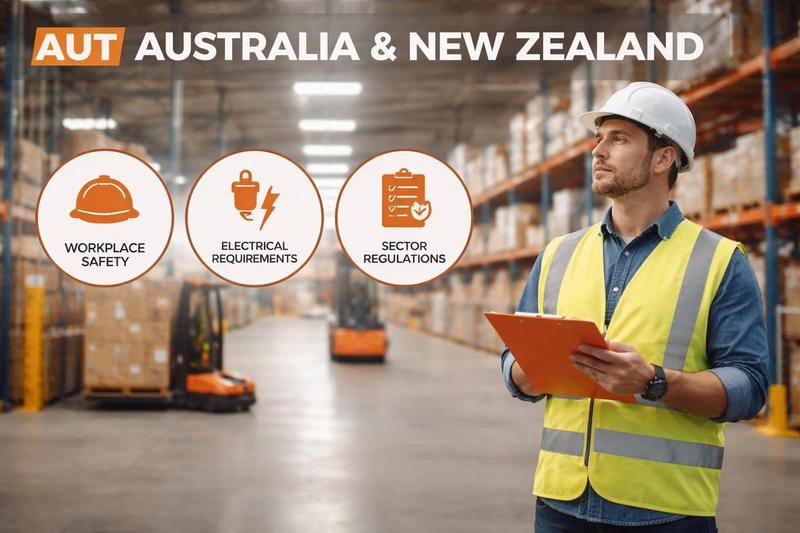
Australian and New Zealand workplace safety regulations, electrical standards, and industry-specific compliance requirements demand careful attention. Warehouse automation companies familiar with regional regulatory frameworks ensure solutions meet all applicable requirements without costly post-installation modifications.
Standards compliance extends beyond safety to include data protection, environmental regulations, and sector-specific mandates affecting pharmaceuticals, food handling, and cold-storage operations.
Evaluating Financial Models and Investment Structures
Warehouse automation represents significant capital investment, making financial structure a key consideration alongside technical capabilities. Modern warehouse automation companies offer diverse approaches to project funding and risk allocation.
Traditional Capital Purchase
Outright equipment purchase provides maximum long-term cost efficiency for organisations with available capital and confidence in technology selection. This approach transfers ownership immediately, enabling full depreciation benefits whilst avoiding ongoing service fees.
Capital purchase suits businesses with:
- Strong balance sheets supporting equipment investment
- Stable operational requirements minimising obsolescence risk
- In-house maintenance capabilities or preferred service providers
- Long-term facility commitments justifying fixed infrastructure
Robotics-as-a-Service Models
RaaS arrangements transform automation from capital expenditure to operational expense, reducing financial barriers and transferring technology obsolescence risk to providers. Emerging trends in warehouse automation highlight growing RaaS adoption, particularly among e-commerce and 3PL operations facing variable demand.
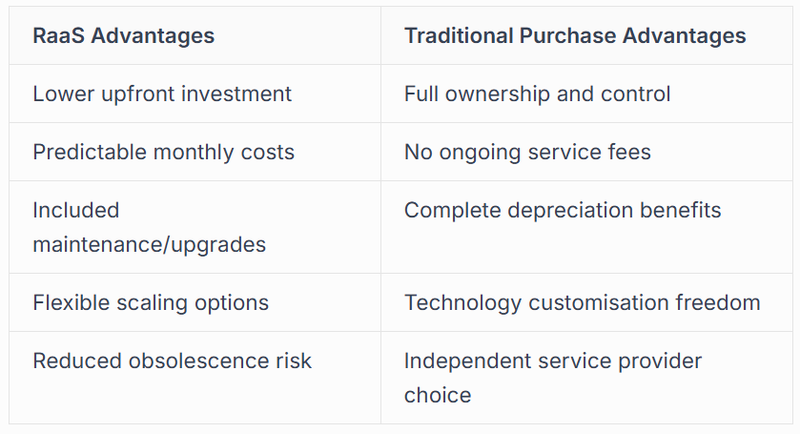
Leading warehouse automation companies structure RaaS offerings with clear performance metrics, transparent pricing, and flexible terms accommodating seasonal fluctuation.
Hybrid and Phased Approaches
Progressive implementation strategies balance investment risk against operational improvement urgency. Organisations uncertain about optimal automation scope benefit from staged deployments proving technology effectiveness before comprehensive rollout.
Phased automation enables:
- Operational validation in controlled environments
- Workforce adaptation and training development
- Technology performance verification before scaling
- Budget distribution across multiple fiscal periods
Warehouse automation companies supporting flexible implementation approaches demonstrate customer-focused partnership orientation rather than purely transactional sales focus.
Performance Metrics and ROI Measurement
Quantifying automation value requires establishing clear performance indicators aligned with strategic objectives. Sophisticated warehouse automation companies help organisations define meaningful metrics and implement tracking systems supporting continuous improvement.
Operational Efficiency Indicators
Core performance measurements track automation's direct impact on warehouse productivity:
- Order accuracy rates measuring fulfillment precision
- Throughput capacity quantifying processing volume
- Labour productivity assessing output per worker-hour
- Space utilisation calculating cubic storage density
- Cycle time reduction tracking fulfillment speed improvements
Warehouse automation statistics provide industry benchmarks helping organisations set realistic performance targets and assess competitive positioning.
Financial Return Calculations
Comprehensive ROI analysis extends beyond simple payback calculations to encompass total cost of ownership and strategic value creation:
- Direct labour cost reduction through automation substitution
- Error and rework cost elimination via improved accuracy
- Inventory carrying cost reductions from space optimisation
- Customer satisfaction improvements enabling revenue growth
- Scalability benefits supporting business expansion
Strong warehouse automation companies provide detailed financial modelling tools and assist with business case development, ensuring stakeholder alignment before project initiation.
Sustainability and Environmental Impact
Sustainability trends in warehouse automation reflect growing emphasis on environmental responsibility alongside operational efficiency. Modern solutions contribute to sustainability objectives through:
- Energy-efficient equipment design reducing power consumption
- Optimised space utilisation minimising facility footprints
- Intelligent routing decreasing unnecessary material movement
- Extended equipment lifecycles through predictive maintenance
- Reduced waste from improved inventory management and accuracy
Progressive warehouse automation companies integrate environmental performance metrics into standard reporting, supporting corporate sustainability commitments whilst delivering operational improvements.
Integration with Existing Systems and Infrastructure
Automation success depends heavily on seamless integration with current technology platforms and facility infrastructure. Warehouse automation companies must demonstrate capability across diverse system environments and legacy equipment.
Enterprise System Connectivity
Modern warehouses operate within complex technology ecosystems spanning ERP platforms, transportation management systems, and customer-facing applications. Automation solutions require robust integration capabilities ensuring data flows seamlessly across organisational boundaries.
Critical integration points include:
- Bi-directional communication with warehouse management systems
- Real-time inventory synchronisation with ERP platforms
- Order data exchange with e-commerce and sales systems
- Shipping system connectivity for fulfillment completion
- Business intelligence platforms for analytics and reporting
Warehouse automation companies with extensive integration experience reduce implementation complexity and accelerate value realisation through proven connectivity approaches.
Legacy Equipment Accommodation
Few organisations implement automation in greenfield facilities, making coexistence with existing equipment essential. Capable providers design solutions that complement rather than require complete replacement of current infrastructure.
Integration strategies maximise existing asset value whilst introducing automation progressively. This approach reduces financial burden and operational risk compared to wholesale technology replacement.
Future-Proofing and Technology Evolution
Rapid technological advancement creates obsolescence risk for fixed automation infrastructure. Forward-thinking warehouse automation companies design solutions with upgrade pathways and technology refresh capabilities built into initial implementations.
Consider providers offering:
- Modular architectures supporting component upgrades
- Open communication standards facilitating future integrations
- Software-defined functionality enabling capability enhancements
- Regular technology roadmap reviews and planning support
Logistics automation transformation trends highlight the pace of change, reinforcing the importance of adaptable solutions that evolve alongside technological progress.
Vendor Partnership Quality and Long-Term Relationships
Technical capabilities and competitive pricing matter, but partnership quality often determines long-term automation success. The best warehouse automation companies function as strategic collaborators rather than transactional suppliers.
Collaborative Design Process
Superior providers invest time understanding unique operational requirements, facility constraints, and strategic objectives before proposing solutions. This consultative approach generates better-tailored implementations than standardised product offerings.
Engagement quality indicators include:
- Comprehensive operational assessment before solution design
- Involvement of senior technical resources in planning
- Willingness to challenge assumptions and suggest alternatives
- Transparent communication about limitations and tradeoffs
- Reference site access and customer testimonial availability
Organisations should expect warehouse automation companies to demonstrate genuine partnership orientation through discovery processes that explore business context deeply.
Training and Knowledge Transfer
Automation investment value extends beyond equipment to include operational knowledge and workforce capability development. Leading providers deliver comprehensive training programmes ensuring staff can operate, troubleshoot, and optimise systems effectively.
Training components should encompass:
- Equipment operation and safety procedures
- Software interface navigation and functionality
- Basic troubleshooting and problem resolution
- Performance optimisation techniques
- Maintenance procedures and schedules
Knowledge transfer quality directly impacts system utilisation rates and return on investment realisation.
Continuous Improvement and Optimisation
Initial implementation represents the beginning rather than conclusion of automation value creation. The most effective warehouse automation companies provide ongoing optimisation services that enhance performance as operational patterns evolve.
Optimisation activities include system parameter tuning, workflow refinement, capacity rebalancing, and integration of complementary technologies. Regular performance reviews and improvement planning sessions maintain momentum beyond initial deployment.
Selecting warehouse automation companies requires careful evaluation across technical capabilities, industry experience, implementation methodology, and partnership quality dimensions. Organisations that approach vendor selection systematically whilst maintaining focus on long-term strategic alignment achieve superior outcomes and maximise automation investment returns. Automate-X combines proven robotics technology, intelligent warehouse software, and comprehensive system integration expertise to deliver transformative solutions for logistics, e-commerce, manufacturing, and distribution operations across Australia and New Zealand. Our team works collaboratively with businesses at every stage of their automation journey, from initial assessment through implementation and ongoing optimisation, ensuring measurable productivity improvements and scalable growth across warehouse and fulfillment environments.