

Warehouse Robots Guide: Transforming Logistics in 2026
Share on
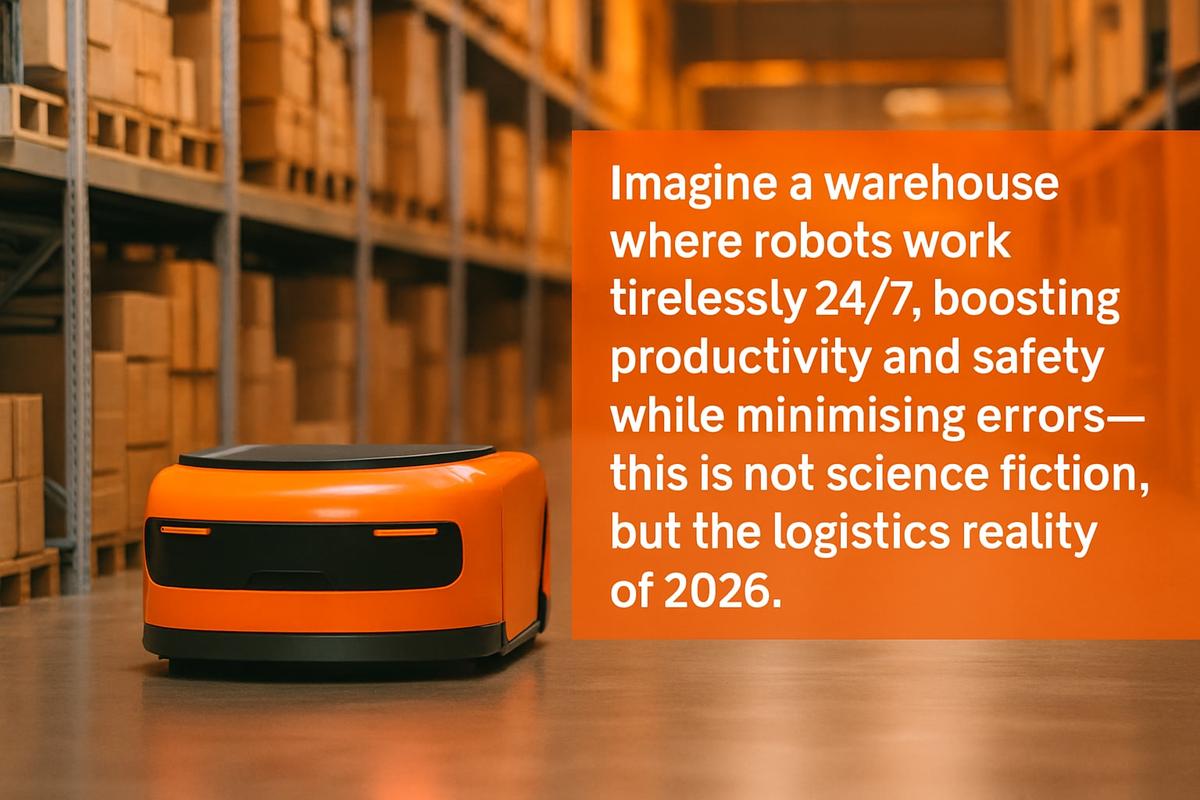
Imagine a warehouse where machines operate tirelessly around the clock, streamlining every task with precision. In 2026, this is the reality, as warehouse robots are reshaping logistics for businesses across New Zealand and beyond. This guide will take you through how warehouse robots are delivering new levels of efficiency, adaptability, and scalability. You will discover the evolution of these systems, their core categories, integration with software, real-world case studies, key benefits, and the latest innovations. Ready to see how automation can transform your supply chain? Let’s explore the future together.
The Evolution of Warehouse Robotics: From Manual to Automated Operations
Warehousing has long been the backbone of logistics, but traditional facilities have faced mounting pressure in recent years. Manual operations, once the industry standard, are now struggling to keep pace with the demands of a rapidly changing market. Labour shortages, rising wage costs, and the sheer volume of SKUs have made it increasingly difficult to maintain accuracy and throughput. As customer expectations for faster delivery grow, the need for smarter solutions has never been more urgent.
The Traditional Warehouse Landscape
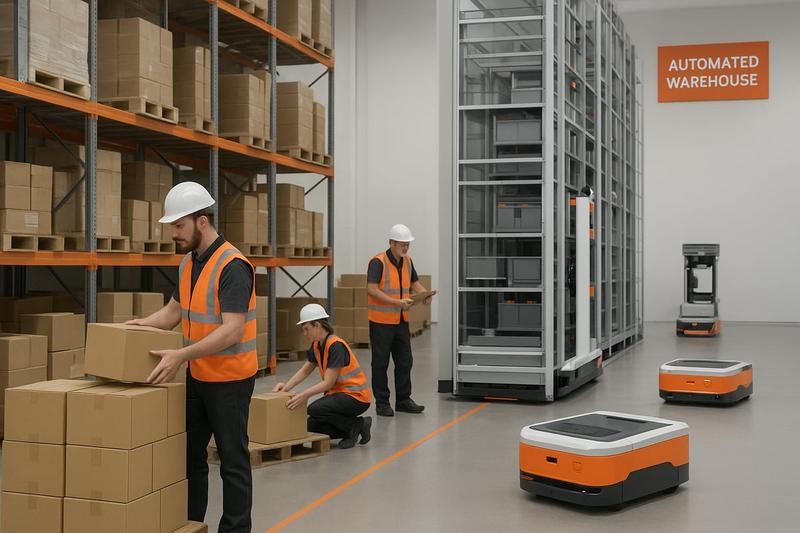
For decades, warehouses relied heavily on manual processes. Workers moved through aisles with paper pick lists, managed pallets with forklifts, and sorted orders by hand. This approach worked when product ranges were small and order volumes predictable. However, as the number of SKUs skyrocketed and online shopping became the norm, these processes revealed their limitations.
Manual picking is time-consuming and prone to human error, leading to mispicks or delayed shipments. Pallet handling requires skilled labour and increases the risk of workplace injuries. Order fulfilment often bottlenecks during peak periods, leaving customers dissatisfied. The rise of e-commerce and third-party logistics (3PL) providers has only intensified these challenges, as businesses must now manage higher order volumes and tighter delivery windows.
A simple comparison highlights the shift:
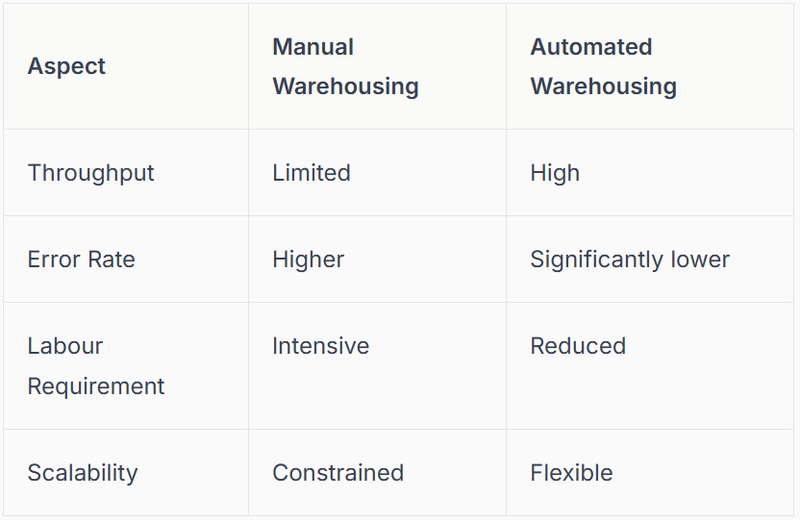
Warehouse robots have emerged as a pivotal solution to these pain points, enabling facilities to keep up with the pace of modern logistics.
Key Milestones in Warehouse Robotics
The journey from manual to automated operations began with basic mechanisation. Early systems featured fixed rail-based cranes and conveyors, designed to move goods along set paths within the warehouse. While a step forward, these systems offered little adaptability, requiring rigid layouts and significant upfront investment.
The introduction of Automated Guided Vehicles (AGVs) marked a new era. AGVs could transport pallets and goods along predefined routes, but they still lacked the ability to adapt to changing environments or dynamic workloads. Their reliance on fixed guidance systems limited flexibility, making them suitable only for stable, predictable operations.
By the 2020s, the landscape shifted dramatically with the arrival of Autonomous Mobile Robots (AMRs) and modular robotics. These advanced warehouse robots combined onboard AI, sophisticated sensors, and real-time mapping to enable dynamic navigation. AMRs could reroute themselves in real time, avoid obstacles, and work safely alongside human staff. The integration of these technologies allowed for much greater flexibility and efficiency, positioning warehouse robots as essential assets in logistics.
The 2026 Landscape: Smart, Connected, and Flexible
Fast forward to 2026, and the adoption of warehouse robots has surged globally, including across New Zealand. Facilities are now equipped with Autonomous Mobile Robots (AMRs) and Automated Storage and Retrieval Systems (ASRS) that operate seamlessly around the clock. These robots are tightly integrated with digital warehouse management systems, optimising space utilisation and reducing turnaround times.
Robots do not work in isolation. They collaborate with Warehouse Management Systems (WMS) and Warehouse Control Systems (WCS) to ensure every square metre is used efficiently and every order is fulfilled on time. According to recent research, the warehouse automation market is projected to exceed $71 billion by 2033, a testament to the growing reliance on robotics as a driver of efficiency and safety. For more on this market trend, see the Warehouse Automation Market Growth report.
E-commerce and 3PL facilities in particular are leveraging warehouse robots to manage high-SKU environments and deliver rapid, accurate order fulfilment. With 24/7 operation capabilities, increased safety, and unmatched accuracy, warehouse robots are now the foundation of modern logistics, enabling businesses to meet rising expectations and stay ahead in a competitive landscape.
Core Types of Warehouse Robots and Their Roles
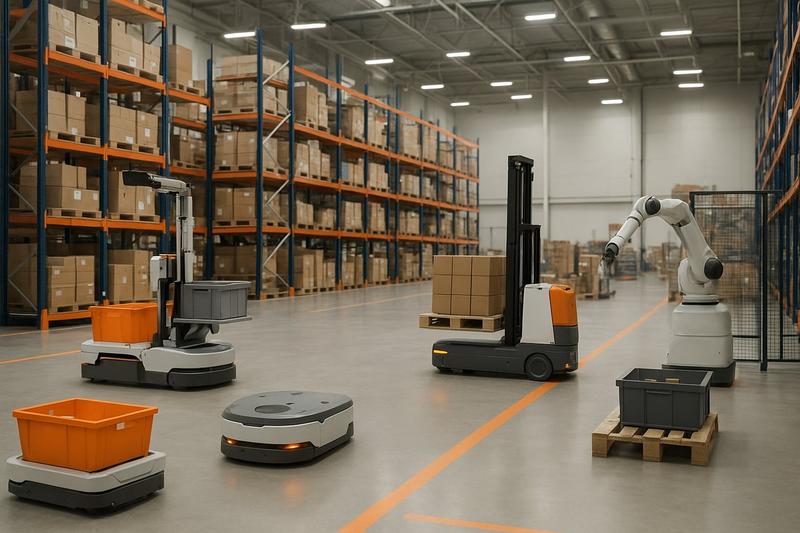
Warehouse robots come in many forms, each designed to solve specific challenges in modern logistics. Understanding the main types is essential for choosing the right solution for your operation. In 2026, warehouse robots are at the core of efficient, flexible, and scalable supply chains.
Tote-Handling Robots
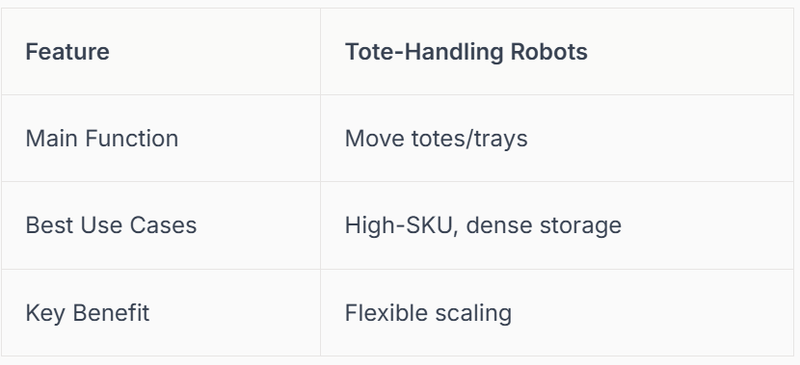
Tote-handling robots are engineered to automate the movement of totes and trays between storage racks and picking stations. These warehouse robots are key to goods-to-person systems, where speed and storage density are priorities.
Their primary functions include automated picking, put-away, and maximising vertical space by accessing high storage locations. Industries such as electronics, apparel, grocery, healthcare, and spare parts distribution benefit greatly from their precision.
A leading example is the HaiPick A42 series, which demonstrates how tote-handling warehouse robots can retrieve SKUs in real time and scale operations as needs grow. By reducing manual handling, these robots help facilities achieve higher throughput and safer workflows.
Autonomous Mobile Robots (AMRs)
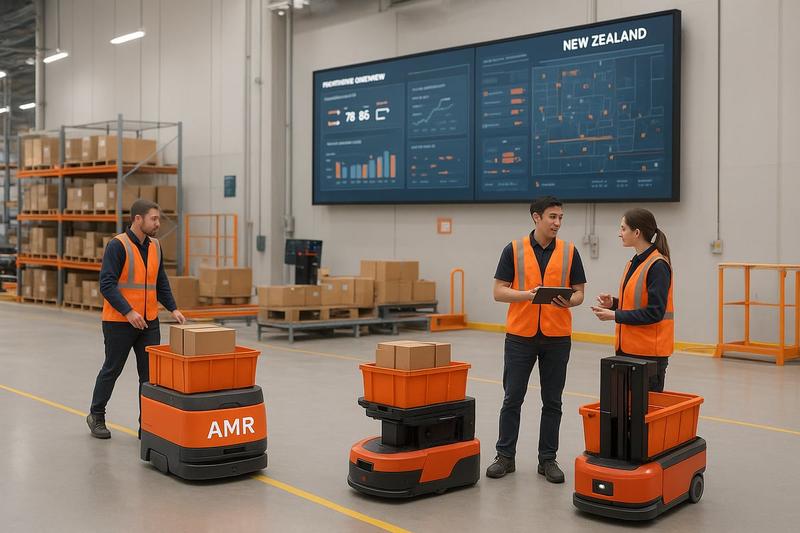
Autonomous Mobile Robots, or AMRs, represent a leap forward in warehouse robotics. These warehouse robots use sensors and AI to navigate warehouse zones independently, adapting to changing layouts and real-time demands.
AMRs seamlessly bridge inbound, packing, and outbound processes. Unlike AGVs, which follow fixed paths, AMRs dynamically reroute for optimal efficiency. This flexibility makes them ideal for facilities with evolving workflows or frequent layout changes.
To learn more about how AMRs are transforming logistics, see Autonomous Mobile Robots in Warehouses. AMRs support collaboration with other robotic systems, ensuring goods are delivered efficiently and safely across all areas.
Key advantages include reduced idle time, compact design, and the ability to scale up or down as needed. AMRs are now standard in environments demanding high productivity and adaptability.
Pallet-Handling Robots
Pallet-handling robots specialise in moving, lifting, and stacking pallets, eliminating the need for manual forklifts in many scenarios. These warehouse robots are vital in distribution centres, food and beverage storage, and manufacturing facilities where heavy goods flow continuously.
Their integration with tote-handling robots enables mixed-case picking and unified warehouse movement. Pallet-handling warehouse robots are engineered for safety, reducing the risk of workplace injuries and ensuring consistent handling of large volumes.
Facilities benefit from improved workflow, streamlined inbound and outbound logistics, and safer environments for staff. As a result, pallet-handling robots play a central role in modern, high-throughput warehouses.
Item-Handling Robots
Item-handling robots are equipped with advanced vision systems and precision grippers, allowing them to pick single items with exceptional accuracy. These warehouse robots are critical in sectors like e-commerce, healthcare, and retail, where orders often contain diverse, small, or fragile products.
By automating item-level picking, these robots reduce manual touches and ensure order accuracy. Their ability to adapt to various item shapes and sizes makes them indispensable in high-SKU environments.
Facilities deploying item-handling warehouse robots experience fewer picking errors, consistent speed, and the capacity to meet demanding customer expectations. They are a cornerstone of error-free, automated fulfilment.
Mixed-Type and Collaborative Robotics
Many modern warehouses combine multiple types of warehouse robots in a single ecosystem. Mixed-type and collaborative robotics enable a flexible approach, allowing tote, pallet, and item-handling robots to operate together in harmony.
An example is a warehouse where tote and pallet-handling robots share storage zones or where AMRs coordinate with robotic arms for order consolidation. This integration offers unmatched scalability and compatibility, supporting a diverse range of products and workflows.
The result is a warehouse that can adapt quickly to market changes, seasonal peaks, or new product lines. By leveraging collaborative warehouse robots, businesses gain the flexibility and resilience needed for long-term success.
Integrating Robotics with Warehouse Software: Achieving True Automation
Seamless integration of warehouse robots with advanced software is transforming logistics operations in 2026. The synergy between robotics and digital control systems allows warehouses to unlock true automation, optimise workflows, and respond rapidly to shifting demands. Let us explore how software integration elevates the capabilities of warehouse robots, from orchestrating tasks to ensuring real-time adaptability.
The Role of Warehouse Management Systems (WMS) and Warehouse Control Systems (WCS)
Warehouse robots rely on sophisticated software platforms to deliver peak performance. Warehouse Management Systems (WMS) oversee inventory, order processing, and workflow management, ensuring every item is tracked and accounted for. Meanwhile, Warehouse Control Systems (WCS) act as the real-time conductors, orchestrating the movement of robots, conveyors, and workstations.
For instance, a WCS can assign tasks to warehouse robots based on current order queues, equipment status, and storage locations. Advanced solutions like HaiQ’s Equipment Scheduling System (ESS) dynamically allocate robots to priority tasks, reducing idle time and maximising productivity. Integration with Automated Storage and Retrieval Systems further enhances coordination, enabling robots to retrieve and deliver goods with pinpoint accuracy.
Data-Driven Coordination and Optimisation
The power of warehouse robots is amplified by real-time data exchange. Software platforms continuously analyse order volumes, inventory levels, and robot locations to optimise routes and task assignment. Dynamic route planning ensures the shortest retrieval and delivery times, even as warehouse layouts or demand patterns shift.
Feedback loops between robots and software enable instant adjustments during workload peaks or equipment downtime. For example, if a robot encounters an obstacle or delay, the WCS reroutes other robots to maintain workflow continuity. This data-driven approach allows warehouse robots to adapt to changing priorities, ensuring consistent throughput and minimising bottlenecks.
Benefits of System Integration
Integrating warehouse robots with WMS and WCS brings measurable improvements across operations. Smoother flows reduce manual interventions and error rates, while real-time dashboards provide visibility into every process. Operators can track robot performance, inventory movement, and order status at a glance.
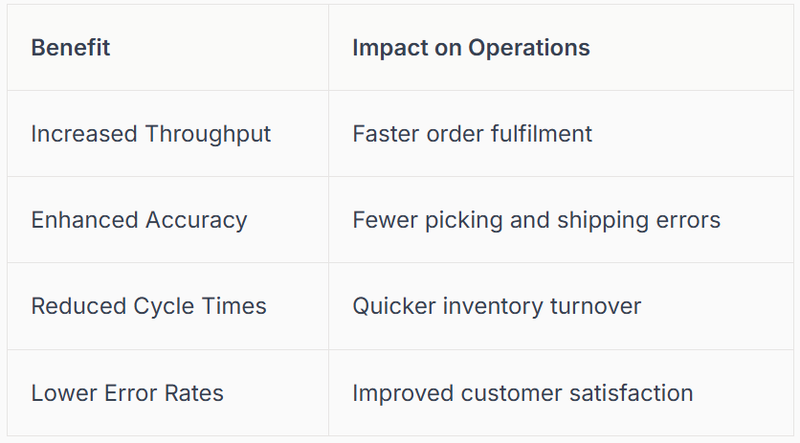
Statistics show warehouses leveraging integrated systems experience up to 30% higher throughput and significant reductions in cycle times. Warehouse robots, when guided by intelligent software, deliver consistent accuracy and reliability.
Challenges and Best Practices
Despite the clear advantages, integrating warehouse robots with legacy systems can be complex. Ensuring compatibility across robots, software, and existing infrastructure requires careful planning and collaboration with technology partners. Change management is equally critical, as staff must adapt to new workflows and digital interfaces.
Best practices include phased rollouts, comprehensive staff training, and robust data security protocols. Protecting sensitive inventory and operational data is essential as warehouses become more connected. By addressing these challenges early, businesses can unlock the full potential of warehouse robots and maintain a competitive edge in a rapidly evolving market.
Real-World Applications and Case Studies: Robots in Action
Warehouse robots are no longer a vision of the future; they are actively transforming logistics across a range of industries. From e-commerce giants to specialised healthcare providers, these intelligent machines are setting new benchmarks for efficiency, safety, and adaptability. In this section, we explore how different sectors are leveraging warehouse robots to overcome unique challenges and achieve operational excellence.
E-Commerce and High-SKU Distribution
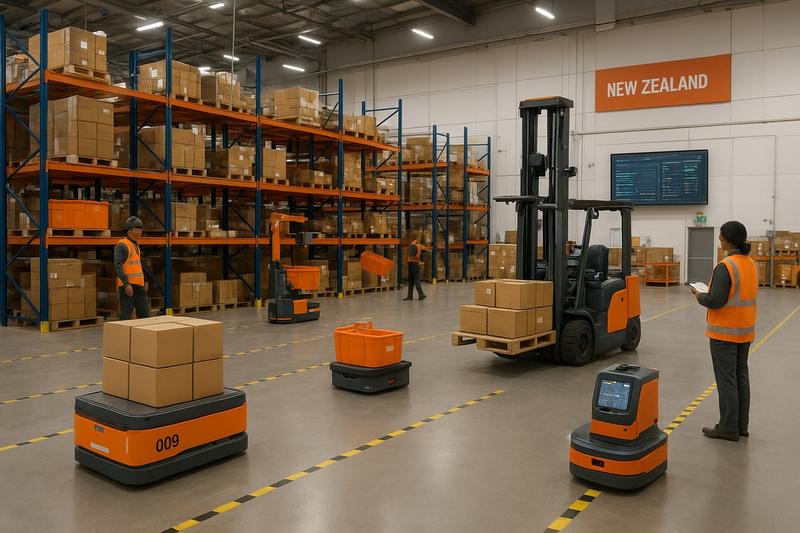
The world of e-commerce faces daunting demands: rapid order fulfilment, accuracy, and management of thousands of SKUs. Warehouse robots, especially AMRs and tote-handling systems, have become essential for streamlining picking and packing workflows. These robots can navigate dynamic layouts, retrieve products from high-density storage, and deliver them directly to human pickers or packing stations. Leading e-commerce brands are setting the standard, with Amazon's Warehouse Robotics Expansion showcasing how large-scale deployment of warehouse robots can boost speed, accuracy, and worker safety. As a result, even smaller retailers are adopting similar strategies to remain competitive in an ever-accelerating market.
3PL and Logistics Providers
Third-party logistics (3PL) providers require flexible and scalable solutions to serve a diverse client base. Warehouse robots offer the agility needed to adapt to varying volumes, product types, and seasonal peaks. By integrating ASRS and AMRs, 3PLs can automate inventory transport, order consolidation, and cross-docking. This allows for rapid onboarding of new clients and ensures reliable service levels, even during demand surges. The modularity of warehouse robots means operations can scale up or down without major infrastructure changes, supporting a broad spectrum of logistics needs.
Food & Beverage and Cold Storage
Food, beverage, and cold storage facilities have unique requirements around temperature control, hygiene, and safety. Warehouse robots excel in these environments by automating pallet and tote movement, reducing manual handling, and maintaining strict temperature compliance. Robots can operate in chilled or frozen zones, ensuring continuous flow of goods without exposing staff to harsh conditions. Enhanced safety features, such as advanced sensors and AI-driven navigation, further reduce the risk of accidents. The ability of warehouse robots to work efficiently in extreme environments makes them invaluable for perishable goods logistics.
Healthcare and Pharmaceuticals
Accuracy and compliance are paramount in healthcare and pharmaceutical logistics. Warehouse robots equipped with advanced vision and gripping technology enable precise, error-free picking of medications, medical devices, and sensitive products. These systems improve traceability and batch management, supporting regulatory requirements. By minimising human touches, robots reduce contamination risks and enhance security for controlled substances. As a result, healthcare providers and distributors rely on warehouse robots to deliver reliable, safe, and compliant supply chain operations.
Manufacturing and FMCG
Manufacturing and fast-moving consumer goods (FMCG) sectors depend on just-in-time inventory, rapid component delivery, and seamless outbound logistics. Warehouse robots integrate directly with production lines, ensuring timely supply of materials and finished goods. AMRs transport parts between assembly zones, while pallet-handling robots manage bulk goods ready for shipment. This automation minimises bottlenecks, reduces downtime, and supports lean manufacturing principles. By employing warehouse robots, manufacturers can respond quickly to changing demand and maintain high efficiency across operations.
Custom Solutions and Retrofitting
Not every warehouse is a new build—many facilities require retrofitting to integrate automation. Warehouse robots are designed with flexibility in mind, making it possible to upgrade existing sites without extensive construction. AMRs, for example, can be deployed in traditional layouts, navigating around fixed structures and working alongside human staff. This approach allows businesses to realise immediate productivity gains while preserving capital investment. Retrofitting warehouse robots also supports gradual automation, enabling organisations to scale their solutions as needs evolve.
Warehouse robots are proving their value across diverse real-world scenarios, delivering measurable improvements in speed, safety, and adaptability. As adoption accelerates, their role as the backbone of the modern supply chain will only continue to grow.
The Benefits of Warehouse Robots: Transforming Logistics Performance
In 2026, warehouse robots are redefining the standards for logistics performance. Their impact reaches far beyond just faster workflows, delivering measurable improvements across efficiency, accuracy, safety, space utilisation, adaptability, cost, and sustainability. Let’s explore how these intelligent systems are transforming warehouses into high-performing, future-ready operations.
Inside America's Most Advanced Robotic Warehouse (AI Robots)
Enhanced Workflow Efficiency and Productivity
Warehouse robots excel at streamlining repetitive, time-consuming tasks. By automating picking, sorting, and transport, they optimise the flow of goods. Robots identify the most efficient routes, reduce travel time, and minimise idle periods.
Facilities running warehouse robots operate 24/7 with near-zero downtime. This round-the-clock capability increases throughput without putting additional strain on human staff. As a result, businesses can meet rapid fulfilment demands and handle seasonal peaks effortlessly.
Accuracy, Safety, and Error Reduction
Accuracy is critical in logistics. Warehouse robots leverage sensors, vision systems, and AI to deliver precise picking and packing. This dramatically reduces human error and ensures the right product gets to the right customer.
Safety is also improved, as robots are equipped with advanced collision avoidance and real-time monitoring. They take on hazardous tasks, reducing workplace injuries. For a deeper dive into how robotics solutions can minimise errors and boost safety, see Goods-to-Person Automation Explained.
Storage Density and Space Utilisation
One of the standout benefits of warehouse robots is their ability to maximise both vertical and horizontal storage. Robots can access higher racks and navigate tighter spaces than manual operators.
This leads to significantly higher storage density, allowing businesses to store more inventory within the same footprint. As a result, facilities can defer costly expansions and make the most of existing space.
Flexibility, Scalability, and Adaptability
Warehouse robots offer unmatched flexibility. Modular systems make it easy to scale up or down as business needs change. Adding more robots or reconfiguring workflows is straightforward, whether responding to demand surges or SKU proliferation.
Adaptability is a key advantage. Robots can be rapidly redeployed for new tasks or integrated with changing warehouse layouts, ensuring long-term operational resilience.
Labour Optimisation and Cost Savings
The introduction of warehouse robots reduces reliance on manual labour for repetitive tasks. Staff are empowered to focus on higher-value activities such as quality control or process improvement.
This shift not only lowers operational costs but also increases job satisfaction. Businesses benefit from faster ROI, improved resilience to labour shortages, and a stronger competitive edge.
Sustainability and Environmental Impact
Sustainability is increasingly important in logistics. Warehouse robots contribute by operating efficiently, using less energy per task, and supporting green logistics initiatives.
Robots also help minimise waste through precise inventory handling and optimised resource usage. These efforts support a reduced carbon footprint, aligning with modern environmental standards.
Benefit Summary Table
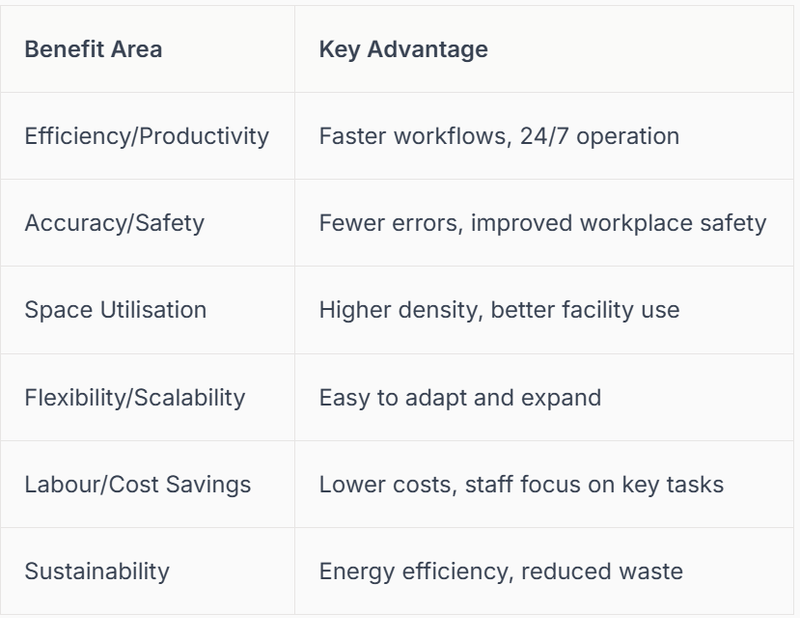
Warehouse robots have become the backbone of high-performance logistics. Their benefits are not just theoretical but proven in real-world operations, setting a new benchmark for the industry.
Implementing Warehouse Robotics: A Step-by-Step Guide for 2026
Deploying warehouse robots in 2026 requires a strategic, phased approach. Success rests on careful planning, stakeholder engagement, and robust integration. The following step-by-step guide will help your organisation maximise the value of warehouse robots and future-proof your logistics operations.
Step 1: Assessing Organisational Needs and Readiness
Begin by evaluating your current warehouse operations and identifying the key challenges. Are manual processes causing bottlenecks, high error rates, or labour inefficiencies? Pinpoint pain points where warehouse robots can deliver measurable improvements.
Collect data on throughput, order accuracy, labour costs, and space utilisation. Benchmark against industry trends and future forecasts, such as those outlined in the Warehouse Robotics Market Forecast, to understand the competitive landscape. This assessment lays the foundation for a business case and aligns stakeholders on the need for warehouse robots.
Step 2: Solution Design and Technology Selection
With clear goals defined, design a tailored solution using the right mix of warehouse robots. Consider application areas: Do you need AMRs for goods movement, tote-handling robots for high-density storage, or pallet-handling robots for heavy loads?
Evaluate integration with your existing warehouse management systems and ensure chosen technologies support future scalability. Engage with vendors who understand the nuances of New Zealand logistics and can customise solutions for your environment.
Step 3: Facility Preparation and Infrastructure Upgrades
Prepare your facility to support warehouse robots by assessing infrastructure requirements. Review power supply, Wi-Fi or 5G connectivity, and floor conditions to guarantee reliable robot performance.
Plan for any needed retrofitting or layout changes, especially if integrating new automation into existing buildings. Establish clear safety protocols to protect both staff and robots during transition and daily operation.
Step 4: Integration and Testing
Collaborate closely with your automation partners for seamless system integration. Integrate warehouse robots with your WMS and control systems, ensuring data flows smoothly between robots, software, and human operators.
Conduct pilot runs and thorough testing. Involve staff in training sessions to build confidence and competence in working alongside warehouse robots. Fine-tune settings based on real-world feedback from test operations.
Step 5: Go-Live and Optimisation
Roll out warehouse robots in phases to minimise business disruption. Start with a limited zone or process, then expand as confidence grows.
Monitor key performance indicators such as pick rates, error reduction, and cycle times. Adjust workflows and robot coordination to maximise efficiency. Encourage staff to provide feedback, fostering a culture of continuous improvement.
Step 6: Continuous Improvement and Scaling
Leverage data analytics from warehouse robots to identify fresh optimisation opportunities. Regularly review performance metrics to pinpoint areas for further automation or process refinement.
Scale your system by adding more robots, expanding storage modules, or upgrading software capabilities. Stay agile to respond quickly to demand surges or changes in product mix.
Key Considerations and Pitfalls to Avoid
Change management is crucial for successful warehouse robots adoption. Engage staff early, clearly communicate benefits, and provide robust training to ease the transition.
Avoid over-automation that can lead to unnecessary complexity or poor ROI. Prioritise cybersecurity and data integrity, especially in highly connected environments. Always align automation investments with your wider business strategy.
Examples of Successful Implementations
New Zealand warehouses are already reaping the rewards of warehouse robots. E-commerce and 3PL sites have boosted efficiency by integrating AMRs and ASRS, achieving higher throughput and fewer errors.
Innovative solutions, such as advanced multi-suction grippers described in TetraGrip: Multi-Suction Grasping Research, are enabling robots to handle a broader range of products and environments. These real-world applications show that warehouse robots can deliver rapid, measurable gains across logistics, manufacturing, and distribution.
Future Trends and Innovations in Warehouse Robotics
The landscape for warehouse robots is evolving rapidly, driven by advances in artificial intelligence, robotics engineering, and shifting supply chain demands. In 2026, the future of logistics is shaped by smarter, more adaptable, and increasingly sustainable robotic solutions. Let us explore the next wave of innovations that are redefining how warehouses operate.
AI, Machine Learning, and Predictive Analytics
Artificial intelligence is now at the core of warehouse robots, enabling smarter decisions and adaptive operations. These systems use machine learning to analyse real-time data, predict maintenance needs, and optimise routes for picking and delivery.
With predictive analytics, warehouse robots can anticipate demand spikes and adjust workflows instantly. This proactive approach reduces downtime and increases throughput. For example, AI-driven robots can reroute themselves to avoid congestion, ensuring smooth operation during peak periods.
The integration of these technologies gives warehouse robots an unprecedented level of autonomy, setting a new standard for efficiency.
Human-Robot Collaboration and Cobots
The rise of collaborative robots, or cobots, is transforming warehouse environments. Unlike traditional machines, cobots are designed to work safely alongside human staff, sharing tasks and complementing human strengths.
Warehouse robots equipped with advanced sensors and responsive controls can handle repetitive or heavy tasks, allowing people to focus on complex problem-solving. This synergy leads to higher productivity and job satisfaction.
Key benefits of cobots include:
- Enhanced safety due to real-time obstacle detection
- Flexible task allocation between robots and humans
- Improved adaptability to changing workflows
In 2026, the partnership between people and warehouse robots is a cornerstone of modern logistics.
Advanced Sensors, Vision, and Gripping Technologies
Warehouse robots are becoming more perceptive than ever, thanks to breakthroughs in sensor and vision technology. High-resolution cameras, lidar, and 3D mapping allow robots to detect obstacles, identify products, and navigate complex layouts with accuracy.
Gripping technology has also evolved, enabling robots to handle items of varying shapes, sizes, and fragility. Soft grippers, tactile feedback, and adaptive pressure control ensure delicate goods are managed safely.
These advancements mean warehouse robots can now:
- Pick irregular or mixed-SKU items
- Operate in low-light or dynamic settings
- Adapt quickly to new product lines
This leap in perception and dexterity is expanding the applications of warehouse robots across industries.
Hyper-Automation and Autonomous Fulfilment Centres
The concept of hyper-automation is pushing the boundaries of what warehouse robots can achieve. In fully autonomous fulfilment centres, robots manage storage, picking, packing, and dispatch with minimal human intervention.
Key features of hyper-automation include:
- Integration of robotics, AI, IoT, and cloud-based control
- Seamless data flow across all warehouse processes
- Real-time monitoring and continuous process optimisation
These centres operate around the clock, delivering unmatched speed and consistency. Warehouse robots are not only executing tasks but also learning and improving with every cycle.
Sustainability and Green Robotics
Sustainability is now a major focus for warehouse robots. Manufacturers are prioritising energy-efficient designs, recyclable materials, and smart energy management to reduce environmental impact.
Green robotics initiatives in warehouses include:
- Low-power operation and regenerative braking
- Automated energy-saving modes during idle times
- Use of eco-friendly components and packaging
By optimising resource usage, warehouse robots contribute to greener supply chains and help businesses meet their sustainability targets.
Regional and Industry-Specific Innovations
New Zealand and Australia are at the forefront of adopting tailored warehouse robots for local supply chain needs. Regional drivers include strict regulatory requirements, the rise of e-commerce, and the demand for cold storage automation.
Industry-specific developments include:
- Robots designed for pharmaceutical traceability and compliance
- Cold storage robots capable of operating in sub-zero environments
- Custom solutions for fast-moving consumer goods and fresh produce
Warehouse robots are increasingly adaptable, ensuring solutions fit the unique challenges of each sector and region.
The Road Ahead: Robotics as the Backbone of Logistics
Looking forward, warehouse robots will become the backbone of logistics, offering modularity, intelligence, and resilience. As technology accelerates, the role of humans will shift towards oversight, process improvement, and innovation management.
To stay ahead, businesses must embrace continuous learning and adapt to new robotics trends. For a deeper dive into what lies ahead, explore Next-Generation Robotics Trends for insights on the emerging technologies shaping 2026 and beyond.
The journey towards fully automated, sustainable, and intelligent warehouses is well underway, with warehouse robots leading the transformation at every step.
As we look ahead to 2026, it’s clear that warehouse robots are reshaping logistics, offering unmatched efficiency, safety, and scalability for businesses like yours. Whether you’re navigating labour shortages, striving for greater accuracy, or aiming to future proof your operations, embracing intelligent automation is no longer a distant ambition—it’s today’s opportunity. If you’re ready to move beyond manual processes and unlock the full potential of your warehouse, let’s take the next step together. Automate Your Warehouse