

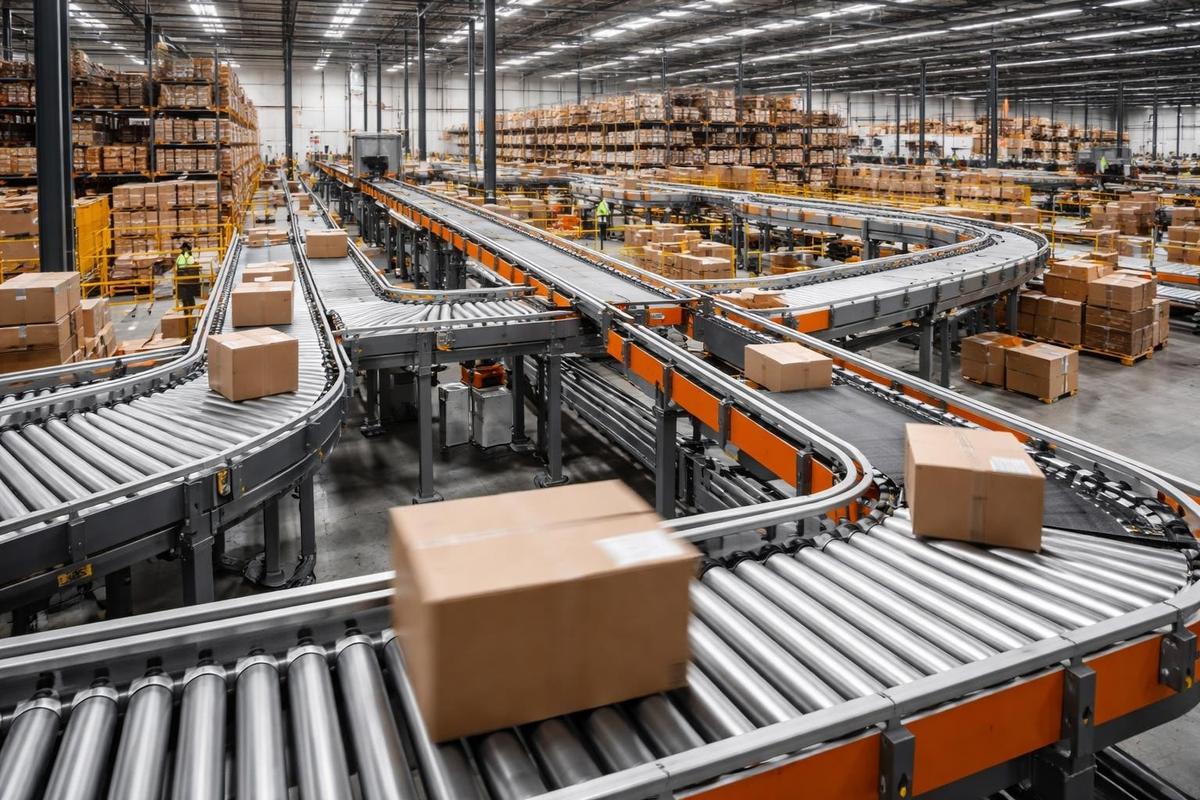
Automation Conveyor Systems for Modern Warehouses
Share on
The evolution of warehouse operations has accelerated dramatically in recent years, with automation conveyor systems becoming the backbone of efficient material handling across distribution centres, fulfillment facilities, and manufacturing plants. These systems represent far more than simple transport mechanisms-they're sophisticated networks that orchestrate product movement, integrate with warehouse management systems, and enable the seamless flow of goods from receiving docks to customer delivery. As e-commerce volumes surge and customer expectations for rapid delivery intensify, businesses across logistics, 3PL, manufacturing, and cold-storage sectors are investing heavily in conveyor automation to maintain competitive advantage while controlling operational costs.
Understanding Modern Automation Conveyor Systems
Automation conveyor systems comprise integrated networks of mechanical equipment, sensors, control systems, and software that transport materials throughout warehouse facilities without manual intervention. Unlike traditional conveyors that simply moved products from point A to point B, modern automation conveyor systems incorporate intelligent routing, real-time tracking, and dynamic decision-making capabilities.
Core Components and Technologies
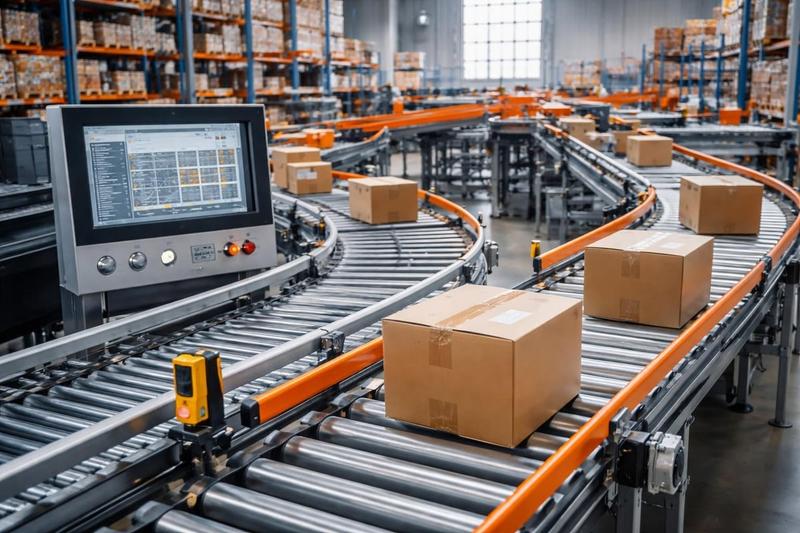
The foundation of effective automation conveyor systems includes multiple integrated elements working in concert:
- Transport mechanisms: Belt conveyors, roller conveyors, chain conveyors, and overhead systems tailored to specific product types
- Control systems: Programmable logic controllers (PLCs) and distributed control systems managing routing decisions
- Sensor networks: Photoelectric sensors, weight scales, barcode scanners, and vision systems providing real-time data
- Software integration: Warehouse management system (WMS) and warehouse control system (WCS) connectivity for orchestrated operations
- Sortation equipment: Diverters, pop-up transfers, and sliding shoe sorters directing products to designated destinations
Modern systems leverage track technology and linear motor applications that offer exceptional precision and flexibility compared to conventional mechanical drives. These technologies enable variable speed control, gentle product handling, and reduced maintenance requirements across high-throughput environments.
Strategic Benefits Across Warehouse Operations
Throughput and Productivity Enhancement
Automation conveyor systems fundamentally transform operational capacity by eliminating manual transport bottlenecks. Facilities implementing comprehensive conveyor networks typically achieve throughput increases of 40-60% while simultaneously reducing labor requirements for material movement tasks.
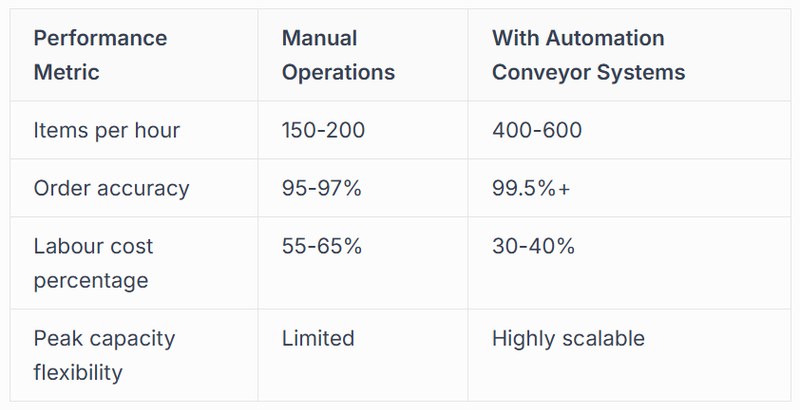
The continuous flow enabled by automated warehouse systems ensures consistent processing speeds regardless of shift changes, break periods, or workforce variability. This reliability proves particularly valuable during peak seasons when demand surges place extraordinary pressure on fulfillment operations.
Safety and Ergonomic Improvements
Beyond productivity gains, automation conveyor systems deliver measurable safety benefits by reducing manual lifting, carrying, and repetitive motion injuries. Workers transition from physically demanding transport tasks to higher-value activities like quality control, exception handling, and system supervision.
Research demonstrates that facilities implementing comprehensive conveyor automation experience 50-70% reductions in musculoskeletal injury rates. This improvement translates directly to lower workers' compensation costs, reduced absenteeism, and improved employee retention across warehouse operations.
Integration with Advanced Warehouse Technologies
Robotics and Autonomous Systems
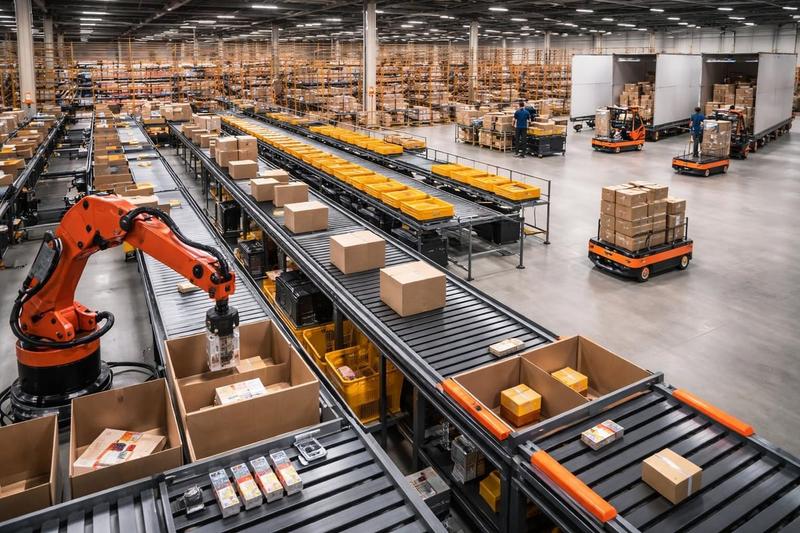
The synergy between automation conveyor systems and industrial robotics creates powerful capabilities for end-to-end automation. Robotic picking cells integrate seamlessly with conveyor feeds, while automated truck loading systems connect sortation conveyors directly to shipping operations.
Recent advances in vision-guided robotics enable real-time grasping of objects directly from conveyor belts, eliminating traditional stop-and-pick delays. This continuous-flow approach maintains conveyor system momentum while achieving the precision required for piece-picking applications across diverse product ranges.
Goods-to-Person System Integration
Goods-to-person automation represents one of the most effective applications of automation conveyor systems in modern warehouses. These configurations use conveyors to transport storage containers, bins, or totes from automated storage systems directly to ergonomic picking workstations.
For businesses evaluating entry points into warehouse automation, starting with a targeted goods-to-person solution offers compelling returns. The Automate-X GTP Starter Grid provides small and medium businesses across Australia and New Zealand with an accessible pathway to automation, combining conveyor transport with intelligent storage retrieval to transform picking productivity without requiring massive capital investment.
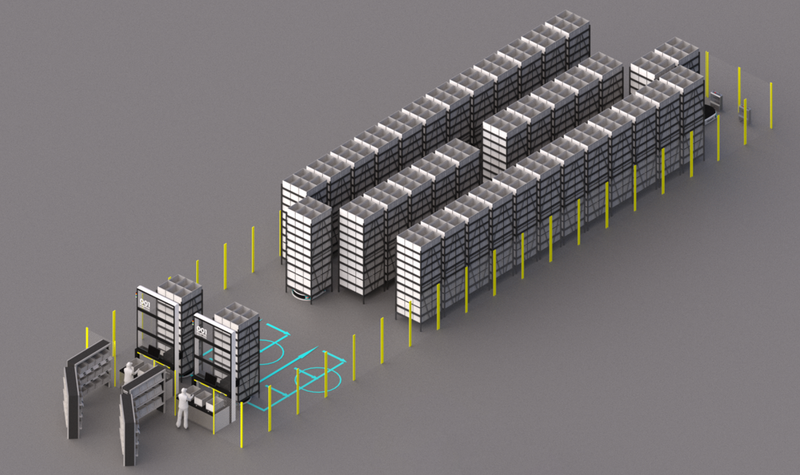
The integration of conveyors with automated storage and retrieval systems (AS/RS) creates highly dense storage environments where products flow continuously to picking positions. This approach typically delivers 3-5x productivity improvement versus traditional walk-and-pick methods while dramatically reducing facility footprint requirements.
Industry-Specific Applications and Considerations
E-Commerce and 3PL Environments
High-velocity e-commerce fulfillment demands automation conveyor systems capable of handling extreme variability in product dimensions, weights, and order compositions. Sortation conveyors route individual items to packing stations or consolidate multi-item orders for efficient packaging.
Leading distribution center conveyor systems incorporate:
- Induction zones with automatic dimensioning and weighing
- High-speed sortation achieving 150+ sorts per minute
- Dynamic buffering to balance downstream workstation loads
- Pack station delivery with order verification and documentation printing
- Shipping sortation organizing parcels by carrier and service level
The flexibility to rapidly reconfigure routing logic enables 3PL operators to accommodate diverse client requirements without physical infrastructure changes, protecting capital investments as customer portfolios evolve.
Food, Beverage, and Cold-Storage Operations
Temperature-controlled environments present unique challenges for automation conveyor systems. Equipment must withstand extreme temperatures, condensation, and stringent hygiene requirements while maintaining operational reliability.
Specialized conveyor designs for food and beverage applications feature:
- Stainless steel construction with sanitary design principles
- Sealed bearings and motors rated for washdown environments
- Quick-release components for efficient cleaning and maintenance
- Temperature-resistant belting materials maintaining flexibility at -25°C
- Integration with blast freezers and climate transition zones
These specialized systems enable cold-storage facilities to maintain product integrity while achieving the throughput levels demanded by modern supply chains serving supermarkets, restaurants, and food service distributors.
Pharmaceutical and Healthcare Logistics
Pharmaceutical distribution requires automation conveyor systems that ensure product traceability, maintain environmental controls, and support rigorous quality assurance protocols. Every product movement must be tracked, verified, and documented to comply with regulatory requirements.
Advanced pharmaceutical automation leverages conveyor systems with integrated serialization verification, ensuring each product's unique identifier is captured and reconciled against order data. Temperature monitoring at multiple conveyor zones maintains cold-chain integrity for biologics and temperature-sensitive medications.
Control Systems and Software Architecture
Warehouse Control System Integration
The intelligence driving automation conveyor systems resides in sophisticated warehouse control systems (WCS) that translate high-level warehouse management system directives into specific equipment commands. This software layer manages:
- Dynamic routing decisions based on real-time system status
- Queue management preventing bottlenecks and maximizing flow
- Equipment coordination across multiple conveyor zones and subsystems
- Performance monitoring and predictive maintenance alerting
- Integration with automated storage, picking, and packing equipment
Modern WCS platforms utilize artificial intelligence and machine learning algorithms to optimize conveyor system performance continuously. These systems learn from historical patterns, adjust to changing conditions, and proactively resolve potential disruptions before they impact throughput.
IoT and Predictive Maintenance
Smart sensors embedded throughout automation conveyor systems generate continuous data streams enabling predictive maintenance strategies. Vibration monitoring, temperature sensing, and motor current analysis detect developing issues before equipment failures occur.
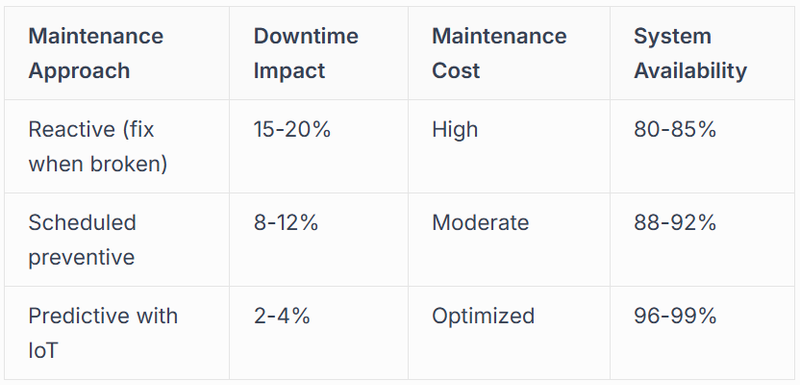
The transition from reactive maintenance to predictive strategies enabled by IoT connectivity delivers substantial operational improvements. Facilities reduce emergency repair costs, minimize unexpected downtime, and extend equipment lifespan through optimized maintenance interventions.
Design Considerations for Implementation Success
Facility Layout and Material Flow Analysis
Effective automation conveyor systems begin with comprehensive analysis of current material flows, identifying bottlenecks, redundant movements, and opportunities for consolidation. This foundation ensures conveyor network design aligns with operational requirements rather than forcing processes to adapt to equipment limitations.
Critical design factors include:
- Receiving and put-away flows from dock doors to storage locations
- Replenishment patterns moving inventory from bulk storage to active picking areas
- Order picking sequences and consolidation requirements
- Packing and quality control station positioning relative to pick zones
- Dispatch staging organized by carrier, route, or service level
Professional custom automation solutions providers conduct detailed time-motion studies and simulation modeling to validate design assumptions before installation begins.
Scalability and Future Expansion
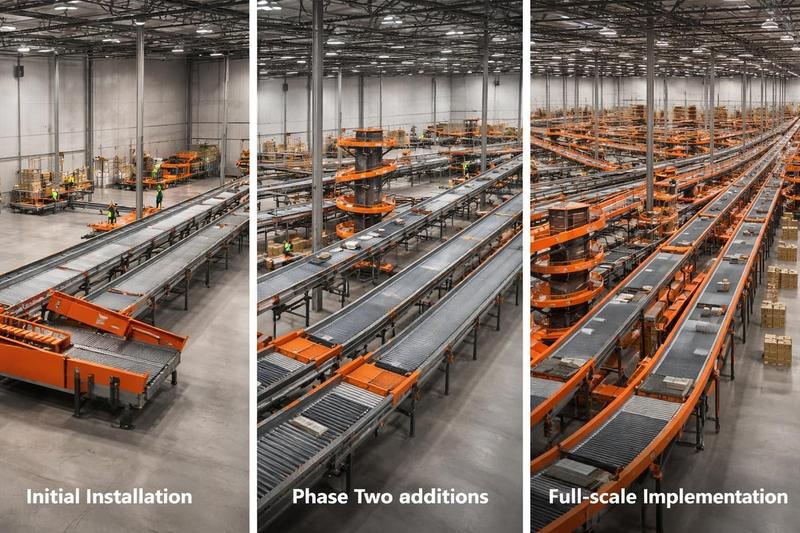
Warehouse automation investments must accommodate growth without requiring complete system replacement. Modular automation conveyor systems enable phased implementation, allowing businesses to start with core functionality and expand capabilities as volumes increase.
Scalable design principles include:
- Oversized conveyor drives supporting additional zones without replacement
- Modular sortation units that can be added or relocated
- Expandable control system architectures accommodating additional equipment
- Physical space allocation for future conveyor extensions
- Software platforms supporting increased transaction volumes
The latest innovations in logistics conveyor systems emphasize flexibility and reconfigurability, ensuring automation investments remain productive as business requirements evolve.
Return on Investment and Financial Justification
Quantifying Operational Benefits
The financial case for automation conveyor systems extends beyond simple labor displacement calculations. Comprehensive ROI analysis accounts for multiple value streams:
Direct cost reductions:
- Labor savings from reduced material handling requirements
- Error reduction eliminating shipping corrections and returns
- Overtime elimination through consistent processing capacity
- Workers' compensation cost reductions from injury prevention
Revenue enablement:
- Increased throughput supporting volume growth without facility expansion
- Improved order accuracy enhancing customer satisfaction and retention
- Faster processing enabling same-day or next-day delivery commitments
- Peak season capacity supporting revenue maximization during critical periods
Strategic advantages:
- Competitive differentiation through superior fulfillment performance
- Scalability supporting business growth without proportional cost increases
- Workforce attraction and retention through improved working conditions
- Asset value enhancement for facilities incorporating automation infrastructure
Well-designed automation conveyor systems typically achieve ROI within 18-36 months depending on throughput volumes, labor costs, and operational complexity.
Implementation Planning and Project Management
Successful conveyor automation projects require disciplined planning, stakeholder coordination, and phased implementation strategies minimizing operational disruption. Leading practices include:
- Detailed project timelines with clear milestone definitions and accountability
- Comprehensive testing protocols validating system performance before go-live
- Parallel operations during cutover periods ensuring business continuity
- Training programs preparing workforce for new roles and responsibilities
- Performance benchmarking establishing baseline metrics and improvement targets
Working with experienced industrial system integration partners ensures projects remain on schedule, within budget, and achieve anticipated performance improvements.
Emerging Technologies and Future Trends
Artificial Intelligence and Machine Learning
Advanced automation conveyor systems increasingly incorporate AI-driven decision-making that adapts to changing operational patterns. Machine learning algorithms optimize routing decisions, predict maintenance requirements, and balance workloads across multiple processing zones without human intervention.
Research into AI-driven magnetic levitation conveyor systems demonstrates the potential for unprecedented precision and energy efficiency in material transport applications. While still emerging, these technologies point toward future generations of conveyor systems with dramatically enhanced capabilities.
Sustainable and Energy-Efficient Design
Environmental considerations increasingly influence automation conveyor system design. Modern installations incorporate:
- Variable frequency drives reducing energy consumption during low-volume periods
- Regenerative braking systems capturing energy from decelerating loads
- LED lighting integration providing illumination only where products are present
- Lightweight materials reducing motor power requirements
- Zone control systems powering down inactive conveyor sections
These efficiency improvements deliver both environmental benefits and operational cost reductions, with leading facilities achieving 30-40% energy savings compared to conventional conveyor installations.
Flexible and Reconfigurable Systems
The rapid pace of change in retail, e-commerce, and supply chain models demands conveyor systems that can be reconfigured quickly to accommodate new requirements. Modular conveyor designs from specialized automation providers enable layout modifications, capacity adjustments, and functional changes without extensive downtime or reconstruction costs.
This flexibility proves particularly valuable for 3PL operators serving diverse clients with varying operational requirements, enabling rapid facility reconfiguration as customer portfolios change.
Integration with Broader Warehouse Automation Ecosystems
Automation conveyor systems achieve maximum value when integrated within comprehensive warehouse automation technologies ecosystems. The combination of conveyors with autonomous mobile robots, automated storage systems, robotic picking cells, and advanced software creates synergistic capabilities exceeding the sum of individual components.
Strategic integration considerations include:
- Data architecture ensuring seamless information flow across all automation systems
- Physical interfaces enabling smooth product transfers between different equipment types
- Control system hierarchy coordinating activities across multiple automated subsystems
- Exception handling protocols managing disruptions without cascading failures
- Performance optimization balancing loads across alternative processing pathways
Facilities implementing holistic automation strategies report 60-80% improvements in overall operational efficiency compared to isolated point solutions, demonstrating the power of integrated system design.
Automation conveyor systems represent foundational infrastructure for modern warehouse operations, enabling the throughput, accuracy, and flexibility demanded by today's competitive logistics environment. As businesses across New Zealand and Australia navigate increasing customer expectations and tightening labor markets, intelligent conveyor automation delivers measurable competitive advantage. Automate-X combines deep conveyor systems expertise with comprehensive warehouse automation capabilities, helping logistics, 3PL, manufacturing, and cold-storage operations design, implement, and optimize material handling solutions that drive sustainable growth and operational excellence.