

AI in Warehouses: Transform Operations in 2026
Share on
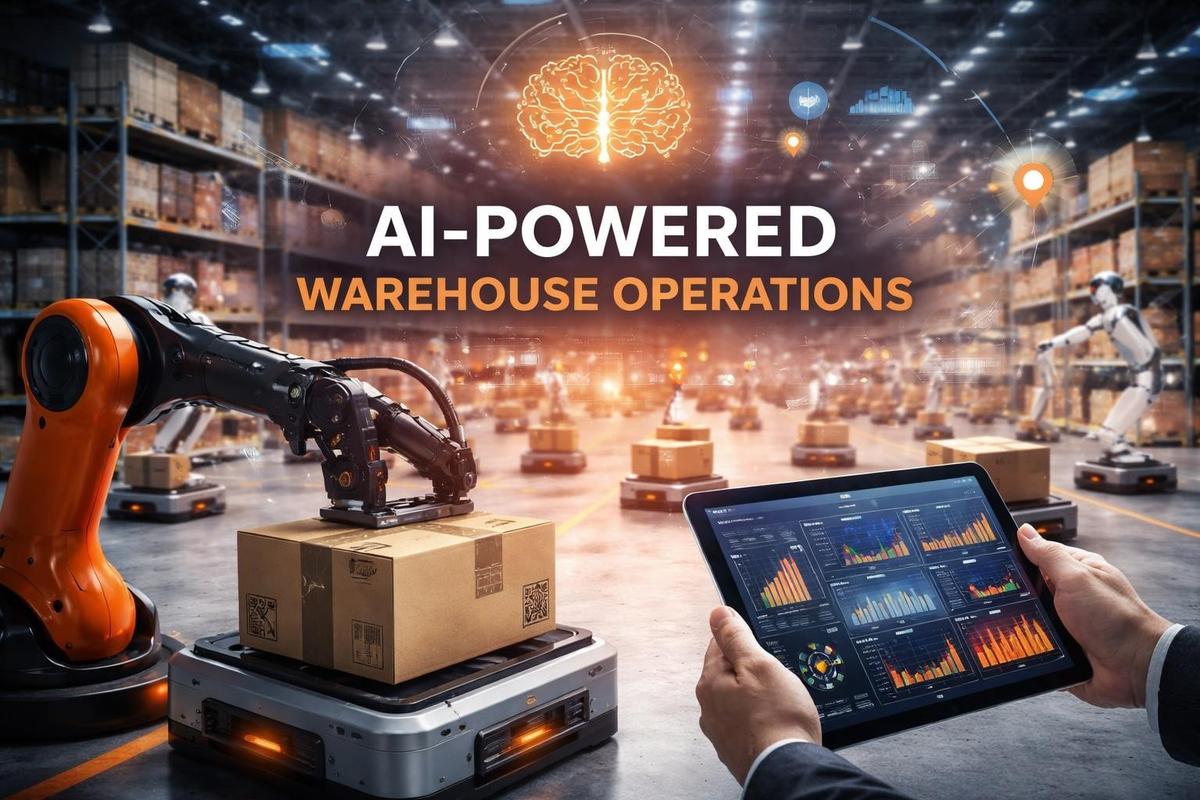
The warehouse landscape has undergone a remarkable transformation over the past decade, with artificial intelligence emerging as the driving force behind unprecedented operational efficiency. Modern distribution centres now leverage sophisticated AI algorithms to orchestrate complex logistics operations, from inventory management to robotic coordination. For businesses operating in logistics, e-commerce, and manufacturing sectors across Australia and New Zealand, understanding how AI in warehouses delivers competitive advantages has become essential for sustainable growth and scalability.
The Foundation of AI-Powered Warehouse Operations
Artificial intelligence fundamentally reshapes how warehouses process, store, and distribute goods. At its core, AI in warehouse management relies on machine learning algorithms that continuously analyse operational data to identify patterns, predict outcomes, and optimise decision-making processes.
Traditional warehouse management systems operated on fixed rules and manual interventions. In contrast, AI-driven platforms adapt dynamically to changing conditions, learning from historical data to improve performance over time. This shift represents a fundamental change in how facilities approach logistics challenges.
Key Components Driving AI Integration
Modern implementations of ai in warehouses typically incorporate several interconnected technologies:
- Computer vision systems that enable real-time product identification and quality control
- Predictive analytics engines that forecast demand patterns and optimise inventory levels
- Natural language processing for voice-activated picking and documentation
- Robotic process automation coordinating autonomous mobile robots and stationary equipment
- Edge computing infrastructure enabling rapid data processing at device level
The convergence of these technologies creates intelligent systems capable of autonomous operation whilst maintaining human oversight for critical decisions. Warehouse execution systems serve as the orchestration layer, translating high-level business objectives into precise operational commands that AI-enabled equipment executes with remarkable accuracy.
Transforming Inventory Management Through Predictive Intelligence
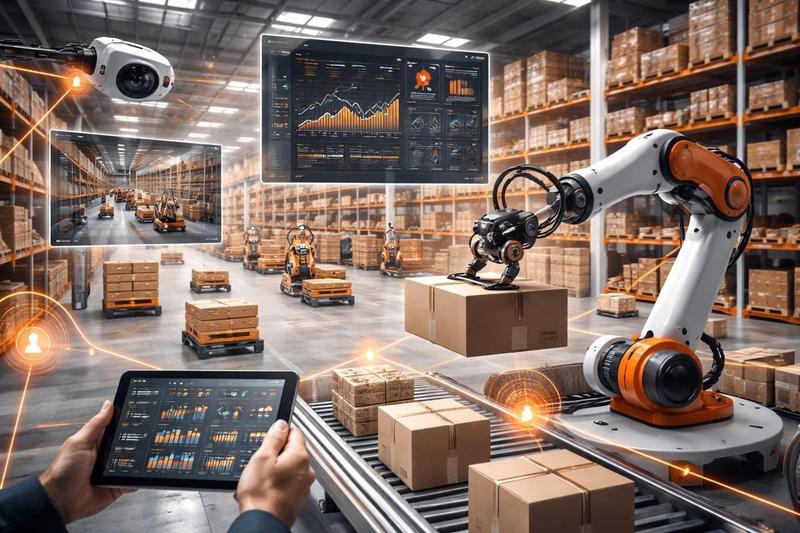
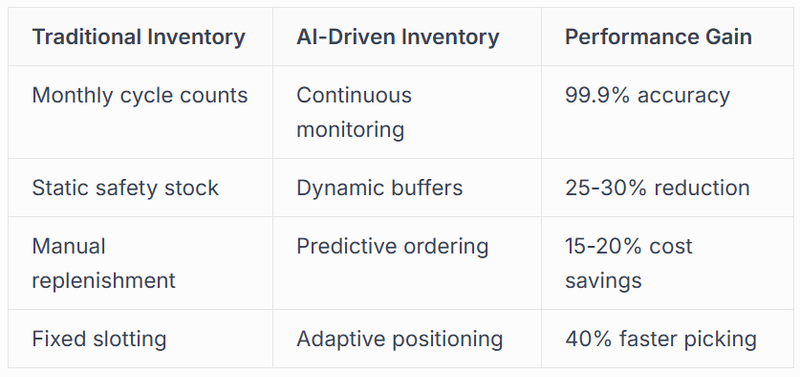
One of the most impactful applications of ai in warehouses manifests in inventory optimisation. Traditional approaches relied on static reorder points and safety stock calculations that often resulted in either excess inventory or stockouts. AI-driven systems analyse multiple variables simultaneously, including seasonal trends, promotional activities, supplier lead times, and external market conditions.
Predictive analytics for warehouse operations enables businesses to reduce carrying costs whilst maintaining service levels. Machine learning models identify subtle patterns that human analysts might overlook, such as correlations between weather patterns and product demand or the impact of social media trends on order volumes.
Real-Time Stock Visibility and Accuracy
AI-powered inventory systems leverage computer vision and sensor networks to maintain continuous stock visibility:
- Automated cycle counting eliminates manual stocktakes through robotic scanning
- Anomaly detection identifies discrepancies between physical stock and system records
- Expiry date management prioritises products based on shelf life and rotation requirements
- Dynamic slotting algorithms reposition inventory to optimise picking efficiency
The integration of automated warehouse systems with AI capabilities creates a self-correcting environment where inventory accuracy improves continuously. For pharmaceutical and food & beverage operations, this precision proves particularly valuable in maintaining compliance with regulatory requirements.
Robotics and Autonomous Systems Integration
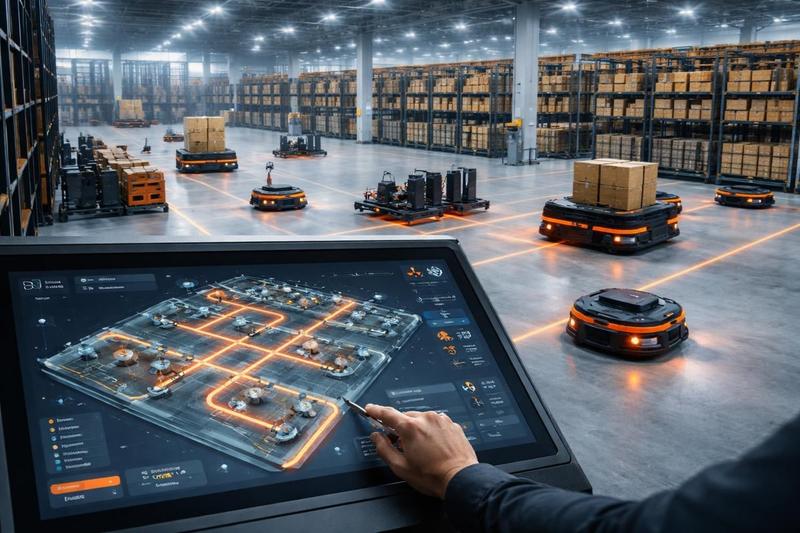
The deployment of ai in warehouses reaches its most visible expression through robotics integration. Autonomous mobile robots (AMRs) now navigate warehouse floors with sophisticated path-planning algorithms that optimise travel routes in real-time, adapting to changing floor conditions and traffic patterns.
Unlike their predecessors that followed fixed paths, modern AMRs utilise simultaneous localisation and mapping (SLAM) technology combined with AI decision-making. Amazon's integration of AI-driven robots demonstrates how large-scale implementations enhance both efficiency and worker safety.
Collaborative robotics represents another frontier where AI enables seamless human-robot interaction. These systems employ machine learning to understand operator behaviour patterns, predicting when assistance is needed and adjusting operation speeds to match human workflows. This collaboration proves particularly effective in goods-to-person automation scenarios where robots deliver inventory to ergonomic picking stations.
The coordination challenge intensifies with fleet size. Managing dozens or hundreds of robots requires sophisticated AI orchestration that prevents collisions, balances workload distribution, and optimises battery charging schedules. Advanced implementations employ reinforcement learning algorithms that improve fleet performance through continuous experimentation and adaptation.
Optimising Picking Operations with Machine Learning
Picking represents the most labour-intensive warehouse operation, accounting for approximately 55% of total operating costs in typical distribution centres. AI in warehouses addresses this challenge through multiple approaches that enhance both speed and accuracy.
Machine learning models analyse historical order data to predict product associations, enabling intelligent batch picking strategies. When the system recognises that certain products frequently appear together in orders, it can pre-position inventory or suggest consolidated picking routes that minimise travel distance.
Intelligent Order Batching and Wave Planning
Advanced automated warehouse picking systems employ AI algorithms that consider numerous variables:
- Order priority levels and customer service agreements
- Picker skill levels and current workload distribution
- Product characteristics including size, weight, and fragility
- Zone congestion and equipment availability
- Delivery time windows and carrier cut-off schedules
These multi-dimensional optimisation problems exceed human planning capabilities, yet AI systems solve them in milliseconds, continuously adjusting plans as new orders arrive or conditions change.
Voice-directed picking systems enhanced with natural language processing interpret operator feedback to refine instructions. If pickers consistently query certain location descriptions, the AI identifies potential signage improvements or suggests inventory relocation to reduce confusion.
Enhancing Quality Control and Compliance
AI-powered computer vision transforms quality assurance processes within warehouse environments. Traditional manual inspections suffer from consistency issues and fatigue-related errors. Automated systems examine products with unwavering attention, identifying defects, damage, or labelling errors that might escape human notice.
For industries requiring strict compliance documentation, such as pharmaceuticals and food & beverage, AI in warehouses provides comprehensive traceability. Every product movement gets recorded with timestamp, location, and condition data. Machine learning algorithms detect patterns that might indicate equipment malfunction, environmental control failures, or process deviations before they result in compliance violations.
Temperature-sensitive operations particularly benefit from AI monitoring. In cold-storage facilities, algorithms analyse temperature sensor data across multiple zones, predicting potential equipment failures and triggering preventive maintenance. This proactive approach prevents costly product losses whilst maintaining the integrity of the cold chain.
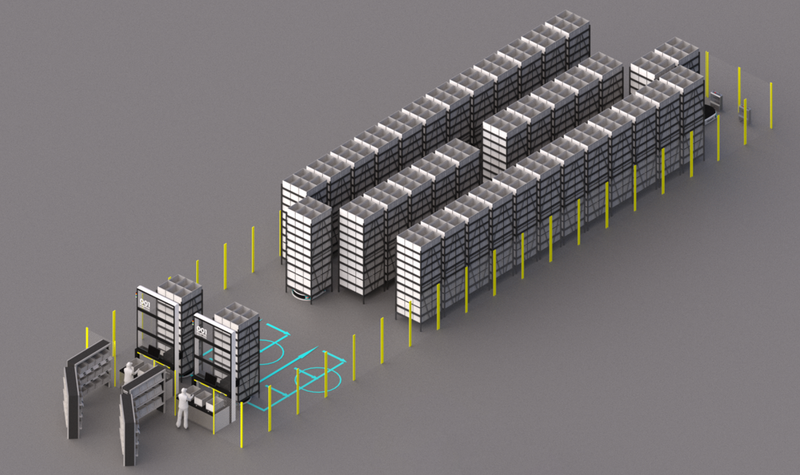
The Automate-X GTP Starter Grid offers businesses an accessible entry point to experience these quality control benefits. By integrating AI-powered picking automation at a manageable scale, organisations can validate the technology's impact before committing to larger implementations, making advanced warehouse automation achievable for small and medium enterprises across Australia and New Zealand.
Predictive Maintenance and Equipment Optimisation
Equipment downtime represents a critical threat to warehouse productivity, potentially halting entire operations. AI transforms maintenance from reactive firefighting to predictive prevention through continuous equipment monitoring and pattern recognition.
Sensors throughout warehouse automation technologies collect vibration, temperature, power consumption, and performance data. Machine learning models establish baseline operational signatures for each piece of equipment, then monitor for deviations that indicate developing problems.
Maintenance Strategy Evolution
The progression from reactive to predictive maintenance delivers substantial operational benefits:
- Reactive maintenance responds after failures occur, resulting in emergency repairs and extended downtime
- Scheduled maintenance follows fixed calendars, often servicing equipment unnecessarily whilst missing actual problems
- Condition-based maintenance triggers service when specific thresholds are exceeded
- Predictive maintenance forecasts failures before they occur, scheduling interventions during planned downtime
Research into AI's role in automating decision-making processes demonstrates how these systems optimise maintenance scheduling across entire facilities. The algorithms balance multiple objectives, minimising both maintenance costs and operational disruption whilst maximising equipment longevity.
For conveyor systems, robotic arms, and automated storage and retrieval systems, this predictive capability proves invaluable. Components receive attention based on actual wear patterns rather than arbitrary schedules, reducing maintenance expenses whilst improving reliability.
Labour Management and Workforce Optimisation
AI in warehouses extends beyond equipment to optimise human workforce deployment. Labour represents the largest operational expense in most facilities, yet scheduling and task assignment often rely on simple heuristics that fail to account for the complexity of modern warehouse operations.
Machine learning models analyse productivity patterns across different times, seasons, and conditions. They identify which workers excel at specific tasks, how team compositions affect overall throughput, and what environmental factors influence performance. This analysis enables intelligent scheduling that matches capabilities to demands.
Performance analytics provide individualised feedback without intrusive monitoring. The systems identify opportunities for additional training, suggest process improvements based on successful worker techniques, and ensure equitable task distribution that prevents burnout.
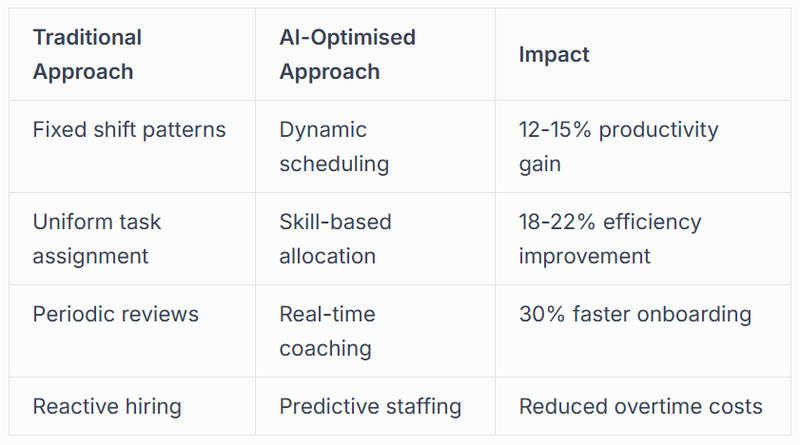
The integration of industrial automation and robotics creates opportunities for workforce upskilling rather than replacement. AI handles repetitive, physically demanding tasks whilst human workers focus on exception handling, quality oversight, and continuous improvement activities.
Space Utilisation and Layout Optimisation
Warehouse space represents a significant capital investment, yet many facilities utilise only 60-70% of available capacity effectively. AI in warehouses addresses this challenge through sophisticated spatial analytics that optimise both horizontal floor space and vertical storage capacity.
Machine learning algorithms analyse product dimensions, turnover rates, and order patterns to determine optimal storage locations. Fast-moving items position near packing stations, whilst slow movers occupy higher racks or more distant locations. The system continuously adjusts these assignments as demand patterns shift, ensuring the layout remains optimised.
Slotting optimisation considers multiple objectives simultaneously:
- Minimising picker travel distance for common order profiles
- Balancing weight distribution across storage infrastructure
- Grouping products that frequently ship together
- Maintaining accessibility for large or irregular items
- Preserving flexibility for seasonal inventory fluctuations
Advanced implementations employ benefits of AI in warehouse operations to simulate alternative layouts, testing configurations virtually before implementing physical changes. This capability proves particularly valuable during facility expansions or operational strategy shifts.
For businesses operating multiple distribution centres, AI enables network-level optimisation. The systems determine which facility should hold specific inventory based on customer proximity, capacity constraints, and cross-facility transfer costs, creating an intelligent distribution network that responds dynamically to market conditions.
Data Integration and Real-Time Decision Making
The effectiveness of ai in warehouses depends fundamentally on data quality and integration. Modern warehouse environments generate massive data streams from diverse sources including warehouse management systems, transportation management platforms, enterprise resource planning software, and IoT sensors.
AI platforms synthesise these disparate data sources into unified operational intelligence. Real-time dashboards present actionable insights rather than raw metrics, highlighting exceptions that require attention whilst confirming that normal operations proceed smoothly.
Enabling Technologies for Data-Driven Operations
Several technological foundations support intelligent decision-making:
- Cloud computing infrastructure providing scalable processing capacity for complex analytics
- Edge computing devices enabling rapid local processing for time-sensitive decisions
- 5G connectivity supporting high-bandwidth, low-latency communication between mobile equipment
- Digital twin technology creating virtual facility models for simulation and optimisation
- Blockchain integration ensuring data integrity and traceability across supply chain partners
The convergence of smart AI-powered warehouse capabilities with these enabling technologies creates facilities that operate with unprecedented visibility and control. Decision-makers access comprehensive operational intelligence regardless of location, whilst automated systems handle routine choices that previously required human judgment.
Implementation Strategies and Change Management
Deploying ai in warehouses requires careful planning that balances technological capabilities with organisational readiness. Successful implementations typically follow phased approaches that deliver incremental value whilst building internal capabilities and confidence.
Pilot programmes targeting specific pain points prove most effective for initial deployments. Rather than attempting wholesale transformation, organisations identify high-impact areas where AI can demonstrate clear benefits. Common starting points include inventory accuracy improvement, picking route optimisation, or predictive maintenance for critical equipment.
These focused initiatives generate measurable results that build support for broader adoption. They also provide valuable learning opportunities, revealing integration challenges, training requirements, and change management needs before large-scale deployment.
Critical Success Factors
Organisations achieving sustainable value from warehouse AI implementations typically demonstrate several common characteristics:
- Executive sponsorship ensuring adequate resources and organisational priority
- Cross-functional collaboration between operations, IT, and business stakeholders
- Data governance frameworks maintaining quality, security, and accessibility
- Workforce engagement involving operators in system design and refinement
- Performance measurement tracking specific KPIs aligned with business objectives
- Continuous improvement culture treating AI deployment as ongoing enhancement rather than one-time project
Training represents a particular challenge and opportunity. Warehouse staff require new skills to work effectively alongside AI systems, whilst managers need capabilities to interpret analytical insights and translate them into operational decisions. Investment in comprehensive training programmes accelerates value realisation and reduces resistance to technological change.
Security, Privacy, and Ethical Considerations
As ai in warehouses becomes more sophisticated, questions regarding data security, worker privacy, and algorithmic fairness require thoughtful attention. Warehouse systems collect detailed information about operational performance, including individual worker productivity and movement patterns.
Responsible implementations establish clear policies governing data collection, usage, and retention. Workers deserve transparency regarding what information gets collected and how it influences decisions affecting them. Privacy protections prevent misuse of detailed performance data whilst preserving the analytical capabilities that drive operational improvements.
Algorithmic bias presents another consideration. If machine learning models train on historical data reflecting past inequities, they may perpetuate or amplify those biases. Regular audits of AI decision-making help identify and correct these issues, ensuring systems treat all workers fairly regardless of demographic characteristics.
Cybersecurity assumes critical importance as warehouses become increasingly connected. AI systems controlling physical equipment require robust protection against unauthorised access that could disrupt operations or compromise safety. Multi-layered security approaches combining network segmentation, access controls, and continuous monitoring protect against evolving threats.
Measuring Return on Investment and Business Value
Quantifying the benefits of ai in warehouses requires comprehensive measurement frameworks that capture both direct cost reductions and strategic advantages. Traditional ROI calculations focusing solely on labour displacement often underestimate total value creation.
Multi-dimensional value assessment considers various benefit categories:
- Operational efficiency improvements including faster order processing and reduced error rates
- Capacity expansion enabling higher throughput without facility expansion
- Quality enhancement reducing returns, damages, and compliance violations
- Working capital optimisation through improved inventory management
- Customer service improvements delivering faster, more reliable order fulfilment
- Risk mitigation via enhanced safety and business continuity capabilities
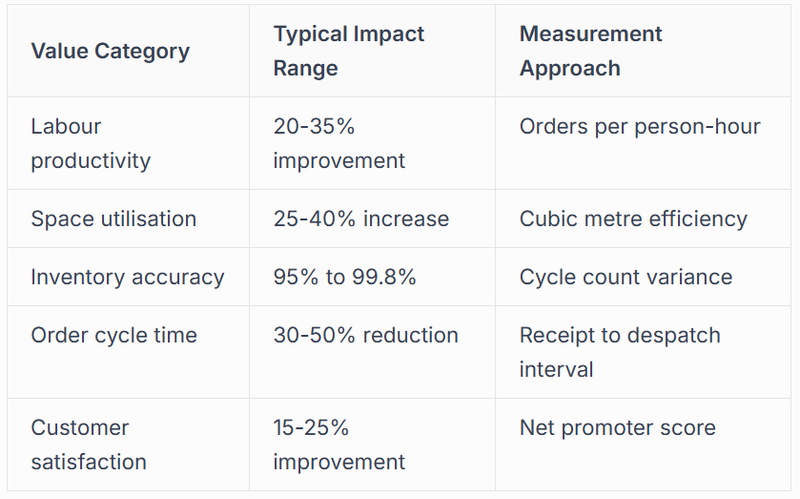
The timeframe for realising these benefits varies by implementation scope and organisational readiness. Focused deployments in specific operational areas may deliver positive returns within 12-18 months, whilst comprehensive facility transformations typically require 24-36 months for full value realisation.
Future Developments and Emerging Capabilities
The evolution of ai in warehouses continues accelerating as new technologies mature and converge. Emerging developments promise to extend AI capabilities into areas currently requiring human judgment and adaptability.
Autonomous decision-making will expand as systems accumulate operational experience and demonstrate reliability. Future implementations may authorise AI to make increasingly consequential choices, from supplier selection to facility capacity planning, under human oversight rather than requiring explicit approval for each decision.
Advanced robotics incorporating soft grippers and tactile sensing will handle products currently requiring human dexterity. Combined with computer vision and machine learning, these systems will adapt to product variations and packaging irregularities that confound current automation approaches.
Natural language interfaces will enable conversational interaction with warehouse systems. Operators will query inventory status, request performance insights, or adjust operational parameters through voice commands in natural language rather than navigating complex software interfaces.
The integration of automation and industrial robotics with augmented reality will provide workers with contextual information overlaid on their physical environment. Smart glasses will highlight optimal picking paths, display product information, and provide real-time guidance for complex tasks.
Quantum computing, whilst still emerging, promises to revolutionise optimisation problems central to warehouse operations. Route planning, inventory positioning, and workforce scheduling involve computational complexity that increases exponentially with scale. Quantum algorithms may solve these problems with unprecedented speed and precision.
AI in warehouses represents far more than technological advancement-it embodies a fundamental transformation in how logistics and distribution operations create value. The convergence of machine learning, robotics, and advanced analytics enables unprecedented operational efficiency whilst addressing the growing complexity of modern supply chains. For businesses seeking to enhance warehouse performance, Automate-X delivers comprehensive automation solutions that integrate intelligent technologies with proven operational expertise. Our approach combines modern robotics, sophisticated software, and system integration capabilities tailored specifically for logistics, e-commerce, manufacturing, and specialised environments across Australia and New Zealand, enabling scalable growth and sustainable competitive advantage.