


Automated Warehouse Picking System Guide 2026
Share on
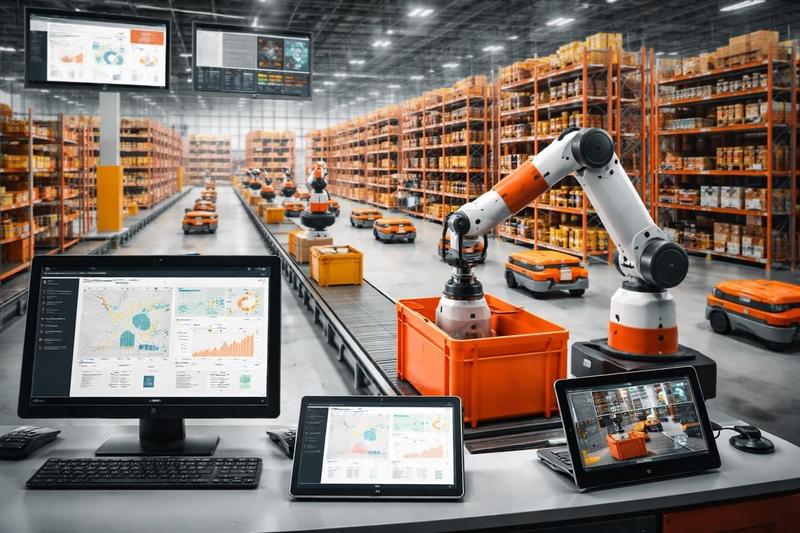
The logistics landscape has undergone a fundamental transformation as businesses seek faster, more accurate order fulfillment. An automated warehouse picking system represents one of the most impactful investments organizations can make to address labor challenges, increase throughput, and reduce operational costs. These intelligent solutions combine robotics, software, and data analytics to revolutionize how products move from storage to shipping, enabling companies to meet rising customer expectations while maintaining profitability.
Understanding Automated Warehouse Picking Technology
Modern automated warehouse picking technology encompasses a diverse range of systems designed to minimize manual intervention in the order fulfillment process. These solutions leverage artificial intelligence, machine learning, and advanced robotics to identify, retrieve, and prepare items for shipment with unprecedented speed and precision.
The core components of an automated warehouse picking system include:
- Warehouse management software (WMS) that orchestrates picking activities and inventory tracking
- Robotic hardware such as autonomous mobile robots (AMRs), articulated arms, and conveyor networks
- Vision systems that identify products and verify picking accuracy
- Integration platforms connecting warehouse operations to enterprise resource planning (ERP) systems
Unlike traditional manual picking methods, automated systems continuously optimize routes, prioritize orders, and adapt to changing warehouse conditions. Research has shown that machine learning algorithms can significantly improve picking efficiency, with some implementations achieving 20% reductions in pick failure rates through intelligent optimization.
Classification of Picking Automation Technologies
The classification framework for automated order picking systems identifies several distinct categories based on operational methodology and technology type. Person-to-goods systems direct workers to specific locations, while goods-to-person configurations bring products directly to stationary picking stations.
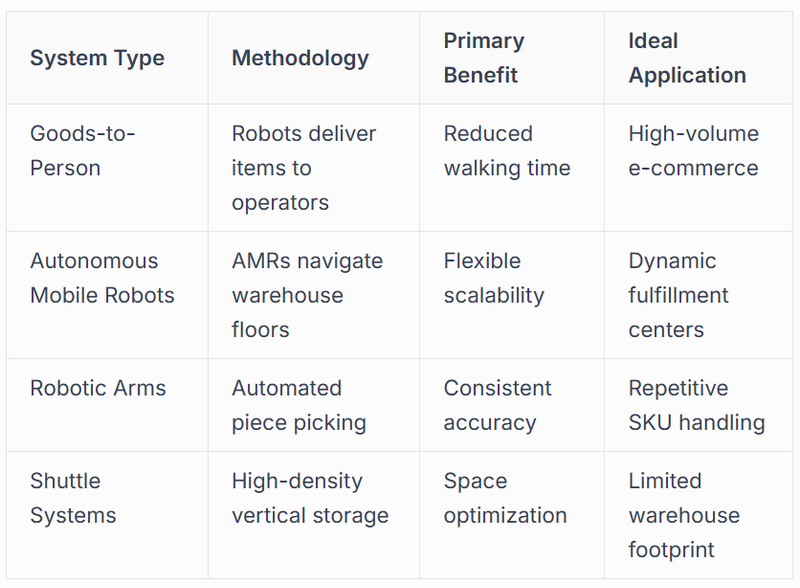
Understanding these categories enables organizations to select solutions aligned with their operational requirements, product characteristics, and growth trajectories.
Benefits Driving Adoption Across Industries
The compelling advantages of implementing an automated warehouse picking system extend far beyond simple labor reduction. Organizations across logistics, manufacturing, and retail sectors are experiencing transformative results that reshape their competitive positioning.
Increased Processing Speed and Throughput
Automated systems operate continuously without fatigue, enabling 24/7 order fulfillment capabilities. Automated picking systems increase order processing speed while simultaneously reducing picking errors, creating a dual advantage that compounds over time. Distribution centers implementing these solutions typically see throughput increases of 200-400% compared to manual operations.
Enhanced Accuracy and Quality Control
Pick errors represent significant costs through returns, customer dissatisfaction, and rework. Vision-guided systems and AI verification reduce error rates to below 0.1% in many implementations, compared to 1-3% error rates common in manual picking environments.
Labor Optimization and Workforce Development
Rather than eliminating jobs, automated warehouse picking systems reshape workforce requirements toward higher-value activities. Employees transition from physically demanding picking tasks to roles managing technology, performing quality assurance, and handling exceptions requiring human judgment.
This shift addresses critical labor challenges facing the logistics industry:
- Reduced dependency on seasonal hiring cycles
- Lower physical injury rates and workers' compensation costs
- Improved employee retention through enhanced working conditions
- Upskilling opportunities that increase workforce satisfaction
Modern warehouse automation technologies create environments where human intelligence combines with robotic precision to achieve results impossible with either approach alone.
Implementation Strategies for Different Warehouse Environments
Successful deployment of an automated warehouse picking system requires careful alignment between technology capabilities and operational requirements. Different warehouse environments demand customized approaches based on product characteristics, order profiles, and facility constraints.
E-commerce and 3PL Operations
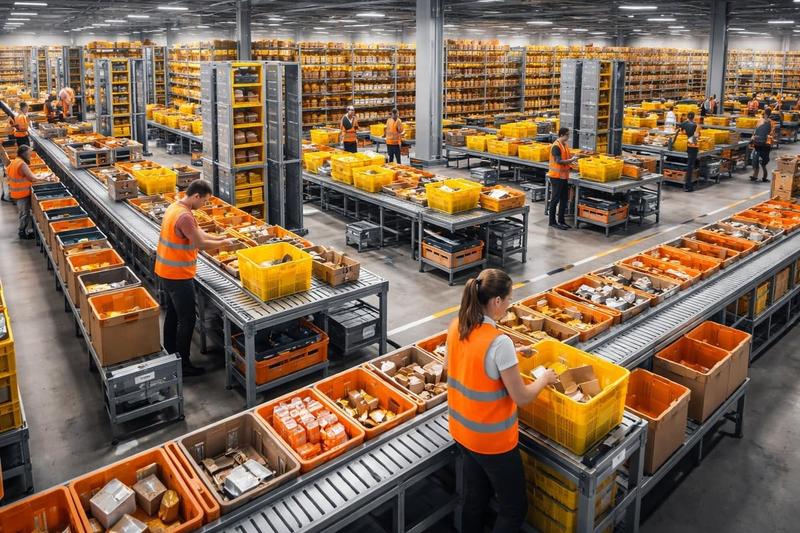
E-commerce fulfillment centers face extreme variability in order composition, seasonal demand fluctuations, and pressure for same-day shipping. Goods-to-person automation excels in these environments by bringing products directly to ergonomic picking stations where operators can rapidly process multi-line orders.
The Automate-X GTP Starter Grid provides an accessible entry point for small and medium businesses in Australia and New Zealand looking to begin their automation journey. This solution offers a low-cost, scalable approach to automating picking processes without requiring massive upfront investment in infrastructure.

Leading 3PL providers implement modular systems that scale capacity during peak seasons and accommodate diverse client requirements across the same facility.
Manufacturing and FMCG Distribution
Manufacturing environments require picking systems that support production line kitting, sub-assembly preparation, and just-in-time component delivery. These operations benefit from automated storage and retrieval systems that maintain precise inventory control while feeding production schedules.
FMCG distribution typically involves case picking and pallet building for retail replenishment. Automated systems in these facilities prioritize:
- High-speed case picking for store orders
- Mixed SKU pallet configuration
- Integration with transportation management systems
- Real-time inventory accuracy for demand forecasting
Pharmaceutical and Cold Storage Applications
Regulated industries demand additional capabilities from automated warehouse picking systems. Pharmaceutical operations require lot tracking, expiration date management, and validation protocols that ensure product integrity throughout the picking process.
Cold storage facilities benefit particularly from automation by minimizing human exposure to extreme temperatures while maintaining consistent picking performance regardless of environmental conditions. Robotic systems operate efficiently in temperatures as low as -25°C, enabling 24/7 operations in frozen food distribution.
Technology Integration and System Architecture
The effectiveness of an automated warehouse picking system depends heavily on seamless integration across hardware, software, and existing infrastructure. Modern implementations follow a layered architecture that enables flexibility while maintaining operational reliability.
Software Orchestration Layer
Advanced warehouse management systems serve as the intelligence directing automated picking operations. These platforms coordinate multiple subsystems:
- Order management and wave planning
- Inventory allocation and slotting optimization
- Robot task assignment and path planning
- Quality control and exception handling workflows
Integration with enterprise systems ensures picking activities align with broader supply chain strategies. Industrial system integration capabilities determine how effectively automated systems communicate with ERP, transportation management, and customer relationship management platforms.
Hardware and Robotics Integration
Physical automation components must work in concert to achieve desired performance levels. Industrial robotics implementations in warehouses now incorporate:
- Collaborative robots that work alongside human operators in shared spaces
- AMR fleets that coordinate movement to prevent congestion
- Robotic arms with adaptive gripping for diverse product handling
- Automated guided vehicles for pallet movement and replenishment
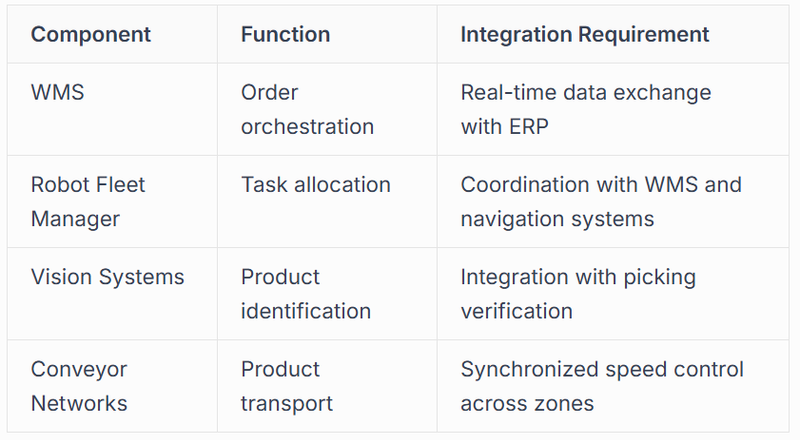
The AutoStore system exemplifies highly integrated automation, using cubic storage grids with robotic retrievers that deliver bins to picking ports. Similar innovations from TGW Logistics Group demonstrate how standardized components can be configured for diverse applications.
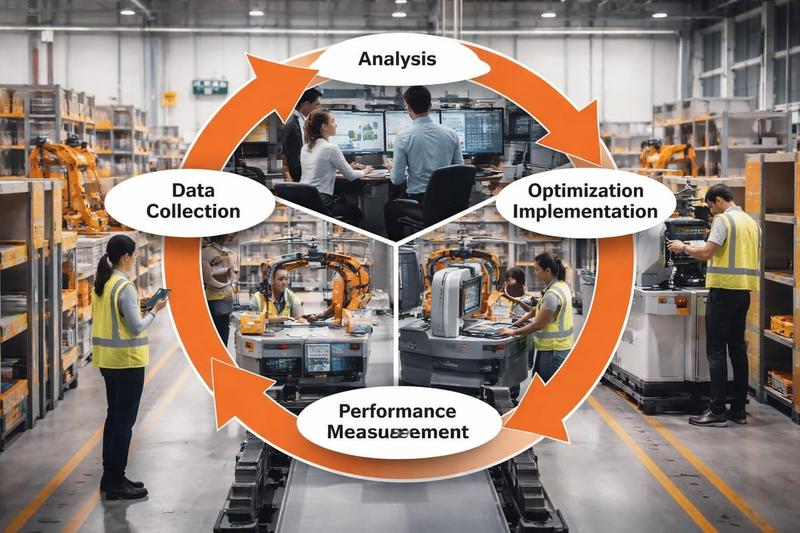
Performance Optimization and Continuous Improvement
Implementing an automated warehouse picking system represents the beginning rather than the end of the automation journey. Leading organizations continuously refine system performance through data-driven optimization and adaptive learning.
Data Analytics and Machine Learning
Modern systems generate vast quantities of operational data that inform improvement initiatives. Machine learning frameworks optimize package picking by analyzing historical performance patterns and predicting optimal picking sequences for current orders.
Key performance indicators tracked by advanced systems include:
- Picks per hour across different product categories
- Travel time and distance for mobile robots
- Order cycle time from release to pack station arrival
- System utilization rates and bottleneck identification
- Error rates by product type, location, and time period
This continuous monitoring enables productivity solutions that incrementally improve operations without major system overhauls.
Adaptive Slotting and Layout Optimization
Static warehouse layouts become inefficient as product mix and demand patterns evolve. Automated picking systems with dynamic slotting capabilities analyze order histories to position fast-moving items in optimal locations, reducing average pick times.
Seasonal variations demand flexible strategies. Waveless order fulfillment methodologies enable continuous order processing without batching delays, improving responsiveness during demand spikes.
Scaling Automation from Pilot to Enterprise
Organizations often begin automation initiatives with limited scope, testing technologies before committing to full-scale transformation. This phased approach mitigates risk while building organizational capabilities to manage advanced systems.
Pilot Program Design
Successful pilots focus on high-impact processes with measurable outcomes. Common starting points include:
- Single picking zone automation targeting the highest-volume product category
- Goods-to-person station handling a portion of daily order volume
- Robotic palletizing for a specific shipping lane or customer segment
- AMR implementation supporting replenishment or crossdock operations
These focused implementations generate proof of concept data while building internal expertise in automation management.
Expansion Strategies
After validating technology performance, organizations scale through several pathways:
- Horizontal expansion adding capacity within existing processes
- Vertical integration automating adjacent processes like receiving or packing
- Multi-site replication deploying proven configurations across distribution networks
- Technology advancement incorporating next-generation capabilities into existing systems
The modular nature of modern automated warehouse picking systems enables gradual expansion that aligns with business growth and capital availability. Organizations can add picking stations, expand robot fleets, or increase storage capacity without disrupting ongoing operations.
Vendor Selection and Partnership Considerations
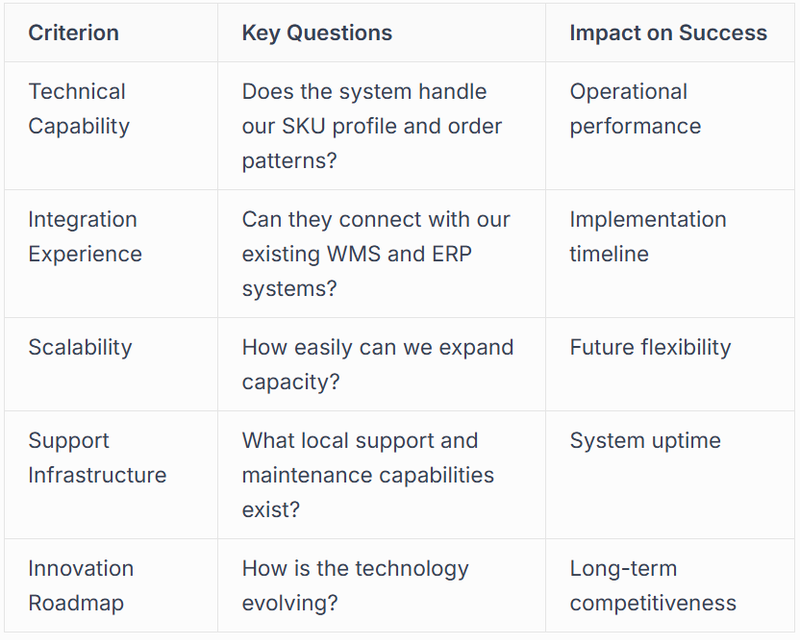
Choosing the right technology partner significantly impacts automation success. Beyond initial system capabilities, long-term support, integration expertise, and continuous innovation determine whether investments deliver sustained value.
Evaluation Criteria
Organizations should assess potential vendors across multiple dimensions:
Companies like Amazon Robotics demonstrate the strategic value of proprietary automation development, though most organizations benefit from partnering with specialized providers offering proven, configurable solutions.
Implementation Partnership
Beyond technology selection, implementation methodology determines project success. Experienced partners bring:
- Process analysis identifying optimization opportunities beyond automation
- Change management support preparing teams for new workflows
- Phased deployment minimizing operational disruption during installation
- Training programs building internal capabilities to operate and maintain systems
- Performance validation ensuring systems meet specified performance targets
Automation and industrial robotics projects benefit from partners who understand both technology capabilities and operational realities of warehouse environments.
Future Trends Reshaping Picking Automation
The automated warehouse picking system landscape continues evolving rapidly as new technologies mature and business requirements intensify. Several emerging trends will shape the next generation of picking automation.
Artificial Intelligence and Adaptive Learning
Next-generation systems incorporate AI that learns from operational experience, continuously improving performance without manual programming. These adaptive systems automatically adjust to new products, seasonality changes, and facility modifications.
Computer vision advances enable robots to handle previously challenging tasks like identifying products without barcodes, detecting damage, and adapting gripping strategies to product characteristics. These capabilities expand automation applicability to operations currently requiring human judgment.
Collaborative Robotics and Human-Machine Teaming
Rather than fully lights-out automation, many facilities are implementing collaborative approaches where robots and humans work side-by-side. Collaborative robots handle repetitive heavy lifting while operators perform quality checks and exception handling, combining the strengths of both.
Sustainability and Energy Efficiency
Environmental considerations increasingly influence automation decisions. Modern systems incorporate:
- Energy-efficient motors and regenerative braking
- Optimized routing reducing unnecessary travel
- Compact footprints maximizing space utilization
- Extended equipment lifecycles through modular design
These features align operational efficiency with corporate sustainability objectives, creating business cases that encompass both financial and environmental returns.
Edge Computing and Real-Time Processing
Distributed computing architectures process data at the warehouse edge rather than centralized servers, enabling faster decision-making and reduced latency. This capability supports real-time route optimization, immediate exception handling, and responsive coordination across large robot fleets.
The integration of 5G connectivity with edge processing will enable warehouse-scale coordination previously impossible with existing network infrastructure.
An automated warehouse picking system transforms fulfillment operations by combining robotics, intelligent software, and continuous optimization to meet the demanding requirements of modern logistics. As businesses navigate labor challenges and rising customer expectations, automation provides a pathway to sustainable competitive advantage through enhanced speed, accuracy, and scalability. Automate-X combines modern robotics, warehouse software, and system integration expertise to help logistics, e-commerce, manufacturing, and distribution organizations throughout Australia and New Zealand implement intelligent automation solutions that streamline operations and enable scalable growth. Our team works with businesses of all sizes to design, deploy, and optimize warehouse automation tailored to their specific operational requirements and growth objectives.