


Warehouse Robotics: Transform Your Operations in 2026
Share on
The logistics landscape has transformed dramatically over recent years, driven by exponential e-commerce growth, labour shortages, and rising consumer expectations for faster fulfillment. Warehouse robotics has emerged as the cornerstone solution for businesses seeking to maintain competitiveness whilst managing operational costs. These intelligent systems combine advanced sensing, artificial intelligence, and mechanical precision to automate repetitive tasks, optimize inventory management, and create safer working environments. For organisations across Australia and New Zealand, implementing robotic solutions represents not just an efficiency gain but a strategic imperative for sustainable growth.
The Business Case for Warehouse Robotics
Modern distribution and fulfillment operations face unprecedented pressure to deliver more with less. Traditional manual processes simply cannot scale to meet demand spikes whilst maintaining accuracy and cost efficiency. Warehouse robotics market analysis indicates that labour shortages and rising wages continue to drive adoption across multiple sectors.
Key business drivers include:
- Reduced operational costs through automation of repetitive tasks
- Improved accuracy rates exceeding 99.9% in picking operations
- Enhanced worker safety by removing personnel from hazardous tasks
- Scalability to handle seasonal demand fluctuations
- Faster order fulfillment cycles and improved customer satisfaction
The return on investment for robotics implementation has improved substantially. Where earlier systems required massive capital outlays and complex infrastructure changes, today's modular solutions offer flexibility and phased deployment options. This democratisation of automation technology means small and medium businesses can now access capabilities previously reserved for enterprise-level operations.
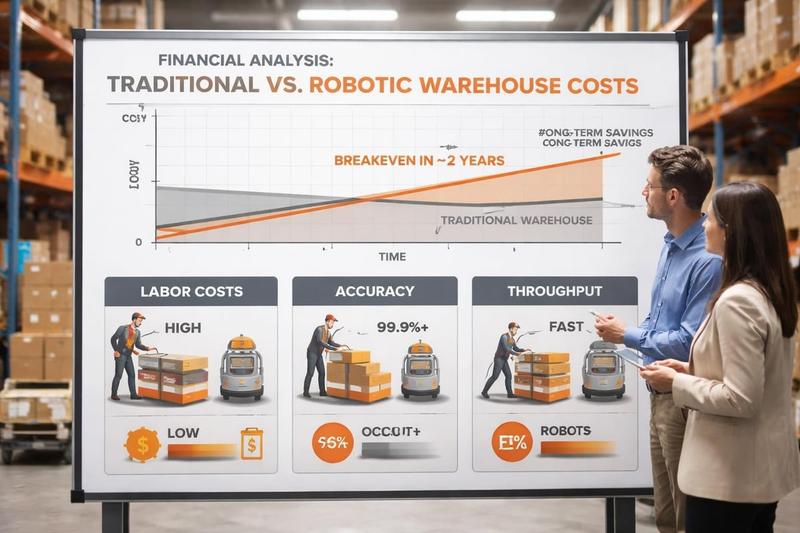
Labour markets across Australasia have tightened considerably, making recruitment and retention increasingly challenging. Warehouse robotics addresses this constraint by augmenting human workers rather than replacing them entirely. Teams shift from manual picking and transport tasks to supervisory roles, quality control, and exception handling, creating more engaging and valuable positions.
Types of Warehouse Robotics Solutions
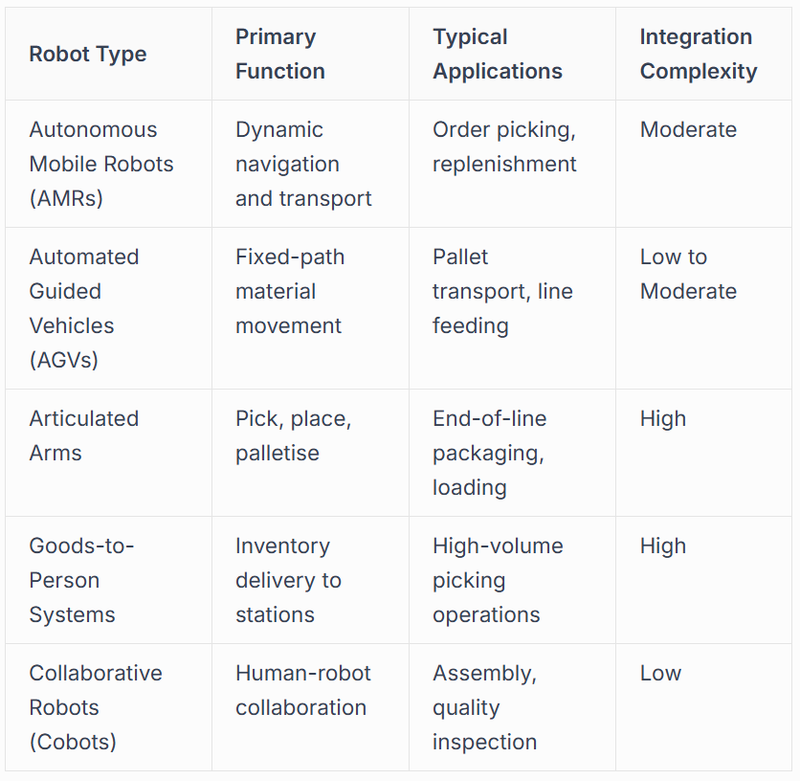
The robotics ecosystem encompasses diverse technologies, each designed to address specific operational challenges. Understanding these categories helps businesses select solutions aligned with their unique requirements and facility constraints.
Automated warehouse picking solutions have evolved significantly, with systems now capable of handling diverse product mixes and packaging types. Modern robots employ advanced vision systems and machine learning algorithms to identify, grasp, and manipulate items with remarkable dexterity.
AMRs represent particularly versatile solutions for dynamic warehouse environments. Unlike traditional AGVs that follow fixed paths, autonomous mobile robots navigate independently using sensors and mapping technology. They adapt to changing floor layouts, avoid obstacles, and optimize routes in real-time, making them ideal for facilities with evolving operational needs.
Implementation Strategies and Best Practices
Successful robotics deployment requires methodical planning and clear understanding of operational workflows. Businesses that rush implementation without proper analysis often struggle with integration challenges and fail to achieve projected returns.
Critical implementation phases:
- Process mapping and analysis – Document current workflows, identify bottlenecks, and quantify performance metrics
- Technology selection – Match robotic solutions to specific operational requirements rather than adopting technology for its own sake
- Infrastructure assessment – Evaluate facility readiness including floor condition, power availability, and network infrastructure
- Pilot deployment – Test systems in controlled environments before full-scale rollout
- Staff training and change management – Prepare teams for new workflows and collaborative working models
- Continuous optimisation – Monitor performance data and refine processes based on real-world results
Floor condition proves surprisingly critical for robotics success. Many systems require level, smooth surfaces for reliable navigation and operation. Research on concrete floors in automated warehousing highlights how infrastructure quality directly impacts system performance and longevity.
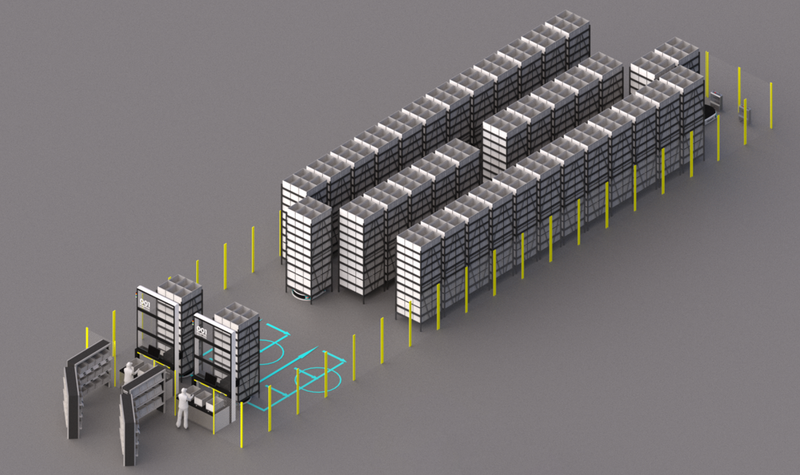
The Automate-X GTP Starter Grid offers an accessible entry point for businesses beginning their automation journey. This scalable goods-to-person solution provides low-cost warehouse automation specifically designed for small and medium operations across Australia and New Zealand, enabling organisations to realise immediate productivity gains whilst maintaining flexibility for future expansion.
Integration with Warehouse Management Systems
Warehouse robotics achieves maximum value when seamlessly integrated with existing software infrastructure. Standalone robotic systems create data silos and coordination challenges that undermine efficiency gains.
Modern automated warehouse systems employ sophisticated orchestration layers that coordinate robots, conveyors, storage systems, and human workers through unified control platforms. These systems make real-time decisions about task allocation, route optimization, and resource deployment based on current facility conditions and order priorities.
Integration considerations include:
- API compatibility between robotics platforms and warehouse management systems
- Data synchronisation protocols ensuring inventory accuracy
- Task prioritisation algorithms balancing efficiency and service levels
- Exception handling processes for scenarios requiring human intervention
- Performance monitoring dashboards providing operational visibility
Cloud-based management platforms have simplified integration complexity considerably. Rather than custom point-to-point interfaces, modern solutions leverage standardised protocols and pre-built connectors. This approach reduces implementation timelines and ongoing maintenance requirements whilst improving system reliability.
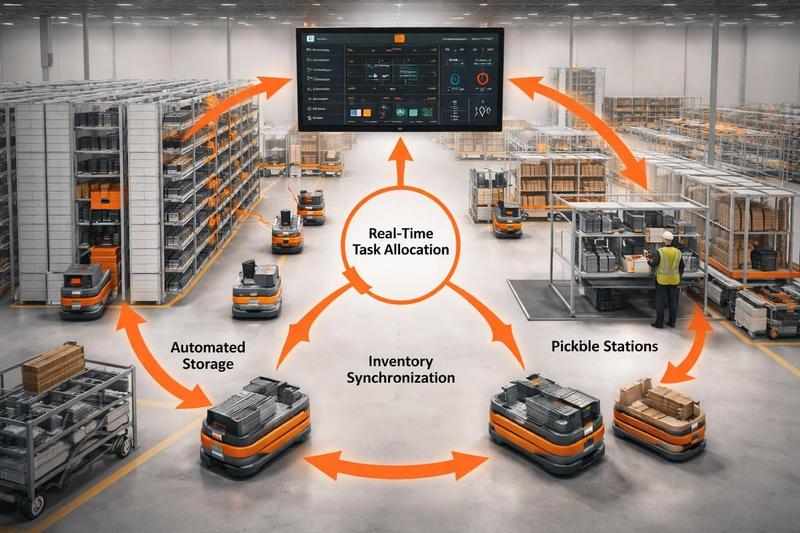
Research on multi-robot task allocation demonstrates how reinforcement learning frameworks can optimise dynamic warehouse operations, minimising travel distances and reducing task delays through intelligent coordination of robotic fleets. These advances enable warehouses to handle increasingly complex order profiles whilst maintaining high throughput rates.
Advanced Robotics Capabilities and Emerging Technologies
The warehouse robotics field continues advancing rapidly, with new capabilities expanding the range of tasks amenable to automation. Technologies once confined to research laboratories now appear in commercial deployments across diverse sectors.
Vision systems represent a particularly transformative development. Modern robots employ sophisticated cameras and AI-powered image recognition to identify products, assess quality, read labels, and determine optimal grasping strategies. Novel grasping approaches like TetraGrip enable robots to manipulate items in cluttered environments, handling diverse object orientations and overcoming occlusions that previously required human intervention.
Manipulating Complex Product Mixes
E-commerce fulfillment and third-party logistics operations face particular challenges with product variety. A single facility might handle thousands of unique SKUs spanning diverse sizes, shapes, weights, and packaging types. Training robots to manipulate this variety reliably has historically proven difficult.
Recent advances in machine learning enable robots to generalise from training data, developing manipulation strategies for products they have never encountered. Compliant manipulation systems now achieve human-level packing density and speed when placing items onto densely packed shelves, a capability essential for maximising storage efficiency in space-constrained facilities.
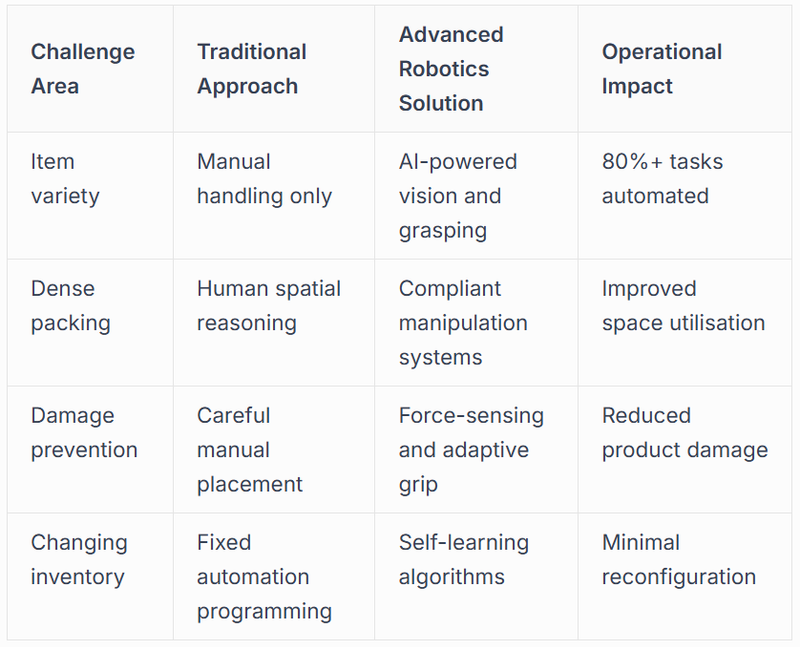
Pharmaceutical and food & beverage sectors particularly benefit from these advances. Goods-to-person automation paired with intelligent manipulation enables precise, traceable handling of temperature-sensitive products and items requiring strict batch control.
Safety and Human-Robot Collaboration
Safety considerations permeate every aspect of warehouse robotics implementation. Organisations must protect workers whilst maintaining operational efficiency and meeting regulatory requirements. The intersection of human workers and autonomous machines creates unique hazard scenarios requiring careful risk assessment.
Modern robotic systems incorporate multiple safety layers including physical barriers, sensor-based detection zones, emergency stops, and speed limitations when operating near personnel. Collaborative robots specifically designed for human interaction employ force-limiting technology that stops movement upon contact, preventing injury during inadvertent collisions.
Safety implementation framework:
- Comprehensive risk assessment identifying potential human-robot interaction scenarios
- Physical segregation of high-speed automation from worker areas where practical
- Visual and audible warnings alerting personnel to robot movement
- Regular safety audits and system validation
- Worker training covering emergency procedures and safe interaction protocols
Amazon's warehouse robotics expansion provides insight into large-scale safety approaches, demonstrating how properly implemented automation can actually reduce worker injuries by removing personnel from physically demanding and hazardous tasks. The transition requires thoughtful change management to address workforce concerns and ensure smooth adoption.
Beyond physical safety, operational reliability proves critical. Robots must perform predictably and gracefully handle exceptions without creating dangerous situations. Industrial robotics solutions incorporate redundant safety systems and fail-safe mechanisms ensuring controlled shutdown in fault conditions.
Supervisory Interfaces and Remote Monitoring
As warehouse robotics systems grow more sophisticated, effective supervision becomes increasingly important. Operations teams require visibility into system status, performance metrics, and exception conditions to maintain optimal functionality.
Virtual reality interfaces like WareVR enable remote monitoring and control of autonomous warehouse robots, particularly valuable for stocktaking and inventory management tasks. These tools provide intuitive visualisations of complex multi-robot systems, simplifying oversight and troubleshooting.
Dashboard systems aggregate data from diverse robotic platforms, presenting unified views of warehouse performance. Operators can identify bottlenecks, monitor task queues, track robot utilisation rates, and receive alerts for conditions requiring intervention. This visibility enables proactive management rather than reactive problem-solving.
Market Trends and Future Outlook
The warehouse robotics market continues robust expansion driven by converging technological, economic, and societal factors. Market forecasts project the sector reaching USD 19.3 billion by 2032, fuelled by AI advances, machine learning capabilities, and e-commerce growth.
Several key trends shape the evolution of warehouse robotics:
Democratisation of automation – Entry-level systems bring advanced capabilities to smaller operations previously unable to justify automation investments. Modular, scalable solutions enable phased deployment matching capital availability and operational readiness.
AI and machine learning integration – Robots increasingly employ artificial intelligence for decision-making, learning from experience to improve performance over time. This reduces programming requirements and enables adaptation to changing operational conditions.
Cloud-based orchestration – Warehouse automation trends highlight the shift toward cloud-based management platforms providing centralised control, data analytics, and remote system updates across distributed facilities.
Humanoid robotics – While still emerging, bipedal robots designed to navigate human-centric environments represent a potential long-term evolution path. Warehouse AI and humanoid robots discussions explore how these systems might eventually handle tasks in facilities designed for human workers without extensive infrastructure modification.
Sustainability focus – Energy-efficient robots, optimised routing algorithms, and space utilisation improvements contribute to reduced environmental footprints, aligning automation investments with corporate sustainability commitments.
The technology convergence extends beyond robotics itself. Automated storage and retrieval systems, conveyor networks, and sortation equipment increasingly integrate with mobile robots through unified control platforms, creating cohesive automation ecosystems rather than isolated solutions.
Sector-Specific Applications
Different industries apply warehouse robotics in ways reflecting their unique operational requirements, product characteristics, and regulatory environments.
Third-party logistics (3PL) providers leverage robotics to serve multiple clients from shared facilities, using flexible systems that adapt to varying product mixes and order profiles. The ability to reconfigure operations quickly proves essential in this dynamic environment.
E-commerce fulfillment emphasises high-speed picking of small items with extreme accuracy. Systems must handle massive SKU counts whilst maintaining rapid order turnaround times. Peak season scalability represents a critical capability, with operations experiencing demand spikes exceeding 10x baseline volumes.
Pharmaceutical distribution requires strict environmental controls, batch traceability, and serialisation compliance. Robots operating in temperature-controlled environments provide consistent, auditable handling of sensitive medications and vaccines.
Food and beverage warehousing deals with expiry date management, temperature zones, and hygiene requirements. Automated systems ensure first-expired-first-out rotation whilst maintaining cold chain integrity and minimising product handling.
Manufacturing support uses warehouse robotics for materials delivery, work-in-process storage, and finished goods handling. Intralogistics solutions connect production lines with storage areas, ensuring just-in-time material availability whilst minimising floor space requirements.
Measuring Success and Optimising Performance
Implementing warehouse robotics represents substantial investment deserving rigorous performance measurement. Organisations require clear metrics demonstrating value delivery and identifying optimisation opportunities.
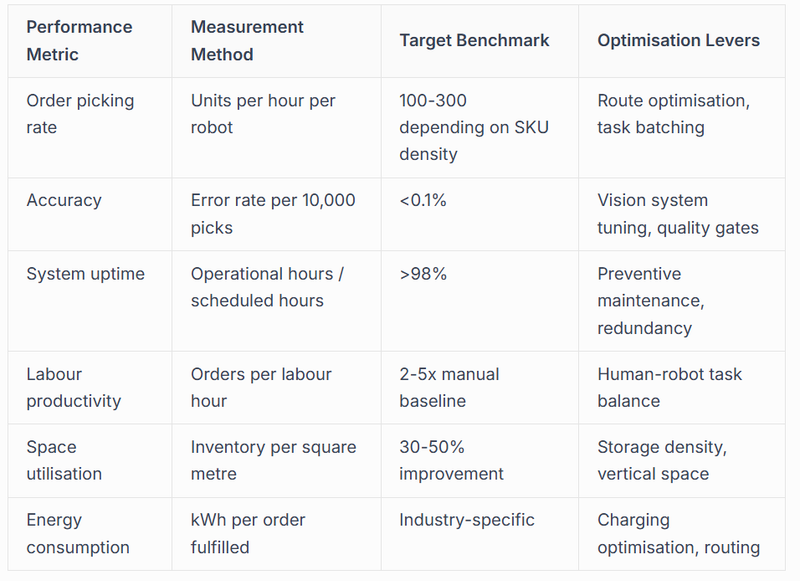
Beyond quantitative metrics, qualitative factors prove equally important. Worker satisfaction, safety incident rates, and customer feedback provide essential context for assessing automation success. Automation and industrial robotics implementations should enhance rather than degrade workplace culture.
Continuous improvement processes leverage performance data to refine operations systematically. Regular analysis identifies patterns, bottlenecks, and opportunities. A/B testing of algorithm changes, workflow modifications, and configuration adjustments enables evidence-based optimisation rather than intuition-driven decisions.
Seasonal patterns require particular attention in e-commerce and retail-supporting warehouses. Systems must scale gracefully to handle peak demand whilst maintaining efficiency during slower periods. Flexible staffing models combining permanent workers, temporary labour, and robotic capacity provide optimal responses to demand variability.
Warehouse robotics has matured from experimental technology to essential infrastructure for competitive logistics operations. As systems become more capable, affordable, and accessible, organisations across all sectors can leverage automation to improve efficiency, accuracy, and scalability. Whether you operate a compact distribution centre or a sprawling fulfillment network, robotics solutions exist to address your specific challenges and growth objectives. Automate-X combines cutting-edge robotics, intelligent software, and proven system integration expertise to help logistics and supply chain businesses throughout Australia and New Zealand transform their warehouse operations and achieve sustainable competitive advantage.