


Robotic Order Picking: Complete Guide for 2026
Share on
The warehouse automation landscape has experienced unprecedented transformation over the past decade, with robotic order picking emerging as a cornerstone technology for modern distribution and fulfilment operations. As e-commerce demand continues its exponential growth and labour markets tighten across Australia and New Zealand, businesses are increasingly turning to intelligent automation solutions that can maintain accuracy whilst scaling operations efficiently. Robotic order picking represents a fundamental shift from traditional manual processes, enabling warehouses to process thousands of orders daily with reduced error rates, improved worker safety, and predictable operational costs.
Understanding Robotic Order Picking Technology
Robotic order picking encompasses a range of automated systems designed to retrieve, sort, and prepare products for shipment without extensive manual intervention. These systems integrate robotics hardware, advanced software algorithms, and sensor technology to identify, grasp, and move inventory items throughout the warehouse environment.
The technology landscape includes several distinct approaches, each suited to different operational requirements and product characteristics. Autonomous mobile robots (AMRs) navigate warehouse floors independently, transporting goods between storage locations and packing stations. Robotic arms equipped with sophisticated grippers handle individual items, whilst goods-to-person systems bring inventory directly to human operators who perform the final selection.
Core Components of Robotic Picking Systems
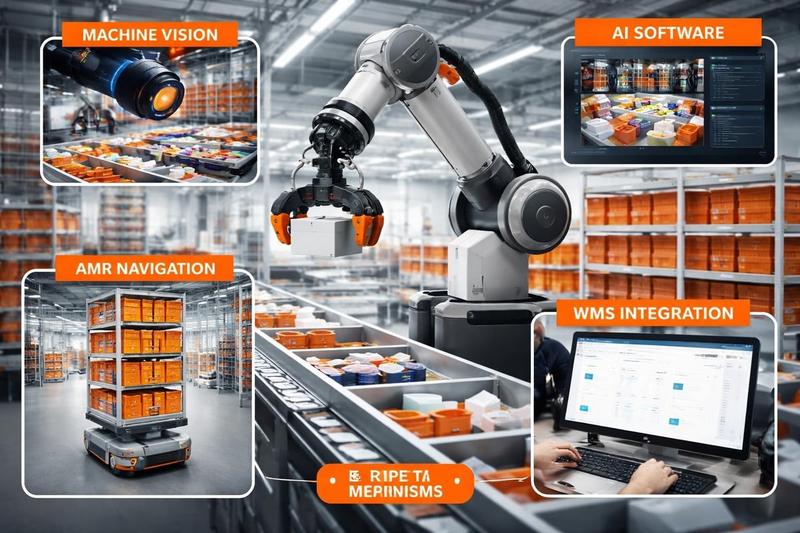
Modern warehouse automation technologies rely on multiple integrated elements working in harmony:
- Machine vision systems that identify products, read barcodes, and assess item orientation
- Advanced gripper technology capable of handling diverse product shapes, weights, and packaging types
- Warehouse management software coordinating robot movements, inventory tracking, and order priorities
- Navigation systems enabling autonomous movement through dynamic warehouse environments
- Artificial intelligence algorithms optimizing pick paths and learning from operational patterns
The integration of these components creates a cohesive ecosystem where robotic order picking systems can adapt to changing inventory profiles and order volumes. Industrial robotics solutions continue advancing rapidly, with 2026 models demonstrating significantly improved accuracy and speed compared to systems deployed just three years ago.
Implementation Models and Operational Approaches
Deploying robotic order picking requires careful consideration of warehouse layout, inventory characteristics, and operational workflows. Several proven implementation models have emerged, each offering distinct advantages for specific business contexts.
Goods-to-Person (GTP) Systems represent the most widely adopted approach, where mobile robots retrieve entire shelving units or bins and transport them to picking stations. Operators remain stationary whilst inventory comes to them, dramatically reducing walking time and physical strain. This model works exceptionally well for operations handling diverse SKU portfolios with moderate unit velocities.
Robotic Mobile Fulfilment Systems (RMFS) extend the GTP concept by incorporating dynamic storage allocation and intelligent pod assignment. Research on optimization strategies for RMFS demonstrates that advanced algorithms can reduce operational costs whilst improving throughput by strategically positioning frequently picked items and coordinating multiple robots simultaneously.
Collaborative Picking Stations integrate human workers with robotic systems, leveraging the strengths of both. Studies exploring human-cobot collaboration reveal that properly designed systems can enhance productivity whilst managing worker fatigue through dynamic task allocation based on real-time performance metrics.
System Configuration Options
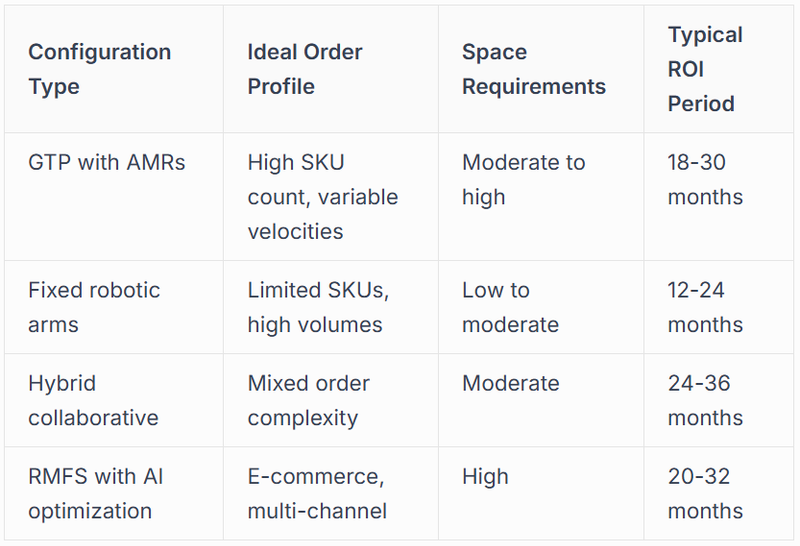
The Automate-X GTP Starter Grid provides an accessible entry point for small and medium businesses in Australia and New Zealand, offering a scalable foundation that can expand as operational demands grow. This modular approach allows organisations to prove the technology's value before committing to full-scale deployment.
Performance Metrics and Efficiency Gains
Quantifying the impact of robotic order picking requires examining multiple performance dimensions beyond simple throughput numbers. Leading operations track comprehensive metrics that reveal both immediate operational improvements and longer-term strategic benefits.
Picking accuracy typically improves from 95-97% in manual operations to 99.5-99.9% with robotic systems. This dramatic reduction in error rates translates directly to fewer returns, reduced customer service costs, and enhanced brand reputation. The financial impact extends beyond avoided costs, as consistent accuracy enables businesses to confidently guarantee same-day and next-day delivery promises.
Labour productivity metrics show equally impressive gains, with robotic systems often handling 300-500 lines per hour compared to 60-120 lines for manual pickers. However, the true value emerges when examining total labour requirements across the operation, including supervision, quality control, and physical handling.
Operational Impact Analysis
Implementing robotic order picking affects multiple operational dimensions:
- Space utilisation improves by 20-40% through denser storage configurations
- Order cycle times decrease by 30-60% depending on system design and order complexity
- Worker safety incidents reduce by 50-70% as robots handle repetitive, ergonomically challenging tasks
- Energy consumption per unit picked drops by 15-30% compared to traditional warehouse lighting and climate control requirements
- Scalability capacity increases exponentially, with systems easily handling seasonal volume fluctuations of 200-300%
Research on combi-stations in RMFS demonstrates that innovative station designs can further reduce robot requirements whilst decreasing order turnover time, making robotic order picking viable for mid-sized operations previously priced out of automation investments.
Technology Selection and System Design
Choosing the appropriate robotic order picking technology demands thorough analysis of current operations and future growth trajectories. The decision framework extends beyond simple cost comparisons to encompass operational flexibility, integration complexity, and workforce transformation requirements.
Product characteristics fundamentally influence technology selection. Items with consistent dimensions, stable packaging, and barcodes in standardised positions represent ideal candidates for robotic picking. Conversely, fragile products, irregular shapes, or items requiring visual inspection may necessitate hybrid approaches combining robotic transport with human selection.
Automated storage and retrieval systems often integrate seamlessly with robotic picking technologies, creating comprehensive solutions where inventory moves automatically from receiving through storage, picking, and dispatch without manual intervention.
Integration Considerations
Successful robotic order picking implementations require careful attention to system integration across multiple dimensions:
- Warehouse management system compatibility ensuring real-time inventory visibility and task coordination
- Existing infrastructure adaptation including floor quality, ceiling height, and charging station placement
- Network infrastructure supporting continuous communication between robots, control systems, and enterprise software
- Power distribution adequate for simultaneous robot charging and operation
- Workflow redesign aligning human tasks with robotic capabilities
Conveyor system integration presents particular opportunities, as combining robotic picking with automated transport creates truly lights-out operational segments. Advanced implementations in FMCG and food & beverage environments demonstrate how coordinated automation enables 24/7 operations with minimal supervision.

Workforce Transformation and Change Management
Introducing robotic order picking fundamentally reshapes warehouse workforce requirements, creating new roles whilst evolving or eliminating traditional positions. Successful implementations recognise that technology deployment represents only half the challenge, with workforce transition determining ultimate operational success.
Role evolution typically follows predictable patterns. Traditional pickers transition to system monitors, quality auditors, or exception handlers addressing items robots cannot process. Maintenance requirements expand significantly, creating demand for technicians skilled in robotics, electrical systems, and software troubleshooting. Supervisory roles shift from direct task management to performance analytics and continuous improvement initiatives.
Studies examining automation's impact on logistics operations reveal that organisations investing in comprehensive training programmes achieve productivity targets 40% faster than those treating automation purely as technology replacement.
Building Automation-Ready Teams

Forward-thinking organisations establish career pathways demonstrating how warehouse roles evolve within automated environments. This transparency reduces resistance whilst attracting talent interested in working with cutting-edge technology rather than performing repetitive manual tasks.
Advanced Applications and Emerging Innovations
The robotic order picking field continues evolving rapidly, with 2026 bringing several breakthrough capabilities previously confined to research laboratories. These innovations expand the range of products and operational contexts where robotic automation delivers compelling returns.
Deep learning vision systems now handle products previously considered too variable for robotic manipulation. Recent deployments showcasing advanced 3D vision technology demonstrate successful picking of deformable packages, transparent containers, and items with reflective surfaces that challenged earlier generation systems.
Adaptive gripping technology employs soft robotics and force-sensing capabilities enabling gentle handling of fragile items whilst maintaining speed on robust products. This versatility eliminates the need for product-specific end effectors, dramatically reducing changeover times when transitioning between different inventory categories.
Analysis of factors shaping robotic picking's future identifies artificial intelligence advancement, edge computing deployment, and battery technology improvements as key enablers for next-generation capabilities.
Sector-Specific Innovations
Different industries drive unique automation requirements, resulting in specialised robotic picking applications:
- Pharmaceutical operations leverage automation in pharma with serialisation tracking and temperature-controlled handling
- Cold storage facilities deploy robots engineered for extended operation in sub-zero environments
- E-commerce fulfilment implements mixed-case palletising solutions combining picking with automated packing
- 3PL operations utilise flexible systems handling diverse client products and variable order profiles
- Manufacturing support integrates picking with production line feeding for kitting and sequencing
Case studies of successful implementations, such as JUSDA's robotics integration, demonstrate measurable improvements across inventory accuracy, order cycle times, and operational costs within twelve months of deployment.
Financial Modelling and Investment Justification
Building a compelling business case for robotic order picking requires comprehensive financial analysis extending beyond simple payback period calculations. Sophisticated models capture both quantifiable cost reductions and strategic value creation often overlooked in traditional ROI frameworks.
Direct cost impacts include labour expense reduction, improved space utilisation, and decreased error-related costs. However, these immediate savings represent only the foundation of the financial story. Strategic benefits such as enhanced scalability, improved customer service levels, and reduced capital requirements for facility expansion often exceed operational savings in long-term value creation.
Research on efficient order picking methods demonstrates that optimised pod-to-station assignments and order splitting strategies can improve system throughput by 25-35% without additional capital investment, highlighting the importance of software optimisation in maximising automation ROI.
Investment Components and Cost Drivers
Understanding total cost of ownership requires examining multiple expense categories:
- Capital expenditure: robot hardware, charging infrastructure, software licences, installation
- Integration costs: WMS connectivity, workflow redesign, physical infrastructure modifications
- Ongoing operational expenses: maintenance, software updates, energy consumption, spare parts inventory
- Transition costs: training programmes, temporary productivity decreases, parallel operation periods
- Continuous improvement: performance optimisation, capacity expansion, technology refresh cycles
Financial models must also account for avoided costs in alternative scenarios. Manual operation scaling typically requires proportional facility expansion, whilst robotic systems often enable 2-3x throughput increases within existing footprints through denser storage and extended operating hours.
System Optimisation and Performance Enhancement
Maximising robotic order picking system performance extends far beyond initial deployment, requiring ongoing refinement of operational parameters, software algorithms, and workflow designs. Leading operations establish continuous improvement frameworks systematically identifying and capturing efficiency opportunities.
Slotting optimisation represents a critical lever for performance enhancement. Unlike static manual warehouses, robotic systems enable dynamic inventory positioning based on real-time demand patterns. Items experiencing velocity surges automatically migrate to positions minimising robot travel distances, whilst slow-moving products shift to distant locations without productivity impact.
Order batching strategies significantly influence system efficiency. Sophisticated algorithms examine pending orders, robot availability, and inventory locations to create pick waves maximising throughput whilst meeting service level commitments. The integration of machine learning in warehouse operations enables predictive batching that anticipates order patterns based on historical data and seasonal trends.
Performance Enhancement Tactics
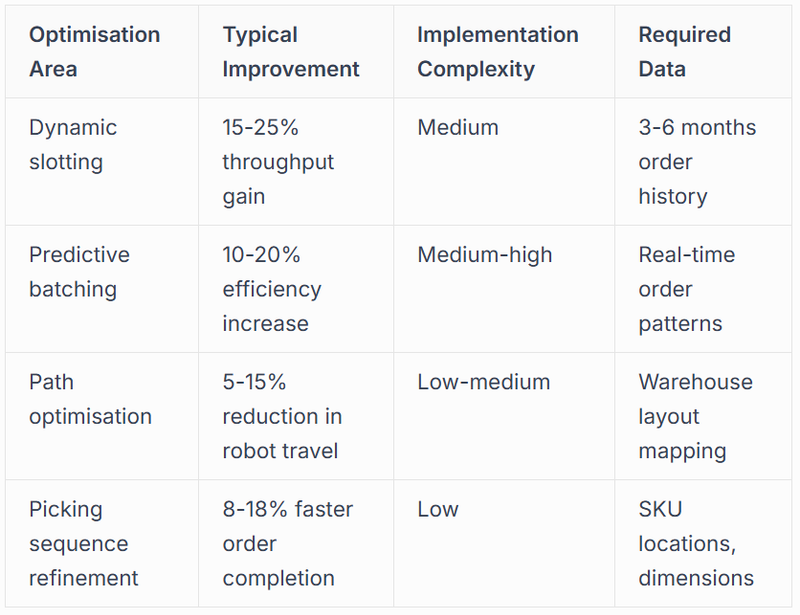
Case studies from operations like MESH Automation's implementations demonstrate that systematic optimisation programmes deliver cumulative improvements of 40-60% over baseline performance within eighteen months of initial deployment.
Integration with Broader Warehouse Automation
Robotic order picking achieves maximum value when integrated within comprehensive automated warehouse systems addressing the complete flow from receiving through dispatch. Isolated automation creates inefficiencies as inventory accumulates at interfaces between automated and manual processes.
Upstream integration connects robotic picking with automated inbound receiving and palletising, ensuring inventory flows seamlessly into storage locations optimised for robotic retrieval. Vision systems capture dimensional data during receiving, enabling accurate slotting decisions and eliminating manual measurement steps.
Downstream connectivity links picked orders with automated packing and dispatch systems, creating continuous material flow without manual handoffs. This integration proves particularly valuable for high-volume operations where order consolidation and shipping preparation represent significant labour pools.
Exploring comprehensive order picking system options reveals how robotic solutions complement rather than replace other automation approaches, with optimal configurations blending multiple technologies based on specific operational requirements.
Risk Mitigation and Contingency Planning
Responsible robotic order picking implementation requires thorough risk assessment and mitigation strategies addressing potential failure modes, operational disruptions, and technological limitations. Whilst modern systems demonstrate impressive reliability, prudent operations maintain contingency capabilities ensuring order fulfilment continuity.
System redundancy approaches vary based on operational criticality and available capital. Some operations deploy excess robot capacity enabling continued operation despite multiple unit failures, whilst others maintain manual picking capabilities for emergency backup. The optimal strategy balances investment costs against revenue impact from potential outages.
Maintenance programmes directly influence system reliability and long-term performance. Preventative maintenance schedules based on manufacturer recommendations and operational data prevent unexpected failures, whilst predictive maintenance using sensor data and performance analytics enables intervention before component failure occurs.
Critical Risk Categories
Effective risk management addresses multiple potential disruption sources:
- Technology failures: robot malfunctions, software crashes, network outages, power interruptions
- Integration challenges: WMS communication errors, inventory synchronisation issues, task coordination failures
- Operational constraints: product packaging changes, SKU proliferation beyond system capacity, unexpected demand spikes
- External factors: supply chain disruptions affecting spare parts availability, software vendor issues, regulatory changes
- Workforce dynamics: key personnel turnover, training gaps, resistance to process changes
Examining real-world implementations through resources like distribution centre automation case studies provides valuable insights into risk mitigation strategies proven effective across diverse operational contexts.
Robotic order picking represents a transformative opportunity for warehouses seeking sustainable competitive advantage through operational excellence, scalability, and workforce enhancement. The technology has matured beyond early-adopter experimentation into proven solutions delivering measurable returns across diverse industries and operational scales. Whether you operate a compact distribution centre or a large-scale fulfilment network, Automate-X combines deep technical expertise with practical implementation experience to design, deploy, and optimise robotic automation solutions tailored to your specific operational requirements and growth objectives.